The International Economics Olympiad (IEO) is an annual competition for high-school students in economics and finance, run by the IEO Association (based in Bern, Switzerland, and supported by Nobel laureate Eric Maskin). It has three parts — a multiple-choice test, open questions, and a business-case presentation — and you reach the international final by first winning your national round.
What the IEO actually is
The IEO brings together national teams of high-school students from around the world to compete in economics and financial literacy. It is not an essay competition and it is not a pure maths contest: it rewards students who can combine textbook economics with real-world reasoning and can defend a recommendation out loud, in English, in front of judges.
Two facts anchor eligibility, and both come straight from the organiser: contestants must be high-school students, and each must be under the age of 20 on 30 June of the year of the Olympiad. Everything else — exact national deadlines, the host city, medal cut-offs — is set year by year, so treat the points below as the durable structure and confirm the current-year specifics on the official site.
The three parts, decoded
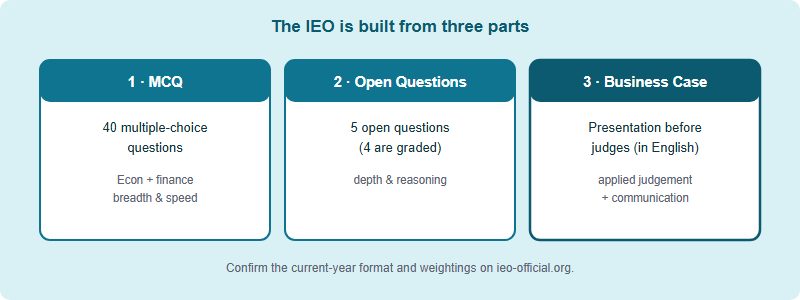
The competition is built from three distinct components, and strong contestants prepare for each separately because they test very different skills:
| Part | What it is | What it really tests |
|---|---|---|
| Finance & Economics MCQ | 40 multiple-choice questions across economics and finance | Breadth and speed — recognising the right concept fast |
| Open Questions | A set of 5 open questions, of which 4 are graded | Depth — working a problem through with clear reasoning |
| Business Case | Presenting a case solution before a panel of judges, in English | Applied judgement + communication under pressure |
The business case is where many well-drilled test-takers lose ground: it is the one part you cannot cram for the night before, because it rewards structured thinking and a confident English presentation. It is also the part Greater China students most often under-practise — which makes it the highest-leverage place to prepare.
Who can enter — and how you qualify
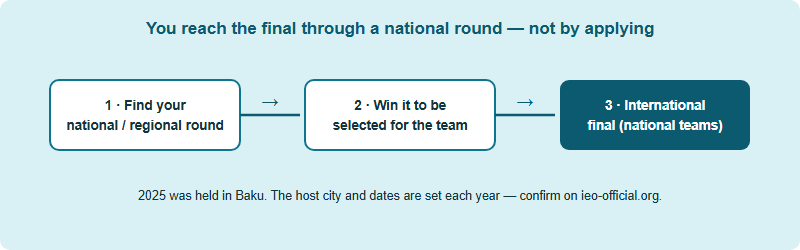
Eligibility is simple: you must be a high-school student and under 20 on 30 June of the Olympiad year. Getting to the international final is the part that catches families out, because you do not apply directly. You qualify by:
- Finding your national (or regional) competition through your country’s organiser;
- Winning that national round, which selects the team that represents you at the international final.
For Greater China students, the practical first question is therefore not “how do I enter the IEO?” but “which national or regional round do I sit, and when does it open?” Those dates change each cycle, so check the official channels and your regional organiser rather than assuming last year’s timeline.
How the IEO differs from an economics essay competition
Greater China students weighing their options often line the IEO up against essay-based contests. They reward different strengths, and it helps to be clear about the contrast before you commit a season to one:
- The IEO is a test-plus-presentation competition — timed questions across economics and finance, plus a live business-case defence. It rewards broad command and quick applied judgement.
- Economics essay competitions (for example the LSESU or HIEEC essay prizes) reward one long, original written argument developed over weeks.
Neither is “better”; they suit different students. If you enjoy fast problem-solving and speaking to a case, the IEO plays to you. If you prefer building a single deep written argument, an essay prize may fit better. We cover that trade-off in a dedicated comparison, and you can start from our syllabus overview, the competition page, and the regional rounds for Greater China.
Frequently asked questions
Who can take part in the IEO?
High-school students who are under 20 on 30 June of the Olympiad year. You take part through your national or regional competition.
What are the three parts?
A 40-question multiple-choice test, a set of five open questions (four graded), and a business-case presentation in English before judges.
How do I qualify for the international final?
You don’t apply directly — you win your national (or regional) round, which selects the team that competes internationally. Check current dates on the official site.
Where is the IEO held?
It moves each year; the 2025 edition was in Baku, Azerbaijan. Confirm the current host city and dates on ieo-official.org.
This is an independent guide to the International Economics Olympiad for Greater China students, operated by Hanlin Education. It is not affiliated with, endorsed by, or the official site of the International Economics Olympiad Association (ieo-official.org). Competition rules, eligibility, dates and the host city are set by the organiser and change each year — always confirm current details on the official channels. Confirmed errors are corrected within 7 working days.