At IEO 2025 in Baku, Azerbaijan, 258 students from 52 countries and territories competed, the International Board awarded 133 medals (24 gold, 43 silver, 66 bronze), and in the team competition Singapore took gold, Canada silver, and China and Russia tied for bronze. Read past the placings and Baku becomes a lesson: the teams on the podium were balanced across all three parts, not brilliant at one.
The Baku 2025 scoreboard, at a glance
The 2025 edition in Baku was the eighth International Economics Olympiad and the most recent completed cycle before Shenzhen 2026. It is worth studying not as a set of trivia but as the clearest available picture of the standard you are aiming at. Two numbers frame everything: 258 participants and 133 medals. Medals are individual awards, so a little over half the field left Baku with one — which tells you the medal bar is reachable, while the team podium is a different, far narrower contest.
| IEO 2025 — Baku, Azerbaijan | Result |
|---|---|
| Countries & territories | 52 |
| Participants | 258 |
| Individual medals awarded | 133 total — 24 gold, 43 silver, 66 bronze |
| Team competition — gold | Singapore |
| Team competition — silver | Canada |
| Team competition — bronze | China & Russia (tied) |
Notice the two layers. The 133 individual medals reward how each student personally performed across the papers; the team placings — Singapore, Canada, then China and Russia — are decided separately, with the team business case carrying real weight. A country can send strong individual medallists and still miss the team podium, or the reverse. Understanding that split is the first thing Baku teaches. For the event basics behind these results, start with What Is the IEO.
What a winning campaign actually looks like: three parts, not one
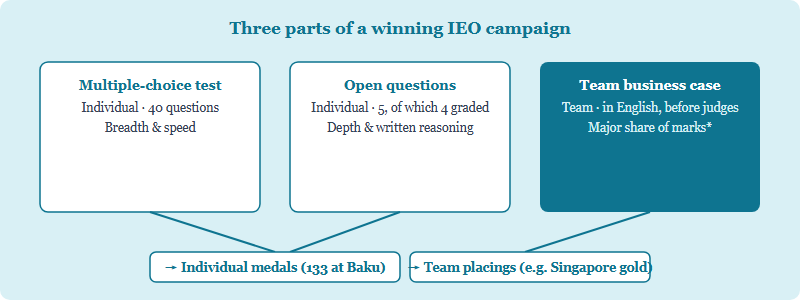
The IEO final is built from three parts, and the Baku podium is a reminder that you cannot bank a top result on any single one. Each part rewards a different skill, and a team that is world-class at one but weak at another gets overtaken. Here is the anatomy of what the strong teams had to cover:
- Finance & Economics multiple-choice test — an individual paper of 40 questions, per the official format. This is the breadth-and-speed round: it rewards wide, secure coverage of economics and finance and the ability to move quickly under time pressure.
- Open questions — an individual set of five, of which four are graded. This is the depth round: fewer questions, longer answers, and marks for clear written reasoning rather than recall alone.
- Team business case — presented in English before a panel of judges. This is the collaboration round and a major team event carrying a substantial share of the marks; confirm the current weighting on the official site. It is where team placings such as Singapore’s gold are largely won.
Put those together and the profile of a podium team becomes obvious. Individual medals come from the two individual papers; the team ranking leans heavily on the live business case. Singapore’s team gold at Baku was not an accident of one strong paper — it reflects a squad that could hold its own on the individual tests and deliver a structured, persuasive case in English before judges. That is the standard, and it is why lopsided preparation rarely reaches the top. You can see the full topic map behind the individual papers in our syllabus overview.
How the gold / silver / bronze medal structure works
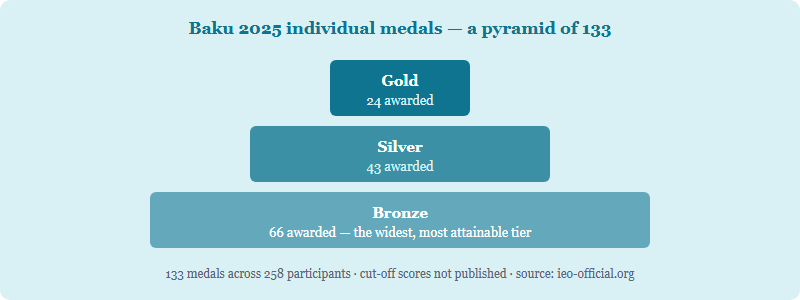
Baku’s 133 medals split into 24 gold, 43 silver and 66 bronze — a pyramid, not a flat line. That shape is worth reading carefully, because it changes how you should set a target. Bronze is the widest tier and the most attainable entry point onto the medal table; silver sits above it; gold is the narrow peak. The progression from bronze up to gold is what a multi-year IEO plan is really climbing.
| Baku 2025 medal tier | Number awarded | Share of the 133 medals |
|---|---|---|
| Gold | 24 | Roughly one in six medals |
| Silver | 43 | Roughly one in three medals |
| Bronze | 66 | Roughly half of all medals |
| Total | 133 | Awarded across 258 participants |
Two honest caveats keep this useful rather than misleading. First, medals are individual — the gold/silver/bronze tiers above describe how students placed, which is a separate table from the team podium of Singapore, Canada, and China & Russia. Second, the exact score cut-offs for each tier are not published here and typically move from year to year with the difficulty of the papers, so do not assume a fixed mark guarantees a colour — confirm how medals are set on ieo-official.org. What is durable is the shape: a broad bronze base narrowing to a small gold tier, awarded to a little over half the field.
What Baku 2025 tells a Greater China student to do next
Turn the results into a plan. The Baku data points to a small number of decisions that separate teams that arrive ready from teams that hope to be. In order of leverage:
- Train all three parts, deliberately. The podium rewarded balance. If your economics reading is strong but you have never rehearsed a live case, you are optimising the part that carries less of your team’s ranking. Audit your weakest part first.
- Treat the team business case as a term-long project, not a rehearsal week. It is the round where placings like Singapore’s gold are decided, it is delivered in English before judges, and it is the hardest part to cram. Practise building a recommendation and defending it out loud, together, over months.
- Aim at bronze as a real, reachable first target. With 66 bronze medals the widest tier, a medal is a credible goal for a well-prepared student — then climb toward silver and gold across cycles rather than expecting the peak on a first attempt.
- Remember you qualify by winning your round first. None of the above happens at the final. Each country sends a team of up to five, chosen through a national or regional round — you reach the international stage by winning that round, not by applying directly. Check the regional rounds for the route that applies to Greater China.
- Verify every current-year specific. Cut-off scores, the exact 2026 schedule, and current mark weightings change year to year — confirm on ieo-official.org (and 2026.ieo-official.org for Shenzhen) before relying on any figure here.
The through-line from Baku is simple and a little demanding: medals reward all-round competence, and the team podium rewards a genuine business case delivered under pressure. Neither can be faked late. A student who reads the 2025 results as a training brief — balance the three parts, start the case early, target bronze then build — is doing exactly what the medal teams did. Our competition page sets out the format in more detail.
Frequently asked questions
What were the IEO 2025 Baku results?
52 countries and territories, 258 participants, and 133 medals (24 gold, 43 silver, 66 bronze). In the team event: Singapore gold, Canada silver, China & Russia bronze.
Are IEO medals individual or team awards?
The 133 gold/silver/bronze medals are individual. The team podium — Singapore, Canada, then China and Russia — is a separate ranking decided largely by the team business case.
What score do I need for a bronze, silver or gold medal?
Exact cut-offs are not published here and change year to year with paper difficulty. Confirm how medals are set on ieo-official.org.
Which part of the IEO matters most for team placings?
The team business case, presented in English before judges, is a major team round carrying a substantial share of marks — confirm the current weighting on the official site.
This is an independent guide to the International Economics Olympiad for Greater China students, operated by Hanlin Education; NOT affiliated with, endorsed by, or the official site of the International Economics Olympiad Association (ieo-official.org). Rules, eligibility, dates and the host city are set by the organiser and change each year — always confirm current details on the official channels; corrected within 7 working days.