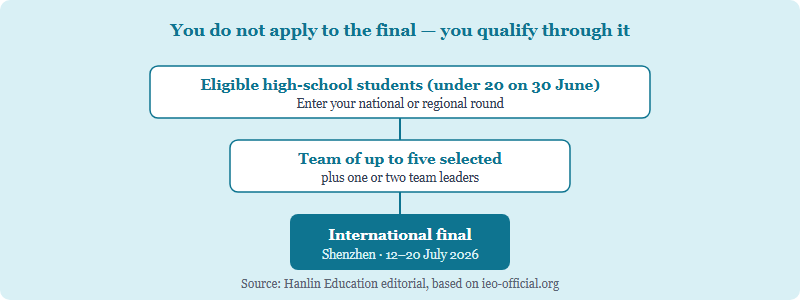
To reach the International Economics Olympiad (IEO) from Greater China you do not apply directly to the global final. You enter your national or regional round, compete to be selected onto a team of up to five students (led by one or two team leaders), and that team represents your region at the international final — Shenzhen, China, 12–20 July 2026.
The one thing families get wrong about entering
The most common mistake is treating the IEO like an exam you sign up for. There is no open “register for the world final” button that a student clicks in the spring. The IEO is a team competition: each participating country or territory sends a national team of up to five high-school students, accompanied by one or two team leaders, and those places are earned earlier in the cycle through a national or regional round. Win your round, make the team, travel to the final. That is the whole shape of it.
Some background makes the route make sense. The IEO is an annual competition for high-school students in economics and finance, founded in 2018 in Moscow with 13 countries and now run by the IEO Association (based in Bern, Switzerland, and supported by Nobel laureate Eric Maskin). It has grown quickly — the 2026 edition in Shenzhen is the ninth. Because it is built around national teams rather than individual applications, the selection layer is a feature, not an obstacle: it is how the field stays competitive and how each region fields its strongest five. If you are new to the event itself, start with our primer, What Is the IEO.
One eligibility rule anchors everything and comes straight from the organiser: contestants must be high-school students who are under 20 on 30 June of the Olympiad year. If that is you, the door is open — the question is simply which round you sit.
The route in, step by step
Read the IEO backwards from July and the plan writes itself. The international final is the last step, so the dates a Greater China student should actually circle are the earlier ones — the round that selects the travelling team. Here is the sequence:
| Step | What you do | Why it matters |
|---|---|---|
| 1 · Check eligibility | Confirm you are a high-school student and under 20 on 30 June 2026 | This is the single hard gate set by the organiser |
| 2 · Find your round | Identify the national or regional round that applies to your part of Greater China, and when it opens | This is your real entry point — not the Shenzhen final |
| 3 · Compete for a team place | Sit your round and place high enough to be selected onto the team of up to five | Only the selected team travels; leaders are named alongside |
| 4 · Prepare the three parts | As a selected team, drill the two individual papers and the live business case | The business case especially rewards weeks of rehearsal |
| 5 · Represent at the final | Compete in Shenzhen, 12–20 July 2026 | The reward at the end of the road — on the mainland this year |
The practical takeaway: do not wait for a “2026 IEO final” announcement and then act. By the time the July final is in the headlines, national selection is typically already settled. The action item for a student today is Step 2 — pin down which round applies to you and its opening date. Because those specifics vary by cycle and by region, confirm them against your regional round and on ieo-official.org rather than trusting last year’s calendar.
What a “team of up to five” actually means
The team structure shapes how you should prepare, so it is worth being precise. A national team is up to five students plus one or two team leaders. Two consequences follow for a Greater China contestant:
- You are selected as an individual, but you compete partly as a unit. Two of the three IEO parts are individual (the multiple-choice test and the open questions); the third — the business case — is a team round presented in English before judges. So making the team is an individual result, but doing well at the final is partly a team result.
- Leaders are part of the machine, not spectators. The one or two team leaders accompany the students; the exact role leaders play in preparation and at the event is set by the organiser and your regional round, so confirm the current arrangement rather than assuming.
This is why strong candidates start rehearsing the business case before selection is even finalised: the moment you are on the team, the clock to July is already short, and the team round is the one part that cannot be crammed. For the topic map behind the two individual papers, see our syllabus overview.
What you compete in once you are on the team
The Shenzhen final is built from three parts, each rewarding a different skill. Knowing the shape early tells a selected team where to spend its limited preparation time:
| Part | Format | What it rewards |
|---|---|---|
| Finance & Economics multiple-choice | Individual paper of 40 questions | Breadth and speed across economics and finance |
| Open questions | Individual set of five, of which four are graded | Depth and clear written reasoning |
| Team business case | Presented in English before a panel of judges | Applied judgement and communication under pressure |
The business case is a major team round carrying a substantial share of the marks — and because the exact weighting changes year to year, you should confirm the current weighting on the official site rather than relying on a figure. What does not change is its character: it is the highest-leverage place to prepare, precisely because it rewards structured thinking and a confident English presentation built over weeks, not the night before. A home-continent final does nothing to lighten that load. For more on the format, see our competition page.
The field you are competing to join
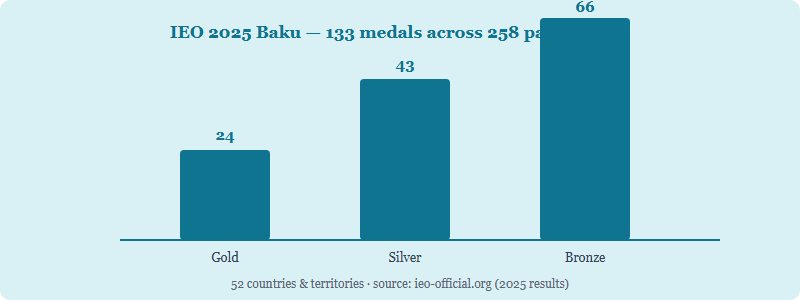
Making the team is competitive because the international field is large — and the most recent edition is the clearest read on the standard. IEO 2025 in Baku, Azerbaijan drew 258 participants from 52 countries and territories, and the International Board awarded 133 medals (24 gold, 43 silver, 66 bronze). It is not a forecast of Shenzhen’s numbers, but it sets realistic expectations for the depth of the pool and where placings are decided.
| IEO 2025 (Baku) | Figure |
|---|---|
| Countries & territories | 52 |
| Participants | 258 |
| Total medals awarded | 133 (24 gold, 43 silver, 66 bronze) |
| Team competition — gold | Singapore |
| Team competition — silver | Canada |
| Team competition — bronze | China & Russia (tied) |
The team results carry the sharpest lesson for a Greater China planner. In the team competition at Baku, Singapore took gold, Canada silver, and China and Russia tied for bronze — a direct signal that the headline placings ride on the team business case. Once you have earned your place on the team of up to five, that is where a region’s preparation should concentrate. These are the 2025 outcomes; Shenzhen’s participant count, medal split and team results are not yet known — confirm on 2026.ieo-official.org.
What to check with your regional organiser
Because the route in runs through a national or regional round, the details that decide your season sit with your regional organiser — not on a global sign-up page. Before you commit, get concrete answers to these, and treat anything you cannot confirm as “to be verified” rather than assumed:
- Which round applies to me, and when does it open and close? The entry point and its dates vary by region and by cycle — do not carry over last year’s timeline.
- How is the team of up to five selected? Confirm what the round consists of and how places are awarded, so you know exactly what you are preparing for.
- What is the current business-case weighting at the final? It carries a substantial share of the marks, but the exact figure changes — confirm it on the official site.
- What do the one or two team leaders do? Their role in preparation and at the event is set by the organiser — check the current arrangement.
- Which official channels are authoritative? Cross-check everything against ieo-official.org, and 2026.ieo-official.org for Shenzhen specifics, before you rely on it.
The honest headline is that a mainland host makes Shenzhen 2026 more reachable for Greater China students than the IEO has been in years — but reachability is about the final, and the final is the last step. The discipline is to work Step 2 now: find your round, confirm its dates, and start rehearsing the business case early, because the round that decides whether you travel to Shenzhen happens months before July.
Frequently asked questions
Do I apply directly to the IEO final?
No. You enter your national or regional round; winning it selects you onto the team of up to five that represents your region at the final.
How many students are on a national team?
Up to five high-school students, accompanied by one or two team leaders. You are selected through your national or regional round.
Where and when is the IEO 2026 final?
Shenzhen, China, from 12–20 July 2026 — the ninth IEO, after Hong Kong 2024 and Baku 2025.
What should I confirm with my regional organiser?
Which round applies to you and its dates, how the team is selected, and current rules — verify these on ieo-official.org.
This is an independent guide to the International Economics Olympiad for Greater China students, operated by Hanlin Education; NOT affiliated with, endorsed by, or the official site of the International Economics Olympiad Association (ieo-official.org). Rules, eligibility, dates and the host city are set by the organiser and change each year — always confirm current details on the official channels; corrected within 7 working days.