Students preparing for the International Economics Olympiad (IEO) frequently collect fragments of IEO past papers and practise them sequentially by year. The logic seems sound: older papers are easier, newer ones reflect current trends. However, this approach has a critical flaw. It does not reveal which specific round skill each question trains. Consequently, practice time is spent on content rather than competency transfer. A student might master ten multiple-choice questions from 2024 but remain unprepared for the written argumentation required in open-question tasks.
The IEO is a three-round competition, described in available preparation notes as using a 200-point system. For practice design, it helps to treat the competition’s demands as three different cognitive modes: multiple-choice recall and calculation, open-question written reasoning, and business-case assumption and defence. Each round demands a different type of engagement with economic data. Practising by year mixes these demands, making it difficult to diagnose whether a mistake was due to knowledge gaps, calculation errors, or poor communication strategy. This article proposes a selection rubric: classify available questions by the round skill they train, then build a balanced set that targets those specific competencies.
Why Year-Order Practice Is a Weak Default
When you practise IEO past papers in chronological order, you assume that the difficulty curve aligns with your learning curve. In reality, the difficulty of an economics problem depends less on the year it was asked and more on the skill required to answer it. A simple supply-and-demand shift question from an earlier year might be harder for a novice than a complex game theory calculation from a recent year if the novice lacks foundational graphing intuition.
Furthermore, year-order practice obscures the transition between rounds. Multiple-choice questions test speed and accuracy in recalling definitions or performing quick calculations. Open-question tasks test depth, requiring structured written arguments that justify a position using economic models. Business-case tasks test application and defence, where assumptions must be stated clearly and challenged by counterarguments. If you mix these types randomly, you cannot isolate which skill is failing. You might lose marks in the Open Questions section not because you do not know the answer, but because you have not practised writing a coherent paragraph under time pressure.
To fix this, decouple the source year from the practice purpose. Instead of asking “What did they ask in 2025?”, ask “Which round skill does this question train?” This shift allows you to build targeted drills even when official full papers are scarce or fragmented.
Three Selection Buckets for IEO Questions
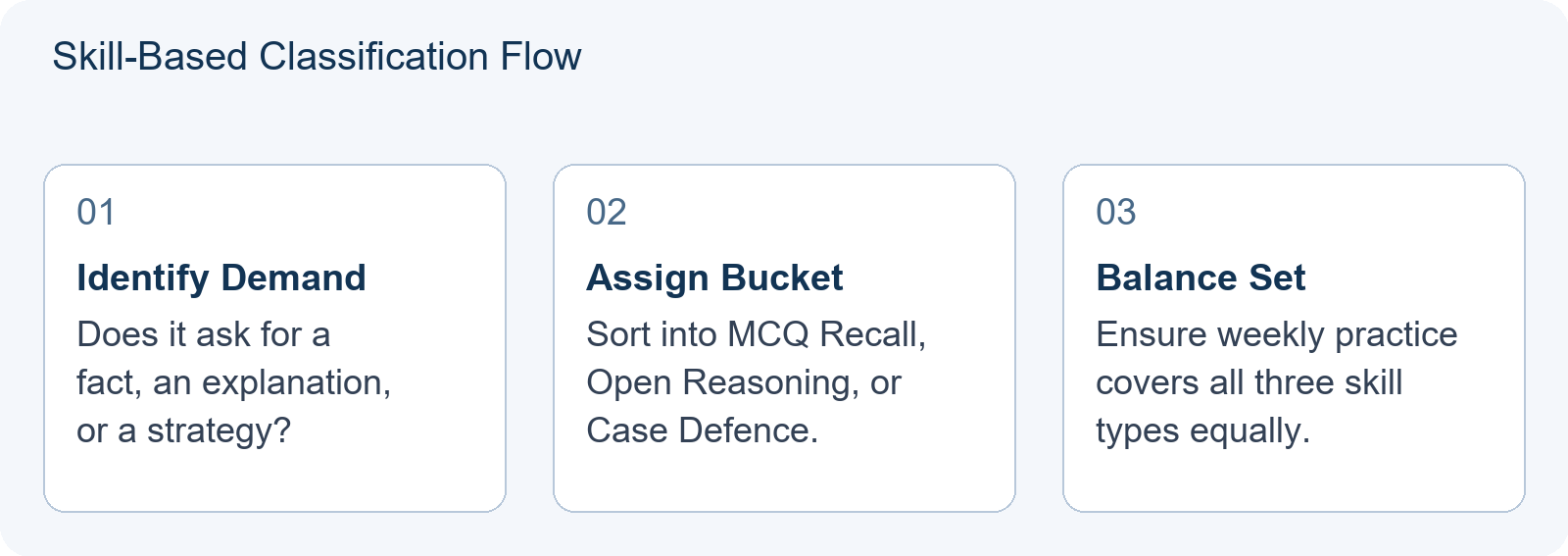
Every question in an IEO practice bank can be sorted into one of three buckets based on the primary skill it assesses. When selecting from available IEO past papers, label each item accordingly.
Bucket 1: MCQ Recall and Calculation
This bucket includes questions that test factual knowledge or rapid mathematical processing. Examples include defining terms like “opportunity cost,” calculating elasticity given two price points, or identifying the correct graph for a tax or subsidy. The key metric here is accuracy within a short time frame. These questions do not require explanation; they require recognition. If a question asks you to select one option from four without justifying your choice, it belongs here. Practising these builds the foundation needed to survive the first round of the competition.
Bucket 2: Open Question Written Reasoning
These prompts require a structured response. They often ask “Explain why…” or “Analyse the impact of…” The goal is to demonstrate logical flow. For instance, a question might ask you to explain how a change in interest rates affects investment decisions. The answer is not just a number; it is a chain of causality: rate up, cost of borrowing up, investment down. This bucket trains the ability to articulate economic mechanisms clearly. It is distinct from MCQ because you must show reasoning, not just select a final option.
Bucket 3: Business Case Assumption and Recommendation
This bucket involves strategic decision-making under uncertainty. Questions here rarely have a single “correct” numerical answer. Instead, they ask you to propose a solution to a business problem, such as entering a new market or launching a product. The skill tested is the ability to state assumptions explicitly, for example “Assuming consumer demand remains constant…”, and defend a recommendation against counterarguments. This mirrors the business-case presentation task, where the robustness of your logic is tested.
Teaching Illustration: One Tariff Question, Three Skills
To understand how classification works, consider a hypothetical teaching illustration involving a tariff on imported steel. Note that this is a suggested example for training purposes, not an actual contest problem.
As an MCQ: “Assume Country A is a small open economy facing a fixed world price of steel. It imposes a $100 per-unit tariff on imported steel, with no other taxes or distortions. What happens to the domestic price paid by consumers? A) Price falls by $100 B) Price rises by $100 C) Price stays the same D) Quantity supplied decreases.” Here, the skill is recognising the immediate mechanical effect of a specific tariff in a small open economy. The answer is B: the domestic price rises by the amount of the tariff, assuming the world price is unchanged.
As an Open Question: “Analyse the welfare effects of the tariff on domestic consumers, producers, and government revenue. Use a diagram to support your answer.” Now, the skill shifts to constructing a narrative. You must identify deadweight loss, transfer payments, and net social cost. The focus is on explaining the why and how, not just the what.
As a Business Case Prompt: “You are the CEO of a domestic steel manufacturer facing increased import competition. The government is considering a tariff. Draft a memo recommending whether your firm should lobby for the tariff, citing potential risks to downstream customers.” Here, the skill is strategic evaluation. You must weigh benefits, such as higher prices, against risks, such as retaliation and customer loss. There is no single right answer; the quality of your assumption and defence is what matters.
By labelling the same topic with different skills, you see that practising only the MCQ version leaves you unprepared for the other two rounds.
Building a Balanced Weekly Set
You do not need a complete official paper to practise effectively. You can build a balanced weekly set by selecting five questions from each bucket. For example, choose five MCQs covering microeconomic concepts, five Open Questions requiring written analysis, and five Business Case prompts focusing on strategic recommendations.
Rotate topics to ensure breadth. If you spend too much time on international trade, you may neglect financial literacy. A balanced set might look like this: two MCQs on finance, two on macro, one on micro; two Open Questions on policy analysis, three on theoretical application; five Business Cases varying in industry context. This structure ensures that every week you engage with all three cognitive modes of the IEO.
For students who find it difficult to locate enough varied questions, the article IEO Past Papers: How to Build Practice When Official Materials Are Scarce offers strategies for sourcing additional material. However, sourcing is only half the battle; classification is the other half.
Using Selected-Year Solutions and Self-Marking
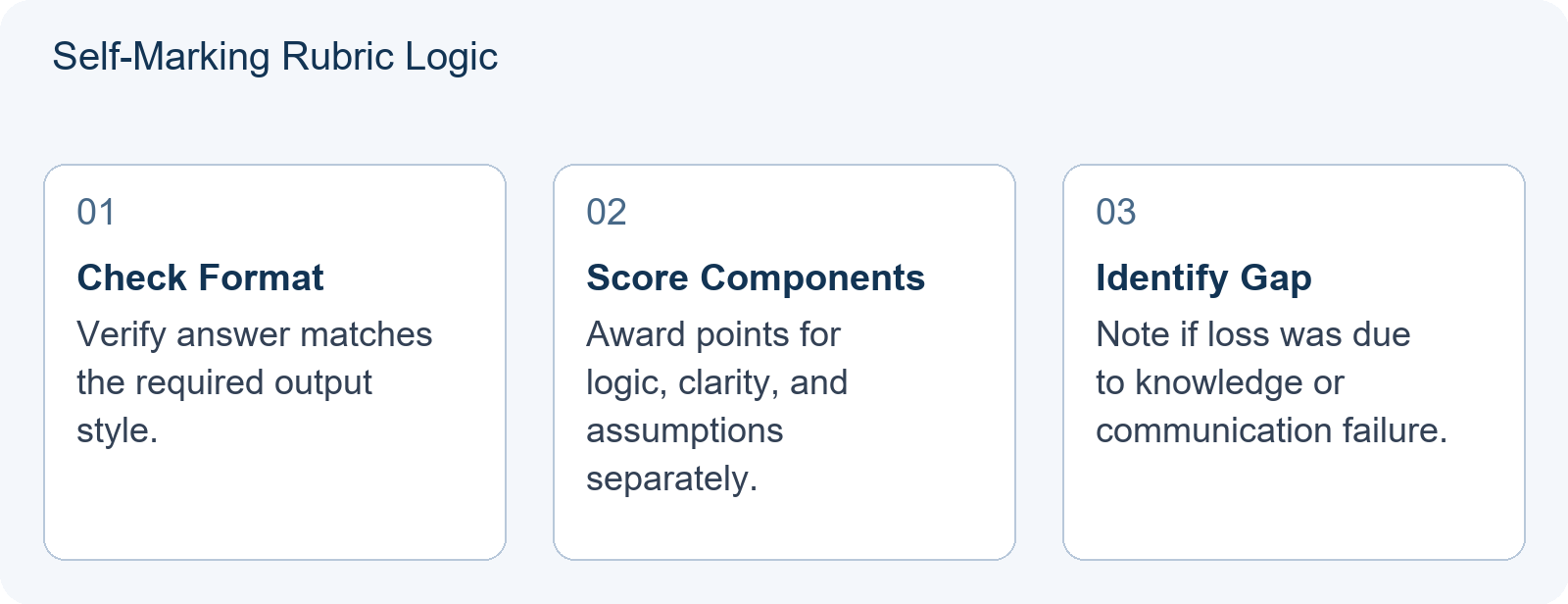
When solutions are available for selected years, use them to calibrate your understanding of the marking scheme. Do not just check if your answer is correct. Look at how the mark was awarded. Did the solution award points for stating an assumption? For drawing a labelled axis? For concluding with a recommendation?
If no official solution exists, self-marking requires discipline. Create a rubric based on the three buckets. For MCQs, correctness is binary. For Open Questions, assign points for: 1) clear thesis statement, 2) logical progression, 3) correct use of terminology, 4) conclusion. For Business Cases, assign points for: 1) explicit assumptions, 2) risk identification, 3) defensible recommendation. This method transforms vague feedback into actionable insights.
Consider reviewing IEO 2026 Open Question 1: Why the AI Export-Policy Answer Loses Marks Even When the Maths Looks Right to see common pitfalls in written reasoning. Understanding where marks are lost in open-ended responses is crucial for improving your self-marking accuracy.
Practical Diagnostic: Label Ten Questions
A useful exercise for prospective families is the “Ten-Question Diagnostic.” Take ten random questions from your current practice bank. Without answering them, label each as Bucket 1, 2, or 3. Count the distribution.
If you have eight MCQs and two Open Questions, your practice is skewed toward recall. You are likely over-prepared for speed but under-prepared for depth. Conversely, if you have many Business Case prompts but few MCQs, you may struggle with the multiple-choice section. Adjust your next week’s selection to balance the gaps. This diagnostic takes five minutes and prevents hours of misdirected effort.
Common Errors in Skill Transfer
A common error is using Business Case prompts for MCQ speed practice. Students try to solve a complex strategic scenario in two minutes, leading to frustration and superficial answers. Business Cases require time to think; MCQs require time to recognise. Mixing these expectations causes burnout.
Another error is using MCQ items for written argument practice. Students write long explanations for questions that only require a letter choice. This wastes time and does not improve their ability to handle genuine open-question tasks that require a written structure. Always match the practice format to the target skill.
Finally, avoid treating the English language barrier as secondary. For a full three-part simulation and self-marking protocol, see Build Your Own IEO Mock Day: A Three-Part Simulation and Self-Marking Protocol. Precision in wording matters in Open Questions and Business Cases. A vague sentence weakens an otherwise sound economic argument.
Turning Selection into Timed Sessions
Once you have classified your questions, organise them into timed sessions. A typical session might be: 15 minutes for ten MCQs (speed focus), 20 minutes for two Open Questions (depth focus), and 15 minutes for one Business Case outline (strategy focus). This mimics the cognitive switching required during the actual competition days.
By selecting IEO past papers based on round skill rather than year, you transform passive collection into active training. You stop guessing what will be on the exam and start building the specific muscles needed to pass each stage. This approach respects the complexity of the IEO format and provides a clear path for improvement, regardless of how many official papers you possess.
Frequently Asked Questions
Do I need complete official IEO past papers to practise effectively?
No. You can build effective practice sets by classifying individual questions from various sources into the three skill buckets: MCQ recall, Open Question reasoning, and Business Case defence. Completeness is less important than balanced skill coverage.
How do I know if a question is suitable for Open Question practice?
Look for prompts that require explanation, analysis, or justification rather than a single correct option. If the question asks ‘Why’, ‘How’, or ‘Evaluate’, it trains written reasoning skills essential for open-question tasks.
Is practising by year ever useful?
Yes, but primarily for familiarising yourself with the overall tone and topic drift of recent competitions. However, for skill development, sorting by round-specific competency is more efficient than chronological order.