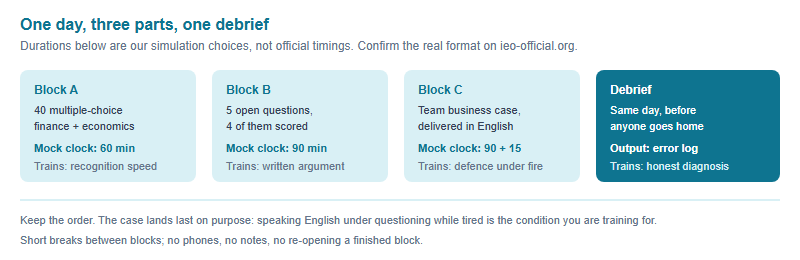
Whatever the organisers publish, you will not get the volume of past papers a school exam gives you, and that is exactly why a self-built mock day is the highest-value practice a team can run. The competition is three parts — a 40-question finance and economics multiple-choice paper, five open questions of which four are scored, and a team business case delivered in English. Sitting them loosely, on separate afternoons, trains none of the thing that actually breaks on the day: sustained performance across all three.
Why the full day is the point
Loose practice hides three failure modes that only appear when the parts run in sequence. The first is fatigue transfer: a team that is sharp in the multiple-choice block writes noticeably worse open answers ninety minutes later, and the case round — the one requiring English delivery in front of people — is placed last in this mock, when everyone is emptiest. The second is switching cost. The three parts reward different modes: fast recognition, structured written argument, and spoken persuasion. Moving between them is a trained skill. The third is triage discipline. With five prompts and four scored, how you allocate effort across them is a decision, and it is a decision most students make badly the first time they face it.
One honest caveat before you build anything. The order of the parts on the day and how the four scored open questions are selected from the five are matters for the organisers, and the official timings are published on ieo-official.org; check them before you set your own clock — confirm them on ieo-official.org. The durations in this article are our simulation choices, picked to be demanding and repeatable, not claims about the real paper. What a mock day can teach you is your own behaviour under load, and that is transferable regardless of the exact clock.
Assembling a mock paper around whatever the organisers publish
You are building a proxy. Label it that way to your team, because a proxy that everyone believes is the real thing produces false confidence about difficulty and topic mix. Four sources cover the day:
- Multiple-choice items. Start with any example questions published on ieo-official.org, then draw from the economics course your school already runs and add finance items you write yourself — interest and compounding, risk and return, reading a simple set of accounts, exchange-rate arithmetic. The finance and financial-literacy items are where school-taught teams are thinnest, so weight it deliberately rather than letting your syllabus decide the mix for you.
- Open questions. Write five prompts that each demand a position plus a mechanism, not a definition. Good prompts sound like arguments: should this policy be used, under what conditions does it stop working, who bears the cost.
- The case. One page of public information about a firm, sector or policy problem, plus a decision to make. Ambiguity is a feature; if the brief contains the answer, the round is a reading test.
- A marking rubric, written before the day. Non-negotiable. A rubric written after you have read the answers is a justification, not a rubric.
Two rules on sourcing. Do not reproduce and circulate copyrighted exam papers as a “pack” — use questions your school is licensed to use, or write your own. And do not let one person both write the case brief and sit the case round; the author cannot be surprised by their own ambiguity.
Marking what has no mark scheme
This is where most self-study collapses. Students mark the multiple-choice block, because it marks itself, and quietly skip the two parts that carry the harder skills. The fix is a rubric written in advance and applied by someone who is not the author of the answer.
For open answers we use a four-dimension rubric, scored 0-3 each for a 12-point total. It is our framework, not an official mark scheme, and it is deliberately built around the things examiners in any economics competition can see quickly:
| Dimension | What earns 3 | What scores 1 or 0 |
|---|---|---|
| Position | A single defensible answer stated in the first two sentences | Circling the question; a verdict that arrives only in the last line, or never |
| Mechanism | An explicit causal chain, step by step, each link stated | Naming a result without the route to it; a diagram with no words |
| Magnitude | Some sense of size: a number, a comparison, an order of magnitude | Everything described as “significant” with nothing quantified |
| Limit | The condition under which the answer flips, stated and justified | A one-sided answer, or a limp “however, there are other views” |
Two disciplines make this rubric work. Mark blind where you can — swap answers between team members with names removed. And mark the fifth answer too, even though only four count. Knowing which of your five is habitually weakest is the whole strategic value of the exercise; whether the scored four are your best four or are chosen another way is something to confirm on ieo-official.org rather than assume.
For the case round, one adult is enough as a panel. Score four things: whether the problem was framed before solutions appeared, whether real options were compared rather than one option defended, whether the recommendation contained a number, and whether the team held up under questioning. Then run the drill that matters most — two minutes of unfriendly follow-ups, aimed at the assumption the team was quietest about. Our guide to the business case round covers what a strong recommendation structure looks like.
The error log is the product of the day
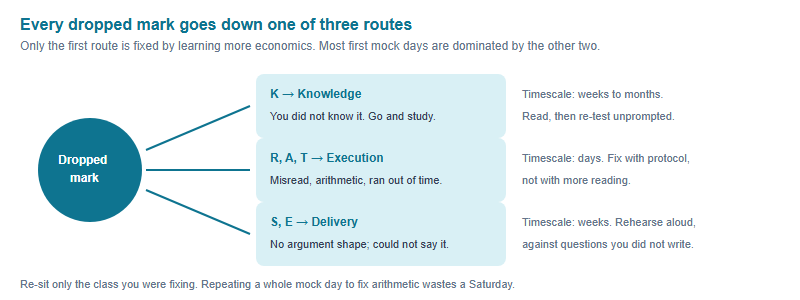
A score is not a diagnosis. Two students can drop the same eight marks for entirely different reasons, and the remedies have nothing in common. So every dropped mark gets a class, written down on the day, while the student still remembers what happened in their head.
| Class | What it means | The fix | How you know it worked |
|---|---|---|---|
| K — Knowledge | You did not know the concept | Study. This is the only class that sends you back to reading | You can explain it unprompted a week later |
| R — Misread | You knew it; you answered a different question | Protocol: underline the instruction verb before answering | Misreads fall on the next timed sitting |
| A — Arithmetic or units | Right method, wrong number, or percentages and units confused | Protocol: write the unit next to every figure | Numeric items stop being the volatile block |
| S — Structure | You had the ideas but no shape of argument | Rubric drills: write positions and limits only, ten in a row | Position and Limit scores stop being your low dimensions |
| T — Timing | You ran out and left marks unattempted | Protocol: fixed per-question caps, hard stop, move on | Nothing is blank at the end |
| E — English | You knew it and could not say or write it fast enough | Speaking rehearsal; phrase banks for argument moves | You survive the two-minute challenge without freezing |
The reason for the taxonomy is simple: only one of the six classes is fixed by studying more economics. A team whose log is mostly R, A and T does not need more content — it needs exam protocol, and it can improve substantially in a fortnight. A team whose log is mostly K needs months and should not be spending its Saturdays on mock days yet. Diagnosing that difference correctly is worth more than the mock score itself.
The week after, and how often to repeat
The rule we would give any team is: re-sit only the class you were fixing. If the log was full of timing errors, run a 40-item block against the clock and nothing else. If it was structure, write ten positions-and-limits with no mechanism in between. A full mock day is expensive — a Saturday, an adult, a room — and repeating it monthly is usually a way of avoiding the unglamorous drilling that actually moves scores.
A workable rhythm for a school team is a full mock day roughly every six to eight weeks, with targeted blocks in between, and a final full simulation shortly before the qualifying round. Two mock days done properly, with rubrics and logs, beat six done as vague practice sessions. If you need the content sequencing to slot around this, our 12-week preparation plan sets out the order to build the three parts in, and what the IEO is covers the overall structure the mock is imitating.
One last thing worth saying to a team that has just had a bad first mock. A low score on a proxy paper you wrote yourself is not evidence about the real competition; it is evidence about your current protocol. That is a much more fixable object than talent, and it is the reason to run the day at all.
Frequently asked questions
How long should each block be?
Official timings should be confirmed on ieo-official.org. The 60, 90 and 90-minute blocks here are our simulation choices, set to be demanding and repeatable.
Should I answer all five open questions if only four are scored?
In a mock, yes — you learn which is habitually your weakest. How the scored four are determined is a matter for the organisers.
Can I mark my own open answers?
Poorly. Swap with a teammate, names removed, and use a rubric written before the day. Self-marking after reading your own answer rewards intention, not output.
How often should a team run a full mock day?
Roughly every six to eight weeks, with short targeted blocks between them, plus one full simulation before the qualifying round.
This is an independent guide operated by Hanlin Education for China-based international-school students. We are not affiliated with, endorsed by, or sponsored by the International Economics Olympiad Association. Competition rules, dates, timings and formats change — confirm current details on ieo-official.org. Factual errors are corrected within 7 working days of notification.