The ninth International Economics Olympiad (IEO) takes place in Shenzhen, China, from 12–20 July 2026, following Hong Kong in 2024 and Baku in 2025. For Greater China students, a world final on the mainland is unusually reachable — but proximity does not change the route in: you still earn your place by winning your national or regional round first, not by applying to the final directly.
What “Shenzhen 2026” actually means for you
The IEO is an annual competition for high-school students in economics and finance, run by the IEO Association (based in Bern, Switzerland, and supported by Nobel laureate Eric Maskin). It began in 2018 in Moscow with 13 countries; the 2026 edition in Shenzhen is the ninth. Hosting on the Chinese mainland removes some of the friction that a far-flung venue creates — shorter travel, an easier time zone, and lower cost — which matters if you are weighing whether a season-long commitment is realistic.
What it does not do is create a shortcut. The IEO is a team competition: each country sends a national team of up to five students plus one or two team leaders, and those five are selected through a national or regional round earlier in the cycle. A Shenzhen venue means the reward at the end of the road is closer to home — it does not move the road itself. For a full primer on the event, start with our companion guide, What Is the IEO.
One eligibility fact anchors everything and comes straight from the organiser: contestants must be high-school students who are under 20 on 30 June of the Olympiad year. Everything below is the durable shape of a season; exact 2026 dates, deadlines and venue logistics should be confirmed on the official channels.
The season shape: national round now, world final in July
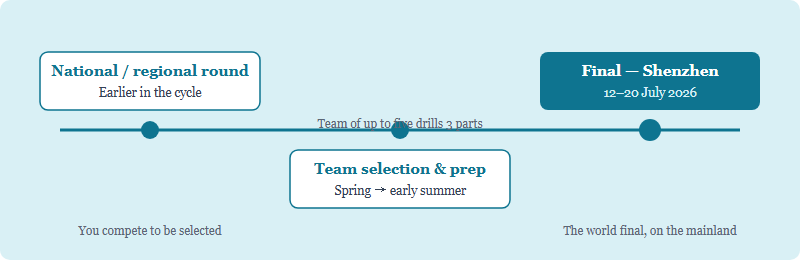
Reading the IEO backwards from the July final is the clearest way to plan. The international stage is the last step, not the first, so the dates that should be circled on a Greater China student’s calendar are actually the earlier ones — the national or regional round that selects the travelling team.
| Stage | Roughly when | What happens |
|---|---|---|
| National / regional round | Earlier in the cycle (before the summer) | You compete to be selected onto your country or region’s team of up to five |
| Team selection & prep | Spring into early summer | The selected team drills the three parts — especially the live business case |
| International final — Shenzhen | 12–20 July 2026 | Individual tests, open questions, and the team business case before judges |
The practical takeaway: do not wait for a “2026 IEO registration” link to appear and then act — by the time the July final is announced, national selection is typically already decided. The action item for a student today is to identify which national or regional round applies to you and when it opens, then work backwards from there. Those dates vary by cycle and by region, so confirm them on your regional round and on ieo-official.org rather than assuming last year’s timeline.
What you compete in once you get there
The Shenzhen final is built from three parts, and each rewards a different skill. Two are individual and one is the team event that most Greater China students under-rehearse:
- Finance & Economics multiple-choice test — an individual paper of 40 questions, testing breadth and speed across economics and finance.
- Open questions — an individual set of five, of which four are graded, rewarding depth and clear written reasoning.
- Team business case — presented in English before a panel of judges. This is a major team round carrying a substantial share of the marks; confirm the current weighting on the official site.
The business case is the highest-leverage place to prepare precisely because it cannot be crammed the night before — it rewards structured thinking and a confident English presentation built over weeks. A home-continent final does nothing to lighten that load; if anything, a reachable venue raises the stakes to arrive genuinely ready. For the topic map behind the individual papers, see our syllabus overview.
What Baku 2025 tells us about the field you’re joining
The most recent edition — IEO 2025 in Baku, Azerbaijan — is the best available read on the scale and standard heading into Shenzhen. It is not a forecast of 2026 numbers, but it sets realistic expectations for the size of the field and how medals are distributed.
| IEO 2025 (Baku) | Figure |
|---|---|
| Countries & territories | 52 |
| Participants | 258 |
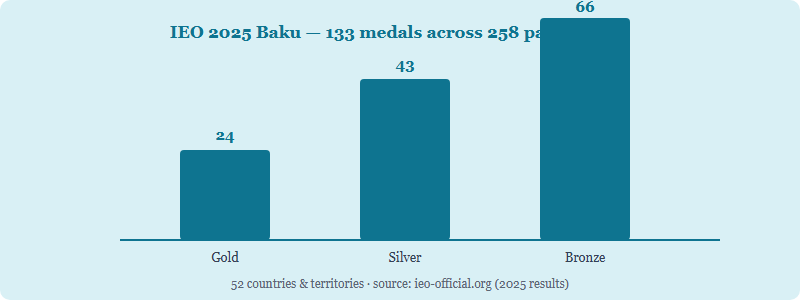
| Total medals awarded | 133 (24 gold, 43 silver, 66 bronze) |
| Team competition — gold | Singapore |
| Team competition — silver | Canada |
| Team competition — bronze | China & Russia (tied) |
Two things stand out for a Greater China planner. First, the field is large and international — 52 countries and territories — so national selection is genuinely competitive well before Shenzhen. Second, the team business case is where the headline placings are decided: in Baku, Singapore took team gold, Canada silver, and China and Russia tied for bronze. That is a direct signal about where to concentrate a team’s preparation. Note that these are the 2025 outcomes; Shenzhen’s participant count, medal split and team results are not yet known — confirm on 2026.ieo-official.org.
A practical checklist for Greater China students
If Shenzhen 2026 is on your radar, here is the sequence that actually gets a student to the start line — in order of what to do first:
- Confirm eligibility. You must be a high-school student and under 20 on 30 June 2026. If that is you, the door is open.
- Find your national or regional round. This is your real entry point — not the Shenzhen final. Check the regional rounds and official channels for the round that applies to Greater China and when it opens.
- Build breadth for the two individual papers. Work steadily through the economics-and-finance syllabus so the 40-question test and the open questions play to strength, not luck.
- Rehearse the team business case in English — early. It carries a substantial share of the marks and is the hardest part to fake. Practise structuring a recommendation and defending it out loud.
- Verify every 2026 specific. Deadlines, the exact schedule within 12–20 July, and current mark weightings change year to year — confirm on ieo-official.org and 2026.ieo-official.org before you rely on any of them.
The headline is genuinely good news: a mainland host makes the IEO more accessible to Greater China students than it has been in years. The discipline is to treat that access as a reason to prepare earlier, not later — because the round that decides whether you go to Shenzhen happens months before July. Our competition page lays out the format in more detail.
Frequently asked questions
Where and when is the IEO 2026?
The ninth IEO is in Shenzhen, China, from 12–20 July 2026 — the world final on the Chinese mainland, after Hong Kong 2024 and Baku 2025.
Does a Shenzhen host mean I can enter the final directly?
No. You still qualify by winning your national or regional round first; each country sends a team of up to five. Proximity does not change the route in.
When should I act if I want to compete in 2026?
Now — focus on your national or regional round, which happens earlier in the cycle. Confirm its dates on ieo-official.org.
How big is the field?
At Baku 2025 there were 258 participants from 52 countries and territories, with 133 medals awarded. Confirm 2026 figures on 2026.ieo-official.org.
This is an independent guide to the International Economics Olympiad for Greater China students, operated by Hanlin Education; NOT affiliated with, endorsed by, or the official site of the International Economics Olympiad Association (ieo-official.org). Rules, eligibility, dates and the host city are set by the organiser and change each year — always confirm current details on the official channels; corrected within 7 working days.