The IEO is not a pure microeconomics contest. Its individual multiple-choice paper is explicitly a Finance & Economics test, and a large share of the questions reward financial literacy rather than supply-and-demand curves: the time value of money, compounding, risk and return, diversification, and reading a basic financial statement. Greater China students who over-index on textbook micro routinely leave these marks on the table. This guide explains what the finance strand asks and how to close the gap.
Why “finance” is baked into the IEO, not bolted on
The International Economics Olympiad was founded in 2018 in Moscow and is run by the IEO Association (based in Bern, Switzerland, supported by Nobel laureate Eric Maskin). It is an annual event for high-school students under 20 on 30 June, and the 2026 edition — the ninth IEO — runs in Shenzhen from 12–20 July 2026. If you are new to the format, our explainer on what the IEO is and how it works is the best place to start.
The competition has three parts, and finance shows up in all three:
- an individual Finance & Economics multiple-choice test (40 questions, per the official organiser);
- an individual open-questions round (a set of five, of which four are graded); and
- a team business case presented in English before a panel of judges.
Notice that the name of the first paper puts Finance first. This is deliberate. The IEO was designed to test economic reasoning and practical financial understanding — the kind of quantitative decision-making an informed adult uses to compare a loan, size a portfolio, or read a company’s numbers. That is precisely the material a syllabus built around A-Level or IB microeconomics tends to under-weight. The exact mark shares of each part are set by the organiser and can change; confirm current weightings on ieo-official.org rather than relying on any figure quoted second-hand.
What the financial-literacy strand actually tests
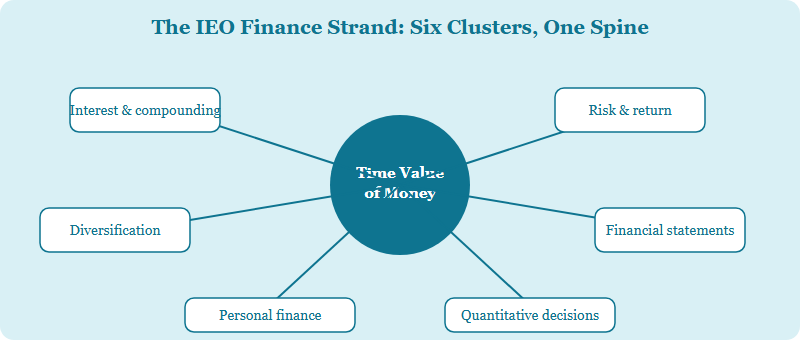
Financial literacy on the IEO is not one topic — it is a cluster of quantitative and interpretive skills. Below is the working map we give our Greater China cohort. Treat it as the terrain the finance questions are drawn from, not an official weighting.
| Concept cluster | What it means | How it surfaces on the paper |
|---|---|---|
| Time value of money | A dollar today is worth more than a dollar next year; present value vs future value. | MCQs that ask which cash flow is worth more; discounting a lump sum or annuity. |
| Interest & compounding | Simple vs compound interest; how frequency and rate change the outcome. | “Which account grows faster?” comparisons; effective annual rate. |
| Risk & return | Higher expected return usually carries higher risk; expected value under uncertainty. | Choosing between investments; computing an expected payoff. |
| Diversification | Spreading holdings reduces idiosyncratic risk without cutting expected return proportionally. | Conceptual MCQs on why a portfolio beats a single stock; open-question reasoning. |
| Financial statements | Reading an income statement, balance sheet, and cash-flow basics; assets, liabilities, equity. | Extracting a figure from a small table; margin or liquidity questions. |
| Personal finance | Budgeting, saving, borrowing costs, inflation eroding real value. | Applied “everyday economics” MCQs; framing in the business case. |
Two of these deserve a closer look because they are where marks are won and lost.
Time value of money is the spine of the whole strand. Compounding, discounting, loan comparison, and investment choice are all applications of the same idea: money has a price over time, called the interest rate. A student who genuinely internalises present value can answer a whole family of questions quickly. A student who memorised a formula but never built intuition will freeze when the question is phrased sideways — “you can receive $1,000 now or $1,100 in a year at a 6% rate; which do you take?” The answer requires comparing the future value of $1,000 (about $1,060) against $1,100, not plugging numbers blindly.
Reading a financial statement is a comprehension skill, not a calculation. The paper may hand you a compact income statement or balance sheet and ask for gross margin, or which line is a liability, or whether the firm is solvent. Nothing here is hard arithmetic — but if you have never seen the layout, you lose time hunting for the right row. This is exactly the kind of item that separates a strong micro student from a strong finance student.
Why strong micro students still drop these marks
In our experience coaching Greater China students, the gap is rarely about intelligence — it is about curriculum coverage and habit. Here is what we see repeatedly, and it maps cleanly onto why the finance half gets underrated.
- The school syllabus skews micro. A-Level, IB, and AP courses spend most of their time on markets, elasticity, market structures, and welfare. Personal finance and corporate finance basics are thin or absent, so students simply have less exposure to compounding and statements. Our walkthrough of the microeconomics side of the IEO shows how much of the paper sits outside that comfort zone.
- Finance rewards speed, and speed comes from intuition. Micro questions often reward careful diagram work. Finance MCQs reward recognising a pattern — “this is a present-value comparison” — and moving on. Students who only ever practised slow, written micro problems run out of time.
- The vocabulary is unfamiliar in English. Terms like “liquidity”, “equity”, “annuity”, “yield”, and “diversification” carry precise meanings. A student who understands the concept in Chinese but stumbles on the English label loses seconds per question and misreads a few outright.
- Risk framing is counter-intuitive. Expected-value questions ask you to weigh probabilities, and diversification questions ask you to accept that combining risky assets can lower total risk. These results feel wrong until you have worked several examples.
None of this is a criticism of Greater China preparation, which is often excellent on the micro theory. It is a coverage gap — and coverage gaps are the easiest kind of weakness to fix, because the material is finite and well-defined.
How the finance strand surfaces across all three parts
Finance is not quarantined in the multiple-choice paper. Understanding where it appears helps you allocate preparation time.
| IEO part | How finance shows up | What good preparation looks like |
|---|---|---|
| Multiple-choice (Finance & Economics, 40 Q) | Direct: time value, compounding, risk/return, statement reading, personal finance. | Timed drills across all six clusters; build recognition speed. |
| Open questions (set of 5, 4 graded) | Applied reasoning: justify an investment choice, explain a financial trade-off, interpret data. | Practise writing tight, quantitative arguments — show the calculation and the logic. |
| Team business case (English, before judges) | Heavy: pricing, cost structure, break-even, funding, reading a company’s numbers. | Rehearse financial analysis and a clear spoken narrative; assign a “numbers” role. |
The business case is where finance becomes decisive. A team that can compute a break-even point, reason about a firm’s margins, and defend a funding decision in fluent English stands out from teams that only describe strategy in words. Our guide to the IEO team business case goes deeper on how to structure that presentation. Because national teams field up to five students plus one or two team leaders, it is worth deliberately assigning one member to own the quantitative analysis.
Remember, too, that you reach the international rounds by winning your national or regional round — you do not apply to the IEO directly. Finance literacy therefore matters from the very first selection stage, not just in Shenzhen. See our qualification path guide for how that pipeline works.
A four-step plan to close the finance gap
Here is the sequence we recommend to Greater China students who are strong on micro theory but untested on finance. It is designed to be worked in order, because each step builds intuition the next one assumes.
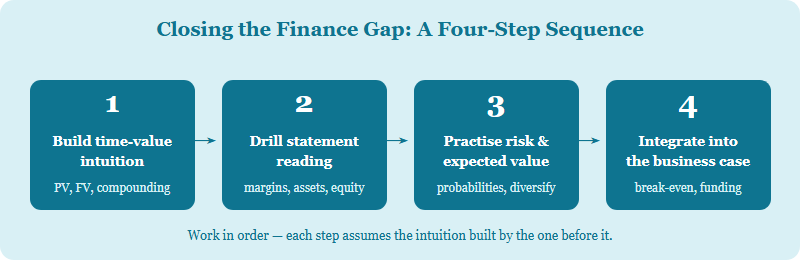
- Step 1 — Build time-value intuition first. Before any formula, get comfortable with the idea that money has a price over time. Do ten present-value vs future-value comparisons by hand until the answer feels obvious. This one skill unlocks compounding, loan comparison, and investment choice at once.
- Step 2 — Drill statement reading. Find three or four simple income statements and balance sheets. Practise pulling out gross margin, spotting liabilities, and judging whether a firm is solvent. Aim for speed: you should locate any line in seconds.
- Step 3 — Practise risk and expected value. Work through expected-payoff questions and diversification reasoning until the counter-intuitive results stop surprising you. Keep a running list of the English terms and their precise meanings.
- Step 4 — Integrate into the business case. Bring it together: take a mock company, compute its break-even, reason about its margins, and rehearse defending a funding decision aloud in English. This is where finance intuition becomes team points.
A practical note on numbers: the IEO paper is about reasoning, not heavy arithmetic. You will rarely need a complicated calculation. What you need is to recognise which financial idea a question is testing and apply it cleanly. That recognition is trainable, and it is the highest-return use of your preparation time in the weeks before a national round.
Frequently asked questions
Is the IEO multiple-choice paper only about microeconomics?
No. It is officially a Finance & Economics test of 40 questions, so a large share rewards financial literacy alongside economics theory.
What finance topics should I prioritise for the IEO?
Start with time value of money and compounding, then statement reading, risk and return, diversification, and personal finance basics.
Do I need heavy maths for the finance questions?
No. The paper rewards recognising the right financial concept and reasoning cleanly, not complex calculation. Intuition and speed matter most.
How much does finance matter beyond the MCQ paper?
A lot. It appears in the open questions and is decisive in the team business case — break-even, margins, and funding. Confirm current details on ieo-official.org.
Finance is the half of the IEO that Greater China students most often underrate — and, because it is a coverage gap rather than a talent gap, it is also the half you can close fastest. Build time-value intuition, learn to read a statement, get comfortable with risk, and carry all of it into the business case. Do that, and the “Finance & Economics” paper stops being a threat and becomes an edge.
This is an independent guide to the International Economics Olympiad for Greater China students, operated by Hanlin Education; NOT affiliated with, endorsed by, or the official site of the International Economics Olympiad Association (ieo-official.org). Rules, eligibility, dates and the host city are set by the organiser and change each year — always confirm current details on the official channels; corrected within 7 working days.