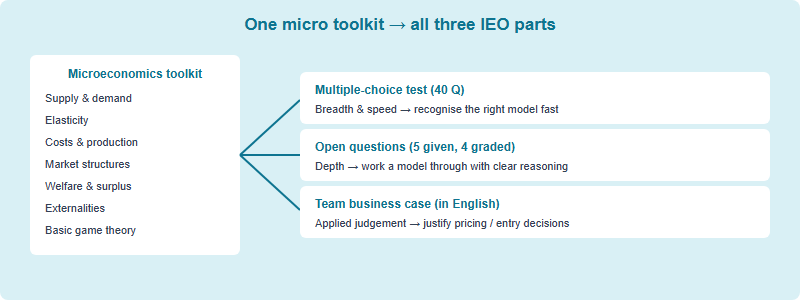
If you can only master one subject before the International Economics Olympiad (IEO), make it microeconomics. Supply and demand, elasticity, costs and production, market structures, welfare, externalities and basic game theory recur across all three parts — the multiple-choice test, the open questions, and the team business case. Micro is the highest-return subject because the same handful of models is tested again and again.
Why microeconomics is the highest-return subject to master first
The IEO has three parts: an individual Finance & Economics multiple-choice test (40 questions, per the official site), a set of individual open questions (five given, four graded), and a team business case presented in English before a panel of judges. Those parts look very different, but they lean on a shared toolkit — and microeconomics is the largest, most reusable part of it.
The logic is simple. Micro gives you a small number of models that transfer everywhere. A demand curve, a cost curve, a market-structure diagram and a surplus triangle are not four exam topics you tick off once; they are the working language you use to answer MCQs quickly, to structure an open-question argument, and to justify a pricing or entry recommendation in the business case. Macroeconomics and finance matter too, but they sit on top of this foundation. Master micro first and the rest of your preparation compounds.
One honest caveat before we go further: we describe what tends to be tested and how, not the exact mark split. The IEO does not publish a fixed weighting you can drill against, and the business case — while clearly a major team round worth a substantial share of the marks — is not tied to a public percentage. Confirm the current weighting and format on the official site rather than trusting any number you see quoted second-hand.
The core micro toolkit, and how each part shows up
Here is the recurring microeconomics that rewards early, deliberate study. Treat the right-hand column as the practical reason each concept earns its place in your revision plan.
| Concept cluster | What it covers | Why it recurs on the IEO |
|---|---|---|
| Competitive markets, supply & demand | Market equilibrium, shifts vs. movements, price mechanism | The default framework for almost any applied question |
| Elasticity | Price, income and cross elasticities of demand; elasticity of supply | MCQ favourite; drives revenue and incidence reasoning |
| Costs & production | Fixed vs. variable, marginal cost, economies of scale, short vs. long run | Underpins every firm-behaviour and business-case decision |
| Market structures | Perfect competition, monopoly, oligopoly, monopolistic competition | High-yield comparisons; core to pricing recommendations |
| Welfare & surplus | Consumer & producer surplus, deadweight loss, efficiency | The standard way to judge whether an outcome is “good” |
| Externalities & market failure | Positive/negative externalities, public goods, taxes, subsidies | Policy questions and case “what should the firm/government do” |
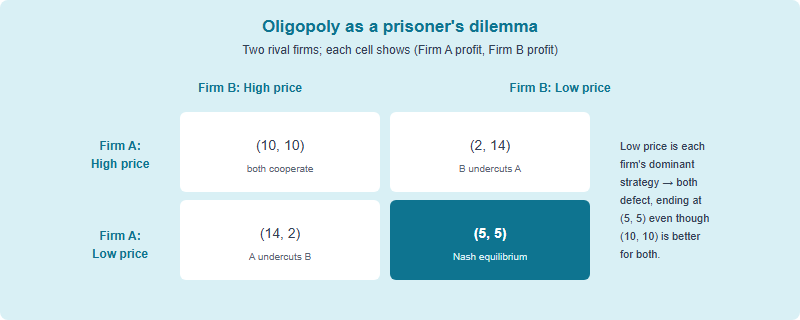
| Basic game theory | Payoff matrices, dominant strategies, Nash equilibrium, prisoner's dilemma | Explains oligopoly and strategic pricing under rivalry |
Notice how the clusters build on each other. You cannot reason about welfare without supply and demand; you cannot analyse a monopoly without cost curves; you cannot make sense of oligopoly without a little game theory. That interlocking structure is exactly why micro rewards being learned as a system, not as isolated flashcards. Our syllabus overview maps how these fit alongside macro and finance.
Where students actually lose marks (and how to fix it)
After coaching Greater China cohorts, the same avoidable slips come up year after year. None of them require more talent to fix — only tighter habits:
- Confusing a shift with a movement. A price change moves you along a demand curve; a change in income, tastes or substitute prices shifts the whole curve. MCQs are built to punish this.
- Sign errors in elasticity. Price elasticity of demand is negative; income elasticity is positive for normal goods and negative for inferior goods; a positive cross elasticity means substitutes. Get the signs automatic.
- Mixing up marginal and average. Firms maximise profit where marginal revenue equals marginal cost — not where average cost is lowest. This single rule anchors most market-structure questions.
- Forgetting the welfare lens. When a policy or a monopoly changes the outcome, examiners want to see who gains, who loses, and whether there is deadweight loss — not just a verbal “prices go up”.
- Skipping the diagram. In open questions, a correct, labelled diagram often earns marks even when the prose is thin. Draw first, then explain.
The through-line is discipline, not cleverness. Micro rewards students who apply the same model the same way every time, so build that reliability early. Our What Is the IEO guide sets out how the three parts fit together if you are new to the competition.
Market structures and game theory: the highest-yield pairing
If you want one high-leverage block, study market structures together with basic game theory. Comparing perfect competition, monopoly and oligopoly is a reliable source of MCQ and open-question material, and it feeds directly into the business case, where teams frequently recommend how a firm should price or whether it should enter a market.
Game theory is the piece that makes oligopoly make sense. Once you can read a simple payoff matrix, spot a dominant strategy and identify a Nash equilibrium, the classic prisoner's dilemma stops being an abstraction and becomes a tool: it explains why rival firms struggle to sustain high prices, why cartels are unstable, and why a “rational” move can leave everyone worse off. That is exactly the kind of strategic reasoning judges reward when a team defends a pricing recommendation out loud.
| Market structure | Number of firms | Price-setting power | Typical IEO angle |
|---|---|---|---|
| Perfect competition | Very many | None (price taker) | Benchmark for efficiency & surplus |
| Monopolistic competition | Many | Some (differentiation) | Non-price competition, branding |
| Oligopoly | Few | Interdependent | Game theory, strategic pricing |
| Monopoly | One | High (price maker) | Deadweight loss, regulation |
A study order that compounds
You do not have to learn these clusters in the order a textbook prints them. For the IEO specifically, this sequence builds each layer on the last and gets you answering real questions sooner:
- Week 1 — Supply and demand. Equilibrium, shifts vs. movements, the price mechanism. Everything else references this.
- Week 2 — Elasticity. All four elasticities, and their link to total revenue and tax incidence.
- Week 3 — Costs and production. Marginal vs. average, short vs. long run, economies of scale.
- Week 4 — Market structures. Compare all four, anchored on the marginal-revenue-equals-marginal-cost rule.
- Week 5 — Welfare, externalities and game theory. Surplus and deadweight loss, then market failure and simple strategic games.
Throughout, alternate two habits: timed multiple-choice sets to build speed, and short written answers with a diagram to build depth. That mirrors how the individual parts of the IEO are actually assessed, and it means your business-case reasoning improves as a by-product. When you are ready to line up a national round, see the competition page and the regional rounds for Greater China — remember you qualify by winning your national round, not by applying to the final directly.
Frequently asked questions
Is microeconomics really the most important IEO subject?
It is the highest-return subject to master first: its models recur across the MCQ, the open questions and the business case.
Which micro topics come up most?
Supply and demand, elasticity, costs, market structures, consumer and producer surplus, externalities, and basic game theory.
How many multiple-choice questions are there?
The individual Finance & Economics test has 40 questions per the official site. Confirm the current format on ieo-official.org.
Do I need game theory for the IEO?
Basic game theory helps: payoff matrices, dominant strategies and Nash equilibrium explain oligopoly pricing that shows up in cases.
This is an independent guide to the International Economics Olympiad for Greater China students, operated by Hanlin Education; NOT affiliated with, endorsed by, or the official site of the International Economics Olympiad Association (ieo-official.org). Rules, eligibility, dates and the host city are set by the organiser and change each year — always confirm current details on the official channels; corrected within 7 working days.