On the Greater China route into the IEO, recognition does not begin at the national team. A preliminary score of 70 or more out of 100 earns an individual achievement certificate, and roughly 35 to 40 per cent of entrants reach it. Above that sit team honours for the top 20 per cent and individual honours for the top 15 per cent, each awarded in three grades.
Three recognitions, not one
Most students arrive with a binary picture in their heads: you make the national team or you get nothing. That picture is wrong, and it does real damage, because it makes a whole cycle look like a coin flip when it is actually a ladder with several rungs you can plan for. The structure below reflects the honours arrangement on the China route (operated as IEOC by NexGenHub) as it was briefed to us in 2026. Thresholds are the organiser’s to set and can change between cycles, so confirm the current figures before you plan around them.
| Recognition | Decided by | Threshold | Grades | Share reached |
|---|---|---|---|---|
| Individual achievement certificate | Your absolute score on the preliminary | 70 or more out of 100 | Single certificate | Roughly 35–40% of entrants |
| Individual honours | Your rank among individuals | Top 15% | Three grades | 15%, by construction |
| Team honours | Your team’s rank among teams | Top 20% | Three grades | 20%, by construction |
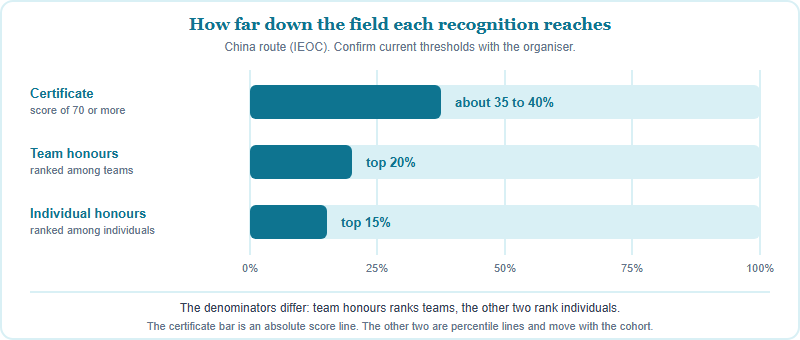
One line is fixed. Two of them float.
This is the most useful thing on the page, and almost nobody notices it. The certificate and the honours are awarded on fundamentally different logic.
The certificate is criterion-referenced. The line sits at 70 out of 100 and does not move because of anybody else. You are competing against the paper. If every student in the country got better this year, every one of them could clear it.
The honours are norm-referenced. Top 15 per cent and top 20 per cent are definitions of a share, not of a standard. Wherever the cohort lands, the top 15 per cent of it takes individual honours. You are competing against the room, and if every student in the country got better this year, exactly the same proportion would be recognised.
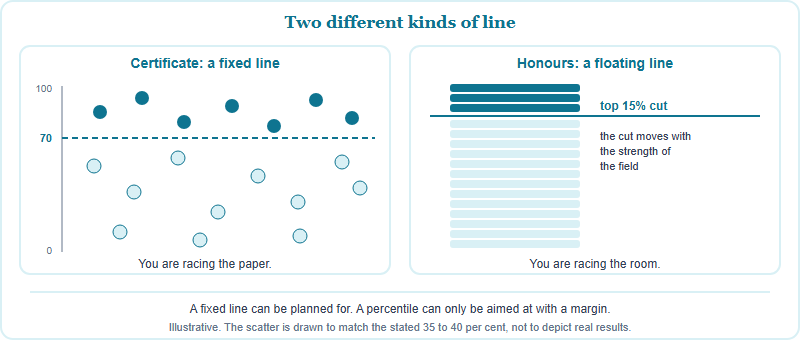
Three practical consequences follow. First, only the certificate can be planned to directly. “Reach 70” is an executable instruction: you can count marks, find the topics you can make safe, and check your progress against it in a mock. Second, a percentile is an outcome, not an instruction. “Get into the top 15 per cent” tells you nothing about what to do on Tuesday. The executable translation is: build the largest margin you can above the line you can see. Third, the certificate is the only one of the three whose status you can estimate on the morning of the exam. Treat it as your floor, and let the honours be the upside.
What a 70 that four in ten clear tells you about the paper
A threshold is also a piece of information about the exam that sits underneath it, and this one is worth reading slowly. A fixed line at 70 out of 100 that roughly 35 to 40 per cent of entrants clear describes a paper that is neither a formality nor a massacre. Something like three in five entrants finish below it. It is a real filter. But it is also not a paper designed so that only specialists survive.
The arithmetic that follows is our own, not the organiser’s: a line at 70 means you can give away 30 marks and still clear it. You do not need to be able to do everything. Roughly seven parts in ten need to be secure, and the other three can be genuinely beyond you without costing you the certificate.
That has a direct bearing on how people revise, because it argues against the instinct almost every ambitious student has, which is to spend the autumn on the hardest material available. Thirty marks of slack is a budget, and the fastest way to waste it is on careless losses in the easy band rather than on genuinely hard questions. Our twelve-week preparation plan is built around that ordering: secure the reachable band first, then buy difficulty with what is left.
Two things we deliberately do not tell you here, because we have not seen them in writing: how the 100 marks are composed, and whether wrong answers carry a penalty. Both change how you should handle a question you are unsure of, and both are worth asking your sending organisation before the paper rather than guessing on the day.
The gap between a certificate and honours is where the work is
Put the two figures next to each other. Roughly 35 to 40 per cent of entrants clear 70. Fifteen per cent take individual honours. On our arithmetic that means something like three in five students who earn a certificate do not reach individual honours — the certificate band is more than twice as wide as the honours band sitting on top of it.
That band is the most instructive part of the whole structure, because the two halves of the climb are not the same kind of work:
- Nothing to 70 is mostly coverage. You are closing gaps in what you have met. Most of the gain comes from meeting more of the syllabus, and it comes relatively quickly because unmet material is the cheapest thing to fix.
- 70 into the top band is mostly conversion. Almost nothing new is required. What changes is the state of what you already have: right slowly becomes right quickly; right with notes open becomes right with them closed; knowing a definition becomes applying it to a situation you have not seen before.
Conversion is unglamorous and it is where we most often watch students stall, partly because it does not feel like progress. Reading a new chapter feels productive. Re-sitting a paper you have already done, under time, and being annoyed by the same three mistakes does not — but it is the part that moves you up a percentile band. One area worth singling out is the finance material, which — in our own coaching, at least — students consistently underrate because it looks less like the economics they study at school; the multiple-choice paper is a finance and economics paper, and treating the finance half as a footnote is a reliable way to sit just below a line.
Finally, note that team honours and individual honours can come apart, because one ranks teams and the other ranks students. Exactly how a team result is arrived at is a question for the organiser, and we will not guess at it. But the structural point stands on its own: if team honours matter to you, a team whose floor is high may serve you better than one with a single outstanding member, and that is worth knowing before you finalise a roster. The same logic runs all the way through to the team business case at the international round, which is a genuinely collective object rather than a solo performance with helpers.
How to describe a result without inflating it
A precise claim is more useful than an impressive one, and it survives contact with an adult who checks things. The rule we use is simple: name the cycle, the route, the division, the round, and the exact recognition. A sentence built that way is verifiable. A vague one invites suspicion of everything else on the page.
Three specific things not to do. Do not promote a certificate into an “award” — the structure distinguishes them and so should you. Do not drop the division, because a junior-division result and a SENIOR result are different objects. And do not let a recognition earned on the national route imply a result at the international olympiad; those are separate stages with separate awards.
We hold ourselves to the same standard, so here is a first-party example written the way we would want a student to write it: at the 2026 Singapore invitational, our own cohort took an individual seventh place and a team silver. That is de-identified, it is our own tally rather than an official published statistic, and results vary between students and between cycles. Notice how much less it claims than the same fact would if it were compressed into a single confident adjective — and notice that it is checkable, which is the entire point.
One closing caution about scope. This ladder describes recognition on the national route; it is not the international medal table, and it is not a selection mechanism. At the 2025 final in Baku, 258 participants from 52 countries competed and 133 medals were awarded, with Singapore taking team gold — a different stage, a different denominator, and a different set of awards entirely. If you are still orienting yourself between the two, our overview of what the IEO is sets out how the stages fit together.
Common questions
What score earns a certificate on the China route?
A preliminary score of 70 or more out of 100 earns an individual achievement certificate. Confirm the current threshold with the organiser.
How many entrants actually reach 70?
Roughly 35 to 40 per cent, per the structure briefed to us. It is a fixed score line rather than a percentile.
Are team honours and individual honours the same thing?
No. Team honours go to the top 20 per cent of teams; individual honours go to the top 15 per cent of individuals.
How many grades does each honour have?
Three, per the structure we were briefed on. We do not publish the grade names because we have not seen them in writing.
This is an independent guide operated by Hanlin Education for China-based international-school students. We are not affiliated with, endorsed by, or sponsored by the International Economics Olympiad Association. Award thresholds, percentages and grade structures are set by the organiser and change between cycles — confirm current details on ieo-official.org and with your sending organisation. Our own cohort figures are de-identified internal tallies, not official statistics, and results vary. Errors are corrected within seven working days of being reported.