Macroeconomics is one of the two great halves of economics, and any olympiad that tests economics at this level leans on it heavily. For the International Economics Olympiad (IEO), that means the AD–AS framework, inflation and unemployment, monetary and fiscal policy, and international macro can surface across all three parts of the competition. This guide maps the macro toolkit and shows how to study it for depth rather than recall.
Why macro is worth deliberate study, not last-minute cramming
Many strong students arrive at olympiad economics through microeconomics: neat diagrams, clean equilibria, a single curve that shifts. Macroeconomics feels messier because it deals with the whole economy at once, with variables that feed back into one another and policy answers that genuinely divide professional economists. That messiness is exactly why it rewards preparation. A candidate who has actually built the models — rather than memorised conclusions — can reason through an unfamiliar scenario instead of guessing.
The IEO is a three-part competition: a 40-question Finance & Economics multiple-choice paper, a set of five open questions (of which four are graded), and a team business case delivered in English. If you are still getting oriented to that structure, our overview of what the IEO is lays out the format before you specialise. Macro is not confined to one part — it can appear in the MCQ, drive an open question, and shape the economic backdrop of a business case. That breadth is the argument for treating it as a core subject, not an afterthought.
The macro toolkit, cluster by cluster
You do not need to memorise a syllabus the length of a textbook. You need a small number of frameworks you can deploy under pressure. Think of macro as six connected clusters. The authoritative topic list is published on ieo-official.org — treat the map below as a study structure, not an official specification.
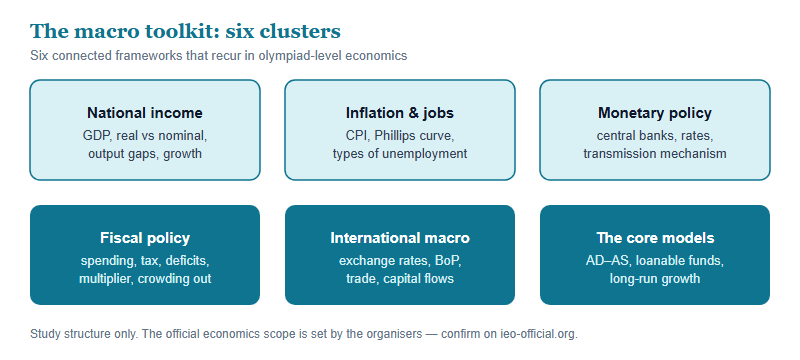
Two principles hold these clusters together. First, every macro variable is connected to the others: raise interest rates and you touch investment, the exchange rate, and eventually inflation and employment. Second, time horizon changes the answer: a policy that boosts output in the short run may only raise prices in the long run. Students who internalise these two ideas stop treating macro questions as trivia and start treating them as reasoning problems.
The macro clusters and where each tends to surface
The table below pairs each cluster with the ideas most worth mastering and where it typically shows up across the competition. The “where it shows up” column is editorial guidance, not an official mark scheme — the composition of each part is decided by the organisers.
| Cluster | Highest-yield ideas | Typically surfaces in |
|---|---|---|
| National income & growth | Real vs nominal GDP, the circular flow, output gaps, sources of long-run growth | MCQ recall & calculation; open-question framing |
| Inflation & unemployment | Demand-pull vs cost-push, the short- and long-run Phillips curve, the natural rate | MCQ; open questions demanding evaluation |
| Monetary policy | How a central bank moves rates, inflation targeting, the transmission mechanism | MCQ; open questions; business-case backdrop |
| Fiscal policy | Multiplier effects, automatic stabilisers, deficits vs debt, crowding out | Open questions; policy-debate prompts |
| International macro | Fixed vs floating exchange rates, the current account, comparative advantage | MCQ; open questions; global business cases |
| Core models | AD–AS shifts, loanable funds, the long-run vertical supply curve | Every part — the shared language of macro answers |
Notice that the core models cut across everything. If you can draw AD–AS cleanly, label both axes, distinguish a shift from a movement, and separate the short run from the long run, you have a diagram that carries you through a large share of macro questions. The 12-week prep plan shows how to sequence this base-building alongside open-question practice and business-case rehearsal.
How to answer a macro policy question
Macro open questions rarely ask “what is the answer.” They ask you to reason about a policy in a specific context and to weigh competing effects. That is why cramming conclusions fails: the marks are in the chain of reasoning. Use a repeatable structure so you never freeze in front of an unfamiliar prompt.
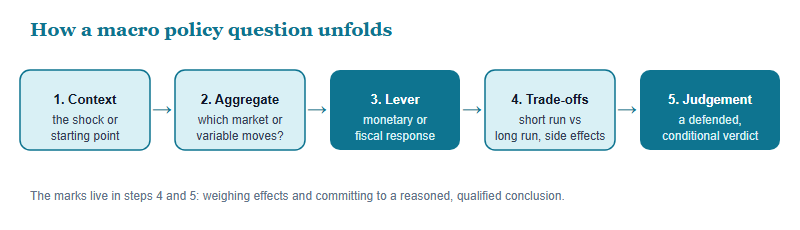
Walk through a worked example. Suppose the prompt describes an economy facing rising inflation and asks whether the central bank should raise interest rates. A weak answer says “yes, higher rates reduce inflation.” A strong answer names the context (is this demand-pull or cost-push?), identifies the aggregate affected (aggregate demand via investment and consumption), specifies the lever (a rate rise working through the transmission mechanism), weighs the trade-offs (slower growth and possible unemployment in the short run; anchored expectations in the long run), and delivers a judgement that is conditional on the type of inflation. The candidate who reaches a qualified verdict — “if the inflation is demand-driven, tightening is justified; if it is a supply shock, the case is weaker” — is writing like an economist.
Where students lose macro marks
The same errors recur across candidates every year. Fixing them is often faster than learning new content.
- Confusing nominal and real. Growth, wages, interest rates, and exchange rates all have nominal and real versions. Mixing them is one of the most common ways to throw away MCQ and open-question marks.
- Shift versus movement. On AD–AS or the money market, a shift of the curve and a movement along it mean very different things. Sloppy diagrams get penalised.
- Ignoring the time horizon. Many macro effects reverse between the short and long run. An answer that never distinguishes them is only half an answer.
- Asserting instead of evaluating. Open questions reward the “on the other hand.” State the trade-off, then commit to a conditional judgement.
- Forgetting the international channel. In an open economy, exchange rates and trade balances react to domestic policy. Leaving them out flattens the analysis.
Macro also underpins the team round: the economic environment you build a case around — interest rates, currency, growth, policy risk — is macro in action. Our guide to the business case round shows how a sound macro backdrop strengthens a team presentation.
A study order that compounds
Build macro in the order a real course would, because later ideas assume earlier ones. Start with national income accounting so the vocabulary is solid. Add the AD–AS model as your master diagram. Layer inflation and unemployment onto it, then monetary and fiscal policy as the two levers that move the aggregates. Finish with international macro, which reintroduces exchange rates and the balance of payments once the closed-economy logic is secure. Test yourself constantly by explaining each idea aloud and drawing the model from memory — recognition is not the same as recall, and the competition demands recall.
Do not try to master macro and micro on the same day. Alternate: a micro block, then a macro block, so the two reinforce rather than blur. And keep one eye on the real world — a central-bank decision or an inflation report in the news is free, current practice for exactly the reasoning the IEO rewards.
Frequently asked questions
Does the IEO test macroeconomics as well as microeconomics?
The IEO draws on standard economics, which includes macro. The authoritative topic scope is published on ieo-official.org, so prepare both halves.
Which macro topics should I prioritise first?
Build national income accounting and the AD–AS model first, then inflation, unemployment, and monetary and fiscal policy. International macro layers on last.
How is answering a macro question different from micro?
Macro rewards weighing trade-offs across time horizons and committing to a conditional judgement, not just identifying one correct curve shift.
Where does macro appear across the three parts?
It can surface in the 40-question MCQ, the open questions, and the team business case. The exact composition is set by the organisers.
This is an independent guide operated by Hanlin Education for China-based international-school students. It is NOT affiliated with, endorsed by, or sponsored by the International Economics Olympiad Association. Competition facts — format, eligibility, syllabus scope, and dates — can change; always confirm current details on ieo-official.org. Any error we are notified of is corrected within 7 working days.