The 2026 International Economics Olympiad (IEO) global final has concluded, and the headline for this region is clear: the two highest-scoring national teams were both from Greater China. Below are the reported team scores, how the team result is actually built from its parts, and — honestly — what a result like this does and does not mean for a university application. Every figure here should be confirmed on the official results page (ieo-official.org/results); this is an independent guide, not the organiser.
The reported 2026 team results
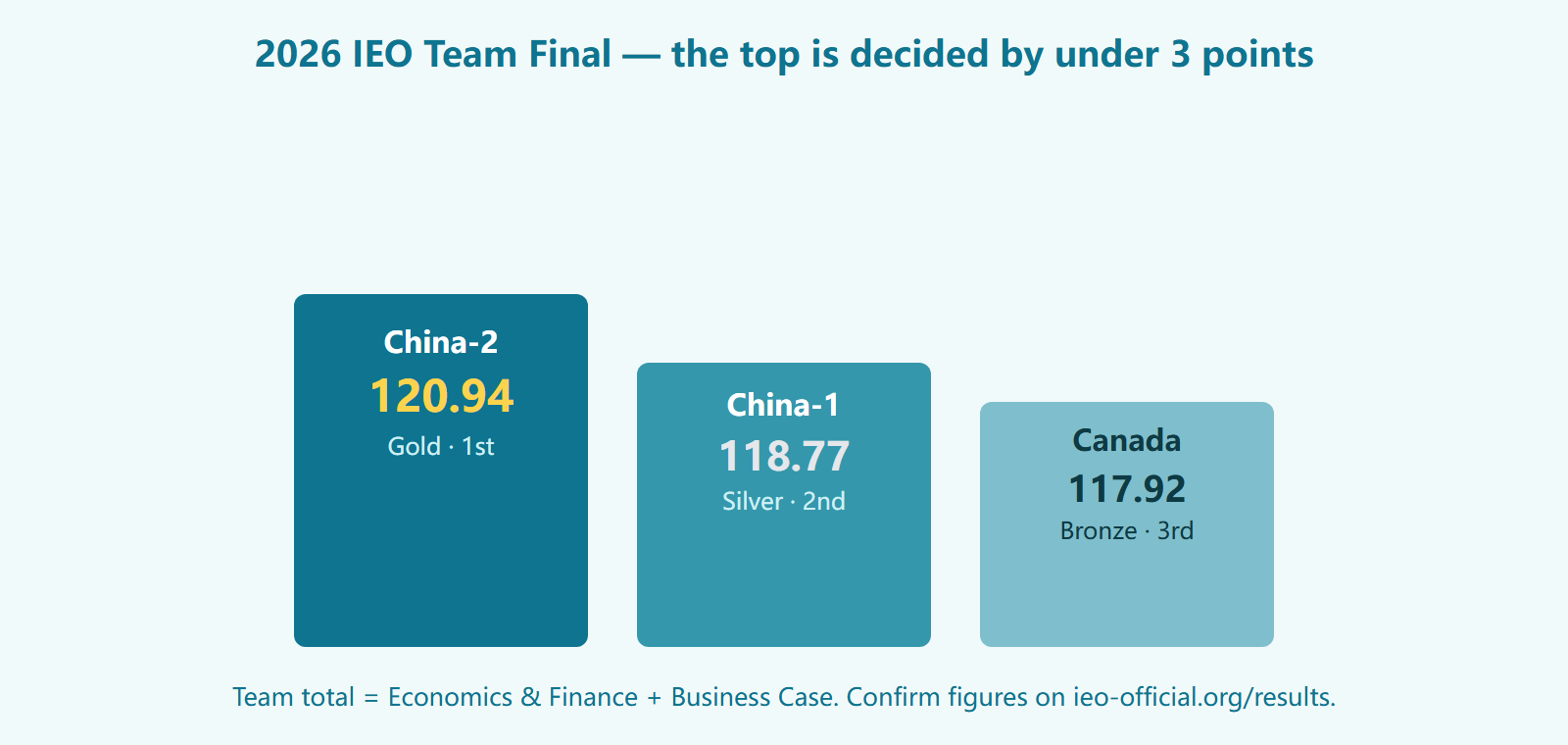
The IEO team score is not a single exam mark — it combines an Economics & Finance component with a Business Case component into a team total. The reported top of the 2026 table:
| Team | Econ & Finance | Business Case | Team total | Trophy |
|---|---|---|---|---|
| China‑2 | 116.65 | 43.17 | 120.94 | Gold — 1st |
| China‑1 | 116.55 | 41.07 | 118.77 | Silver — 2nd |
| Canada | 113.18 | 42.47 | 117.92 | Bronze — 3rd |
| Singapore | 115.05 | 39.67 | 116.37 | Best in Business |
Two things stand out. First, the gap between 1st and 2nd was under 3 points on a ~120-point scale — at the very top, the field is tight and the Business Case component (not just the written exam) decides the order. Second, students that we at Hanlin supported competed on the China and Hong Kong teams and earned individual golds, with one taking the second-highest individual total worldwide; a student on the US team earned an individual bronze (per Hanlin, de-identified; results vary and are not guaranteed; confirm all placings officially).
Why “team” is the whole point of the IEO
Unlike a single-sitting olympiad, the IEO is deliberately built so that a country’s result depends on more than raw exam recall:
- Economics & Finance is the individual-knowledge half — microeconomics, macroeconomics, international economics and personal finance.
- The Business Case is the team half — a live, English-language case that a team presents and defends before judges. It is where the top order actually gets decided (see the table: China-2 won the Business Case component, and that is what put it first).
That mix is exactly what makes the result readable to admissions officers: it evidences not just economic literacy but the collaboration, live reasoning and communication that a written exam can never show. For how those pieces fit together across the season, see our guide to what the IEO is and the divisions and rounds structure.
The pathway that leads to a result like this
A Greater-China team does not simply enter the global final. It climbs a sequence, and the division you enter decides how far you can go:
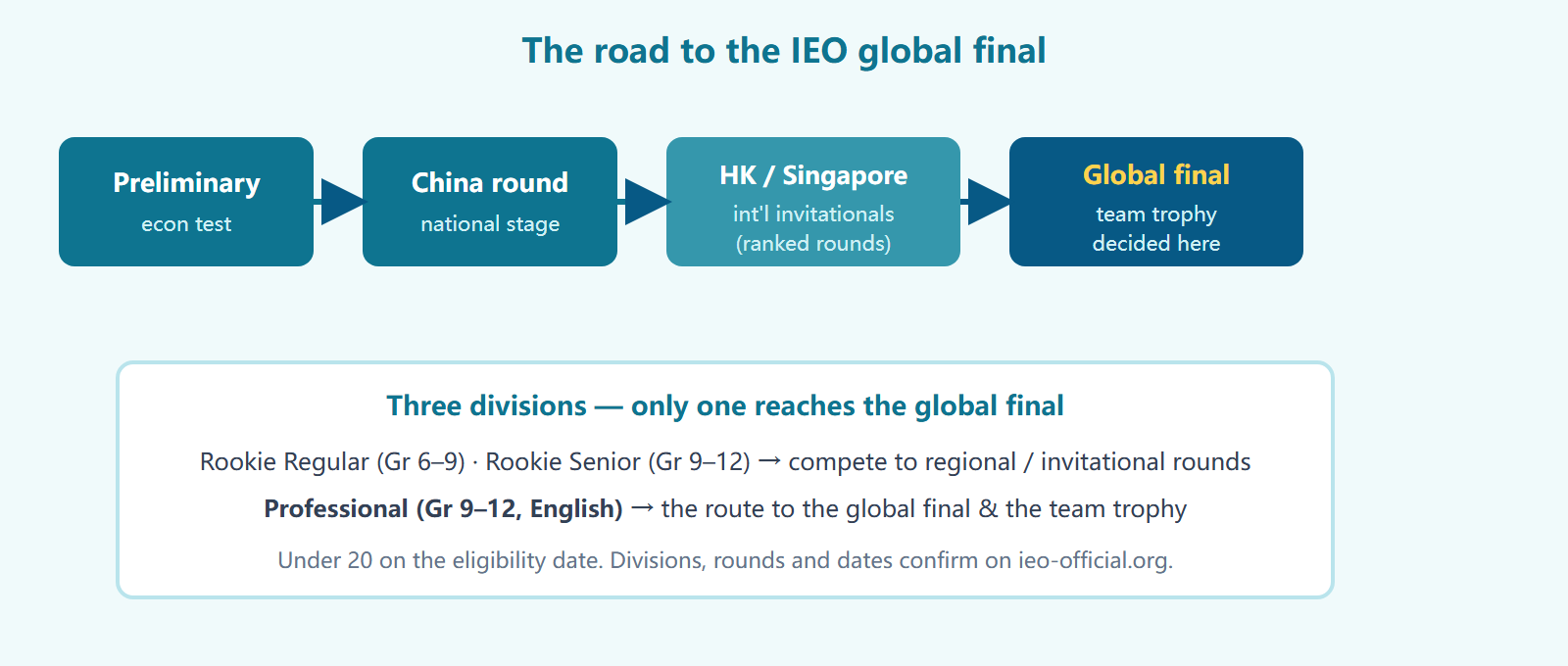
The Professional division (grades 9–12, English) is the one that carries a team to the global final; the Rookie divisions compete strongly through the Hong Kong and Singapore invitationals, which are ranked international rounds in their own right. All entrants must be under 20 on the eligibility date.
What a top-two team result actually signals
Read honestly: a global team placing is a strong, verifiable signal for economics, business and PPE-type applications — but it is a signal, not a guarantee of anything. What makes it valuable is that it is hard to fake and easy to check: the team standings sit on the official site, and the result rewards a full skill set (analysis under a written exam plus a defended business case) rather than one narrow test. The IEO was founded in 2017 with the backing of Nobel laureate Eric Maskin, which is part of why the name carries weight on an application — but the substance a student can write about (how the team scoped the case, where the argument turned) matters far more than the medal itself.
Frequently asked questions
Who won the 2026 IEO team final?
The two top-scoring teams were reported as China-2 (120.94, gold/1st) and China-1 (118.77, silver/2nd), with Canada third (117.92). Confirm the official standings on ieo-official.org/results.
How is the IEO team total calculated?
It combines an individual Economics & Finance component with a team Business Case component. In 2026 the Business Case decided the top order — the leading team won that component.
Which division reaches the global final?
The Professional division (grades 9–12, English). The Rookie divisions compete through regional and international invitational rounds such as Hong Kong and Singapore.
Does an IEO result help university applications?
It is a strong, verifiable academic signal for economics/business/PPE routes — but a signal, not a guarantee. What you can write about the reasoning matters more than the medal.
Next steps
- How the IEO awards work — the medal bands and what each level means
- The competition format — the three assessed parts, and how teams reach the global final
- Preparation resources — where to start if you are aiming at the next cycle
This is an independent guide to the International Economics Olympiad for Greater China students, operated by Hanlin Education. It is not affiliated with, endorsed by, or the official site of the International Economics Olympiad Association (ieo-official.org). Results, scores, division definitions and dates are set by the organiser and must be confirmed on the official channels; student achievements are Hanlin data, de-identified, and results vary and are not guaranteed. Confirmed errors are corrected within 7 working days.