Why the IEO Tests Both Simple and Compound Interest
The International Economics Olympiad (IEO) includes financial literacy as a core pillar alongside economics and business case analysis. In the Senior Division and Junior-HL, candidates encounter problems that require calculating returns under different interest regimes. The distinction between simple interest and compound interest is not merely definitional: it determines which formula applies and, in multi-period scenarios, can alter the final amount by substantial margins.
According to an analysis of IEO preparation needs published by Hanlin Course (WeChat article, October 4, 2026), IEO’s financial literacy component specifically tests “ROI, compound interest, and basic accounting knowledge”—areas that standard AP, IB, or A-Level economics courses may not fully cover. This gap makes targeted practice essential.
This article works through a concrete practice case, verifies every calculation, and shows where a superficially similar problem collapses under the wrong method.
The Core Formulas: Verified and Stated Explicitly
Before touching any numbers, state the two formulas exactly as they appear in standard financial mathematics:
- Simple Interest: A = P(1 + rt)
- Compound Interest: A = P(1 + r/n)^(nt)
Where A = final amount, P = principal, r = annual interest rate (decimal), t = time in years, and n = compounding frequency per year. For annual compounding, n = 1 and the formula simplifies to A = P(1 + r)^t.
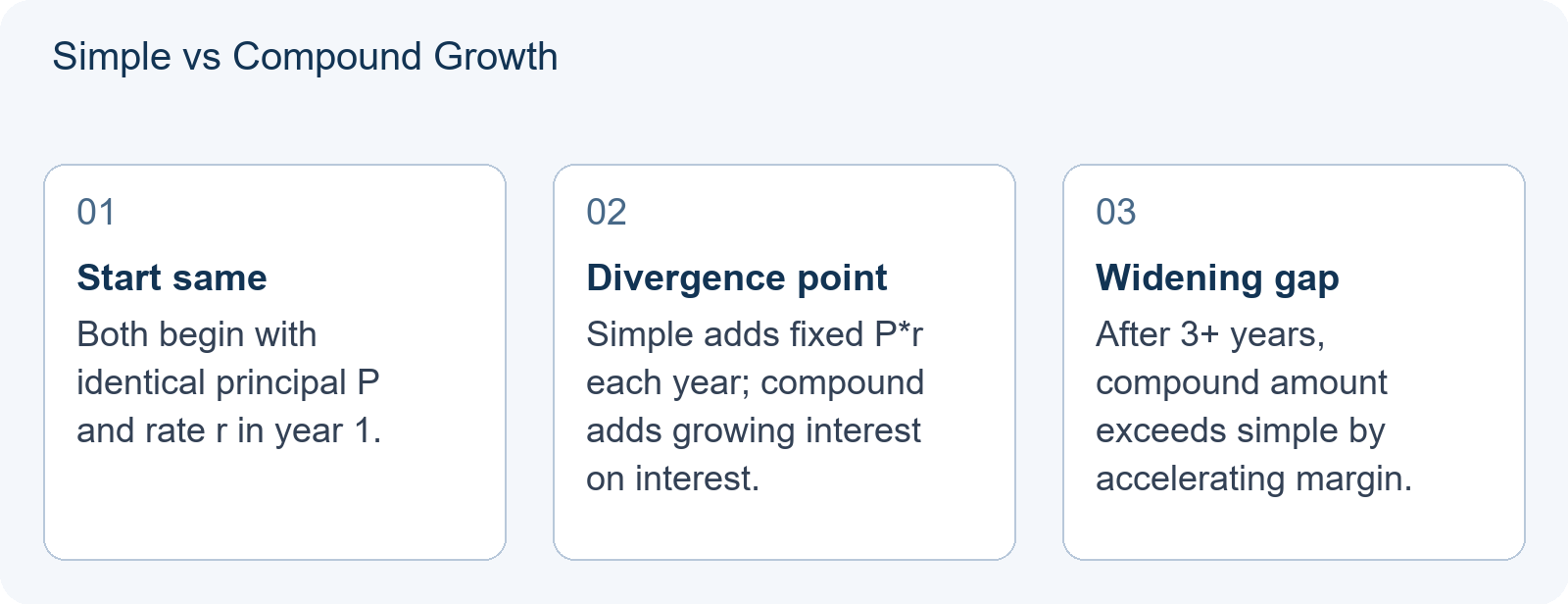
These formulas are not interchangeable. Simple interest applies the same absolute interest amount each period; compound interest applies interest to accumulated interest, creating exponential growth. The IEO does not always signal which to use—the candidate must infer from wording such as “compounded annually” or “simple interest rate.”
Worked Case: The Three-Year Deposit
Problem: An investor deposits $10,000 at an annual rate of 6%. What is the value after 3 years if (a) simple interest applies, and (b) interest compounds annually?
Part (a): Simple Interest
A = 10,000 × (1 + 0.06 × 3) = 10,000 × 1.18 = $11,800
Verification: Annual interest = 10,000 × 0.06 = $600. Over 3 years: 600 × 3 = $1,800. Principal + interest = 10,000 + 1,800 = $11,800. ✓
Part (b): Compound Interest (Annual Compounding)
A = 10,000 × (1.06)^3 = 10,000 × 1.191016 = $11,910.16
Verification by year-by-year expansion:
- Year 1: 10,000 × 1.06 = 10,600.00
- Year 2: 10,600 × 1.06 = 11,236.00
- Year 3: 11,236 × 1.06 = 11,910.16 ✓
Difference: $11,910.16 − $11,800.00 = $110.16. The compound interest yield exceeds simple interest by approximately 1.1% of the principal. This gap widens with longer horizons or higher rates.
Contrasting Case: Where the Wrong Method Fails
Problem: A student loan of $5,000 accrues interest at 8% per annum, compounded semiannually. What is owed after 2 years? A quick solver applies simple interest: 5,000 × (1 + 0.08 × 2) = $5,800. This is incorrect and substantially underestimates the debt.
Correct compound calculation:
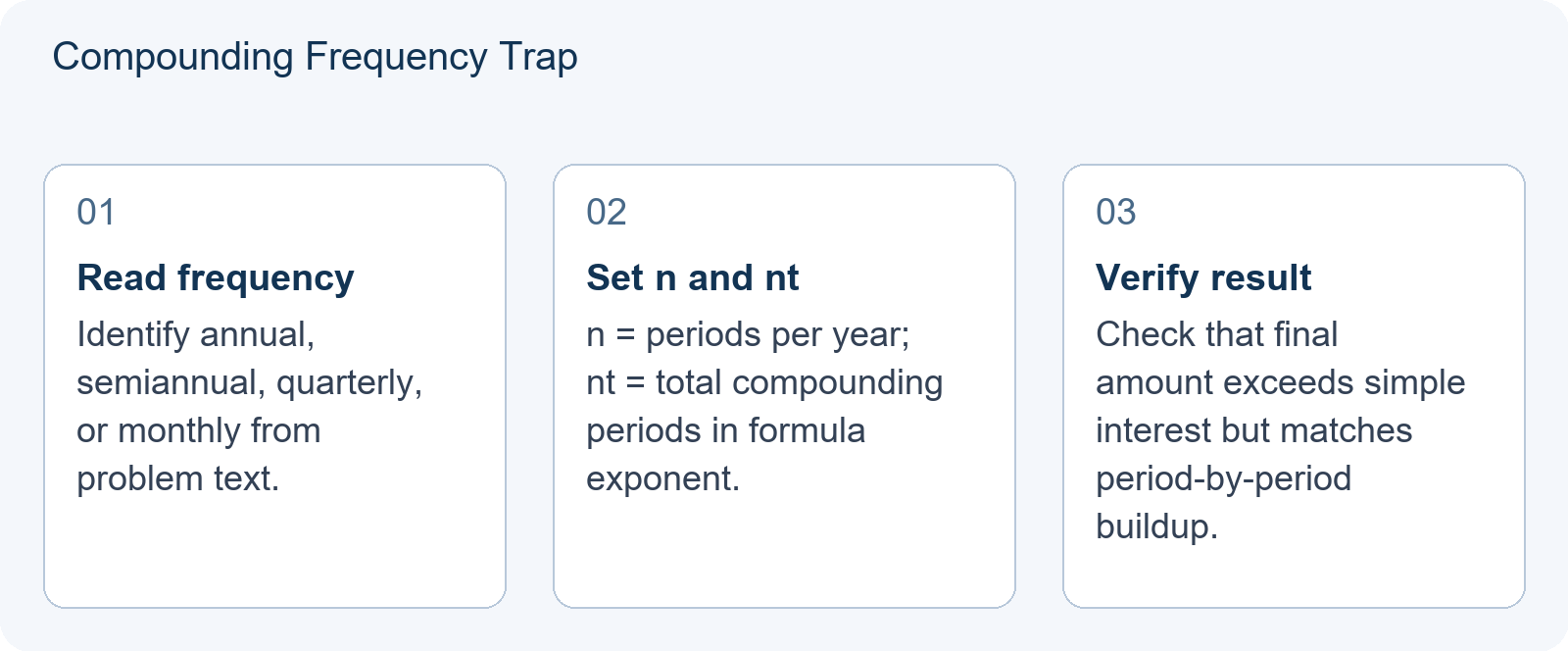
n = 2 (semiannual), r = 0.08, t = 2, so nt = 4 periods.
A = 5,000 × (1 + 0.08/2)^(2×2) = 5,000 × (1.04)^4
1.04^2 = 1.0816; 1.0816^2 = 1.16985856
A = 5,000 × 1.16985856 = $5,849.29
Verification by period:
- Period 1 (6 months): 5,000 × 1.04 = 5,200.00
- Period 2 (12 months): 5,200 × 1.04 = 5,408.00
- Period 3 (18 months): 5,408 × 1.04 = 5,624.32
- Period 4 (24 months): 5,624.32 × 1.04 = 5,849.29 ✓
The simple-interest shortcut understates by $49.29—nearly 1% of principal. In competition settings, misidentifying the interest regime often results in losing credit for that entire calculation, even when arithmetic is otherwise correct.
Teaching Illustration: The “Doubling Time” Approximation
[Teaching Illustration — not an official IEO problem]
A common classroom illustration asks: “At 10% annual compound interest, how many years to double your money?” The Rule of 72 gives 72/10 = 7.2 years. Exact calculation: ln(2)/ln(1.10) = 0.6931/0.0953 = 7.27 years. The rule is pedagogically useful but imprecise. The IEO may test whether candidates recognize that rules of thumb are approximations, not substitutes for exact computation.
Contrast with simple interest at 10%: doubling requires A = 2P = P(1 + 0.10t), so t = 10 years exactly. The compound method achieves the same goal in roughly 70% of the time. This illustrates why compounding accelerates returns—and why the IEO tests it.
Important clarification: The 7.27 figure is a smooth interpolation approximation. In a real account with annual crediting, the balance first reaches 2P at year 8, not year 7.27. Fractional-year solutions are only mathematical conveniences, not credited balances.
Diagnostic Application: Test Your Recognition
Problem: A hypothetical savings account pays 4% per year, compounded quarterly. Principal $2,500. Term: 18 months. Calculate the maturity value. Assume no fees, taxes, deposits, or withdrawals.
Common error: Using t = 1.5, n = 4, but computing (1 + 0.04/4)^(1.5) instead of (1 + 0.04/4)^(1.5 × 4) = (1.01)^6. The exponent must use total compounding periods, not years.
Correct solution:
A = 2,500 × (1 + 0.04/4)^(4 × 1.5) = 2,500 × (1.01)^6
1.01^6 = 1.061520150601 (verified: 1.01^2 = 1.0201; 1.0201^3 = 1.061520150601)
A = 2,500 × 1.061520150601 = $2,653.80 (rounded to two decimal places)
Verification: 2,500 × 0.01 = $25 per quarter. Six quarters of simple interest would yield 2,500 + 150 = $2,650. Compound adds $3.80 in interest-on-interest. Small here, but the principle governs all compound calculations.
What This Means for Your Next Preparation Step
If you correctly distinguished the formulas and computed both cases above, your next task is speed under time pressure. IEO financial literacy problems often nest interest calculations within larger scenarios—calculating net present value, comparing investment alternatives, or evaluating loan structures. Practice extracting the compounding frequency from problem wording: “annual,” “semiannual,” “quarterly,” or “monthly” each dictates a different n.
If you hesitated between simple and compound interest, or made an exponent error, your feedback target is pattern recognition. Create a personal checklist: (1) identify the interest regime from keywords, (2) assign n before touching the calculator, (3) verify the exponent equals total periods. The The Maths You Actually Need for the IEO: Eight Calculation Families and the Five Errors That Cost Most Marks article covers additional calculation families that frequently accompany interest problems.
For students building from school economics toward competition depth, the gap between classroom coverage and IEO financial literacy is documented. The Hanlin analysis (October 4, 2026) notes that standard curricula lack “financial literacy” components, making self-study or structured preparation necessary for IEO candidates.
Related Preparation Paths
The IEO’s financial literacy strand connects to broader competition skills. For the business case round, understanding how interest costs affect unit economics is essential; see IEO Business Case Unit Economics: Testing Whether Growth Improves the Business for how financing costs enter profitability analysis. For candidates weighing competition choices, the IEO OpenTrack: Is This the Right Starting Route for Your Preparation? article offers an alternative entry path with different preparation implications.
Students without school economics coursework can still reach IEO financial literacy competence; the IEO Preparation for STEM Students: Starting Without School Economics article outlines a starting framework. The key is not prior coursework but systematic practice with verified calculations—exactly the kind this article has demonstrated.
Summary: Key Takeaways for IEO Financial Literacy
- Simple interest: linear growth, same absolute amount each period. Formula: A = P(1 + rt).
- Compound interest: exponential growth, interest earns interest. Formula: A = P(1 + r/n)^(nt).
- The IEO does not always label which applies; read for compounding frequency keywords.
- Semiannual and quarterly compounding are common traps; compute total periods (nt) carefully.
- Even small rate differences compound meaningfully over multi-year horizons.
Interpreting the Gap: Why $110.16 Matters in a Competition Context
The difference between simple and compound interest calculated earlier—$110.16 on a $10,000 principal over three years at 6%—is not merely an arithmetic curiosity. In IEO financial literacy problems, this gap represents the cost of misidentifying the interest regime. If a candidate applies the simple interest formula to a problem explicitly stating “compounded annually,” they understate the final amount by exactly that margin. Conversely, applying compound logic to a simple interest scenario overstates it.
Consider the diagnostic implication: The error magnitude scales with time and rate. At 6% for 3 years, the relative error is ~0.9%. At 8% for 5 years, the divergence grows significantly larger. For example, $10,000 at 8% simple interest yields $14,000 after 5 years ($10,000 × (1 + 0.08×5)). Compounded annually, it yields $14,693.28 ($10,000 × 1.08^5). The gap widens to $693.28. This demonstrates why precise keyword recognition is non-negotiable; the numerical consequence of a methodological error becomes material as horizons extend.
Diagnostic Check: Identifying the Regime from Wording
[Teaching Illustration — hypothetical problem statement]
Read the following two statements carefully. Which requires the compound interest formula?
- “A bank account pays 5% per annum, credited quarterly.”
- “A loan accrues interest at 5% per annum, calculated on the original principal only.”
Answer: Statement 1 requires compound interest because “credited quarterly” implies reinvestment of interest within the year, altering the effective annual yield. Statement 2 describes simple interest because “calculated on the original principal only” explicitly excludes interest-on-interest accumulation.
In IEO contexts, wording like “effective annual rate” or “nominal rate compounded monthly” signals compound calculations. Phrases like “flat rate” or “simple interest” signal linear growth. Ambiguity is rare in well-constructed competition problems; if the term “compound” is absent but frequency of crediting is specified, assume compounding unless stated otherwise.
Next Practice Task: Multi-Period Comparison
To solidify pattern recognition, perform this calculation without looking at formulas first. Identify the regime, then compute.
Task: Compare the final value of $2,000 invested for 4 years at 7% annual interest under two scenarios:
- Scenario A: Simple interest.
- Scenario B: Compound interest, annually.
Verification Steps:
- Scenario A: Interest = Principal × Rate × Time = 2,000 × 0.07 × 4 = $560. Total = $2,560.
- Scenario B: Amount = Principal × (1 + Rate)^Time = 2,000 × (1.07)^4.
- Calculate 1.07^2 = 1.1449.
- Calculate 1.1449^2 ≈ 1.310796.
- Total = 2,000 × 1.310796 ≈ $2,621.59.
Difference: $2,621.59 − $2,560.00 = $61.59.
This exercise reinforces that even moderate rates produce measurable gaps over multi-year periods. When practicing, always check if the problem specifies “compounded [frequency]” or “simple interest.” If neither is specified, look for context clues: savings accounts typically compound; short-term consumer loans may use simple interest structures depending on jurisdiction and product type, though competition problems usually clarify this explicitly.
Frequently Asked Questions
Does the IEO provide the interest formulas during the exam?
Preparation guides suggest treating simple and compound interest formulas as essential knowledge. In competition practice, selecting the correct formula and applying it accurately is typically expected without external reference.
Can I use the Rule of 72 for quick estimates in IEO problems?
The Rule of 72 is a useful teaching illustration for mental estimation, but it produces approximate answers. IEO problems requiring numerical answers expect exact computation. Use the rule to sanity-check, not to substitute for precise calculation. Note that the exact doubling time at 10% is about 7.27 years by interpolation, but a real account with annual crediting reaches double at year 8.
Where does financial literacy fit within the overall IEO competition structure?
Financial literacy is assessed as a distinct pillar alongside economics and business case analysis, particularly in the Senior Division and Junior-HL. It appears across multiple formats including the Finance & Economics Paper, open-response calculations, and integrated business case financial modeling. Preparation should build dedicated financial literacy skills while connecting them to broader economics knowledge.