Students with strong science and mathematics backgrounds often assume economics competitions require starting from zero. In practice, many skills transfer directly: graph reading, algebraic manipulation, and logical deduction all appear in IEO preparation. The gap is not typically raw ability but familiarity with economic vocabulary and the specific way questions frame trade-offs.
Separate Mathematical Fluency From Economic Explanation
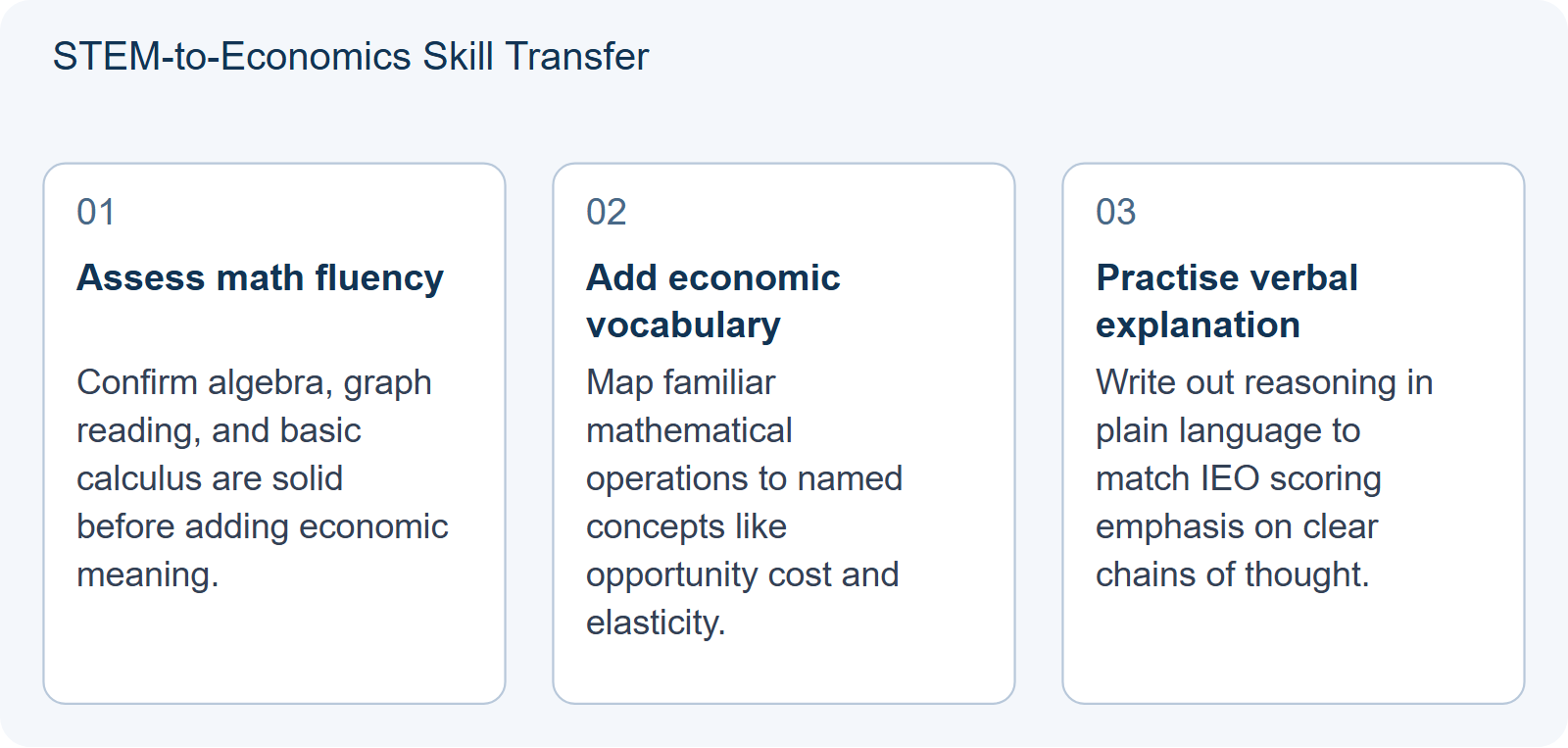
A STEM student may solve a production possibility curve problem numerically yet lose marks by failing to explain why the curve bows outward. IEO preparation demands both calculation and interpretation. The same student who computes opportunity cost correctly might struggle to articulate that increasing opportunity costs arise from resource specialisation.
Consider this distinction:
| Mathematical skill | Economic application in IEO | Common STEM gap |
|---|---|---|
| Reading slopes and intercepts | Supply and demand shifts | Confusing movement along curve with shift of curve |
| Optimisation (derivatives) | Profit maximisation, cost minimisation | Ignoring constraints or institutional context |
| Probability and statistics | Expected value in decision-making | Overlooking behavioural or information assumptions |
| Algebraic rearrangement | National income accounting (Y = C + I + G + NX) | Missing causal narrative behind the identity |
The IEO syllabus tests microeconomics, macroeconomics, and international economics, with a business case component in later rounds. STEM students often find the quantitative sections immediately accessible but discover that microeconomics fundamentals require practising verbal explanation of what the numbers mean.
Why calculation alone scores poorly
IEO questions frequently present a correct numerical answer alongside an incorrect economic interpretation. A student might calculate that GDP rises after a government spending increase yet fail to recognise crowding-out effects in the long run. The scoring rewards the chain of reasoning, not the final number.
Use a Small Reading-and-Explanation Diagnostic
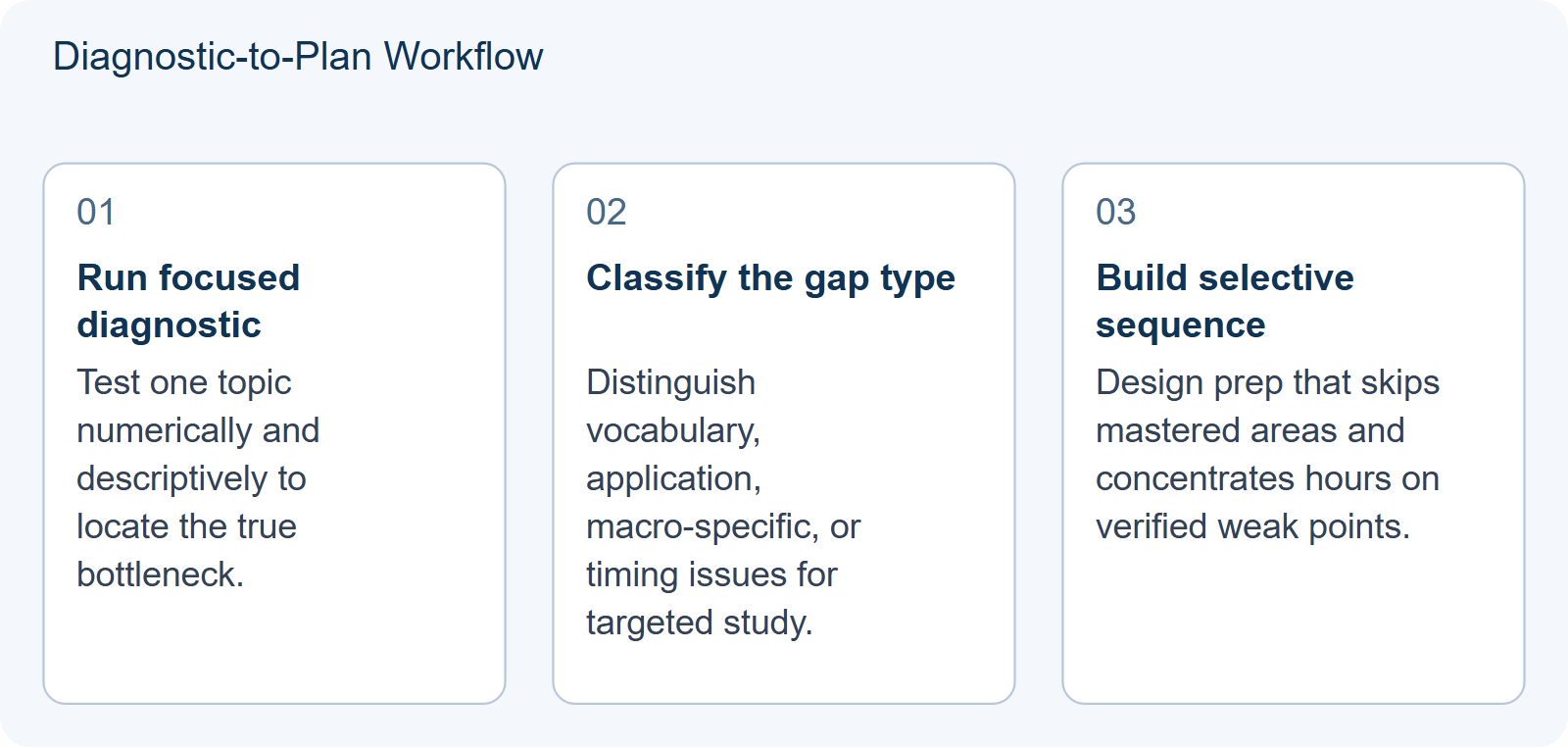
Before committing to a full course, STEM students benefit from a focused diagnostic that isolates whether the bottleneck is concept, vocabulary, or application. A suggested self-assessment:
- Select one foundational topic—opportunity cost, comparative advantage, or market equilibrium
- Solve three numerical problems correctly
- Explain the solution in writing without using formulas, as if to a peer with no economics background
- Identify where the explanation breaks down
This mirrors the IEO’s own emphasis on clear communication. The IEO syllabus and structure rewards students who can translate technical analysis into accessible reasoning.
Sample diagnostic framing
A hypothetical student solves a comparative advantage problem numerically: Country X gives up 1/5 banana per steel; Country Y gives up 1/3 banana per steel. The calculation shows Country X has comparative advantage in steel. The diagnostic question: explain why total output rises if both countries specialise, without referencing the fractions. If the student cannot articulate that each country reallocates resources toward what it sacrifices least to produce, the gap is explanatory, not mathematical.
Connect Concepts to Real Scenarios Without Investment Advice
STEM students often engage more deeply when abstract models link to observable events. The IEO business case round explicitly tests this translation. Suggested practice: read a news article about a policy change, identify the economic model it implies, and sketch the predicted effects.
For example, a central bank raising interest rates connects to:
- Monetary policy transmission (macroeconomics)
- Exchange rate movements if capital flows respond (international economics)
- Firm investment decisions under higher borrowing costs (microeconomics)
This triangulation builds the flexible reasoning the IEO tests across its multiple rounds. It also helps STEM students see economics as a modelling discipline analogous to physics—simplifying assumptions, deriving predictions, testing against evidence—rather than as a memorisation subject.
Avoiding common overreach
Real-scenario practice should not drift into predicting markets or recommending specific financial actions. The IEO tests understanding of mechanisms, not investment acumen. Keep practice focused on explaining mechanisms: what happens to aggregate demand when government spending rises, holding other factors constant, rather than whether a particular asset will appreciate.
Choose Targeted Support Rather Than Restarting All Study
STEM students without school economics sometimes enrol in comprehensive introductory courses that repeat what they already know. A more efficient path identifies specific deficit areas:
| If your diagnostic shows… | Targeted focus |
|---|---|
| Strong math, weak vocabulary | Economic terminology in context; reading past IEO questions for phrasing patterns |
| Strong theory, weak application | Case-study practice; timed writing of short explanations |
| Strong micro, weak macro | National income accounting, monetary/fiscal policy, open-economy models |
| Strong all sections, weak time management | Full timed past papers under competition conditions |
This selective approach respects the STEM student’s existing strengths. Someone fluent in calculus does not need to relearn slope calculation; they need to learn what economic agents the slope represents and why its direction matters for welfare analysis.
When structured support helps
Some STEM students self-study successfully. Others find that feedback on written explanations—particularly why an answer lost marks despite correct mathematics—accelerates progress. The decision depends on honest diagnostic results and available time before the competition round.
Prepare a Starting Profile for Course Planning
Before engaging any preparation service or self-study plan, STEM students should assemble a brief profile:
- Mathematics level: What courses completed? Calculus? Statistics?
- Economics exposure: Any coursework, extracurricular reading, or informal interest?
- Diagnostic result: Which of the four gap types above best describes your situation?
- Competition timeline: When is the target IEO round? How many hours weekly available?
- Output sample: One written explanation of a solved problem, for feedback on reasoning clarity
This profile enables any instructor or mentor to propose a sequence that builds on existing strengths rather than assuming uniform starting points. It also helps the student themselves recognise progress: vocabulary that was opaque becomes familiar; explanations that were fragmented become coherent.
Aligning preparation with IEO round structure
The IEO progresses from multiple-choice and short-answer questions toward deeper case analysis. Early preparation for STEM students should emphasise the transition from “calculate correctly” to “explain convincingly.” Later stages add teamwork and presentation elements where the same communication skills become decisive.
Frequently Asked Questions
Do I need to take a school economics course before IEO preparation?
No. Many STEM students succeed without formal economics coursework by transferring mathematical skills and adding economic vocabulary through targeted reading and practice. The key gap is typically explaining concepts in words, not lack of prior classes.
How can I tell if my mathematics background is sufficient for IEO?
If you are comfortable with algebra, reading graphs, and basic functions, your mathematics is likely sufficient. IEO questions rarely require advanced calculus. The challenge is applying these tools to economic contexts and interpreting results correctly.
What is the biggest mistake STEM students make when starting IEO preparation?
Treating economics as pure calculation and neglecting written explanation. IEO scoring rewards reasoning chains. A correct number with poor explanation earns fewer marks than a well-explained answer with a minor arithmetic slip.