Students searching for an IEO syllabus often find a long list of economic concepts—supply and demand, market structures, fiscal policy—and assume that mastering those definitions is sufficient preparation. But the International Economics Olympiad does not test knowledge in a vacuum. It tests how you apply that knowledge across different performance formats. A topic such as externalities requires a different output when you answer a multiple-choice question, when you write an open-question policy evaluation, and when you defend a business recommendation.
This guide is independent. It does not claim official syllabus access, and it does not replace official competition documents. The operator material supplied for this guide describes IEO China as covering economics, business and finance, including microeconomics, macroeconomics, international economics, business case work, finance and personal finance. That breadth is real, but it is not a study sequence. The practical question is not only “Which topics are in the syllabus?” but “What does this topic look like when the round changes?”
Why a Flat Topic List Fails as a Study Plan
A flat list treats every item as if it demanded the same skill. In reality, preparation improves when you separate three outputs:
- MCQ recall and precision: recognising definitions, model conditions, and single-step calculations quickly.
- Open Question production: explaining mechanisms in writing, using graphs correctly, and evaluating policy trade-offs.
- Business Case judgement: turning economic concepts into assumptions, trade-offs, and recommendation support.
The format labels used in this article—MCQ, Open Questions, Business Case—are preparation lenses. They help students avoid the common mistake of memorising every definition with equal intensity and then discovering that a written answer or a case defence requires a different kind of fluency.
MCQ Demand: Recall, Definition and Single-Step Calculation
In MCQ practice, a syllabus topic usually appears as a definition, a standard condition, or a short calculation. If the topic is market structures, the question may ask which characteristic distinguishes perfect competition from monopoly. It is unlikely to ask for a nuanced critique of why a particular market failed to match the textbook model. If the topic is inflation, the question may ask about headline versus core inflation, or ask you to apply a simple index-number relationship. These are retrieval tasks, not essay tasks.
This is why strong students sometimes lose marks in the MCQ round. They understand the concept loosely, but they have not trained exact recall. A definition with one missing condition becomes a wrong answer. A calculation with one sign error becomes a wrong answer. The remedy is not more reading; it is precision practice. Build flashcards for exact definitions. Practise short calculations under time pressure. Keep a log of careless errors and formula slips.
For calculation-heavy topics, the goal is to recognise the family of operation quickly. A tax, a subsidy, a multiplier, a cross-rate, a growth rate, and a break-even point may all look like “maths,” but they demand different setup steps. If you want a structured way to review those families, see our guide to The Maths You Actually Need for the IEO: Eight Calculation Families and the Five Errors That Cost Most Marks. The point is not to become a calculator; it is to stop wasting time on setup when the MCQ clock is running.
Open Question Demand: Multi-Step Explanation and Policy Evaluation
In Open Question practice, the same syllabus topic becomes a written argument. You must define the mechanism, connect steps, use a diagram if required, and reach a supported judgement. If the topic is market structures, a prompt may ask you to analyse how a merger affects consumer surplus, producer surplus, and total welfare. If the topic is international trade, a prompt may ask you to evaluate how a tariff affects domestic producers, consumers, government revenue, and efficiency.
The mark-earning behaviour here is different from MCQ behaviour. You are not just selecting the correct statement. You are showing the chain of reasoning. That means your answer needs clear sequencing: assumptions first, mechanism second, diagram third, evaluation fourth. A graph must be labelled correctly, and the written text must refer to the graph accurately. Vague phrases such as “the curve moves” are dangerous because they do not distinguish a shift from a movement along the curve.
Open Question preparation therefore combines writing drills and graph drills. Practise turning a one-line definition into a full paragraph. Practise explaining a policy effect without skipping the intermediate step. Practise drawing the diagram before writing, so that the written answer follows the visual logic. Our article on IEO Economics Graphs: Separating a Curve Shift From Movement Along It is useful for this because graph language is one of the fastest places to lose marks even when the underlying economics is correct.
Business Case Demand: Assumptions, Trade-offs and Recommendation Support
The Business Case demands something different again. Here, economic theory is not the final answer; it is a toolkit for making a business recommendation defensible. Elasticity is no longer only a definition. It becomes an assumption about how customers respond to price changes. Market structure is no longer only a classification. It becomes a judgement about entry barriers, pricing power, and long-run profitability. Externalities are no longer only a diagram. They become a reason to invest in cleaner technology, accept regulation, or price differently.
The case round rewards realistic assumptions, acknowledged trade-offs, and a recommendation that follows from the evidence you present. A team can use correct economics and still give a weak case if the assumptions are unrealistic or if the recommendation ignores operational constraints. A simpler but coherent case can be stronger than a complex but disjointed one when the logic and trade-offs are clear.
Preparation should therefore include unit economics, break-even thinking, market sizing, and assumption testing. Do not simply memorise formulas. Ask what each number assumes about customer behaviour, costs, competition, and time horizon. For a fuller treatment of these tools, see our guide to The Business Toolkit for the IEO Case Round: Unit Economics, Break-Even and Sizing a Market. The strongest case preparation turns every economics concept into a question: what would have to be true for this recommendation to work?
Labelled Teaching Illustration: One Topic Across All Three Rounds
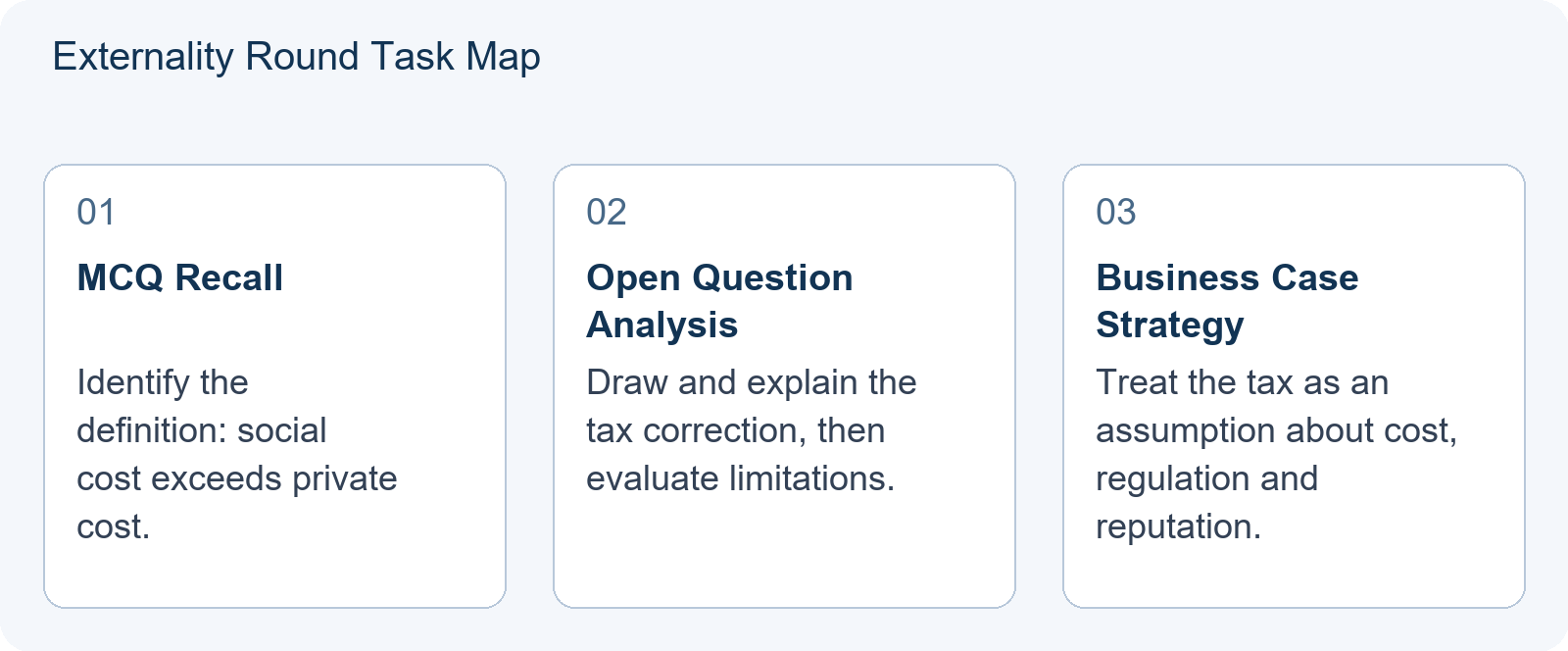
To make the format shift concrete, consider one common syllabus topic: externalities. This is a hypothetical teaching illustration, not an official past-paper question and not a scoring rubric.
- MCQ demand: Recognise the definition. A negative externality exists when social cost exceeds private cost. The task is fast recognition and accurate recall. You do not need to write a policy evaluation.
- Open Question demand: Evaluate a Pigouvian tax as a correction for a negative externality. You need a diagram showing marginal private cost, marginal social cost, and the tax wedge. You need to explain how the tax changes output, discuss limitations such as information problems or administrative cost, and reach a qualified judgement.
- Business Case demand: A manufacturing firm faces an environmental tax. The team must decide whether to invest in cleaner technology or pay the tax. The externality concept becomes an assumption about future costs, regulatory pressure, and reputational risk. The recommendation must weigh short-run cost against long-run strategic position.
One topic, three very different outputs. Studying only the definition prepares you for the first demand. Studying only the policy diagram prepares you for the second. Studying only the strategic argument prepares you for the third. A round-aware syllabus map forces you to practise all three.
Practical Diagnostic: Map Three Topics to Round Tasks
Families can run a simple diagnostic at home. Choose three topics the student has recently studied. For each, write down what a round-specific task would require. This is not an official weighting exercise; it is a preparation diagnostic.
| Topic | Likely MCQ Task | Likely Open Question Task | Likely Business Case Task |
|---|---|---|---|
| Monopoly pricing | Identify the profit-maximising condition. | Analyse welfare loss from market power using a diagram. | Assume a firm has pricing power; decide whether to lower price to deter entry. |
| Exchange rates | Calculate a cross-rate from two quoted pairs. | Evaluate how a depreciation affects export competitiveness and inflation. | Assume currency volatility; recommend a hedging posture for an importer. |
| Public goods | Define non-excludability and non-rivalry. | Explain the free-rider problem and compare provision solutions. | Assume a public-private partnership; argue for a provision level and funding model. |
If the student cannot generate these tasks, the topic may have been studied passively. Active mapping is the first step from recognition to performance.
Misconception: Treating Every Syllabus Item as Equally Weighted
A major error is assuming that all topics matter equally in all rounds. Some topics are high-yield for MCQ recall but rarely become the centre of a Business Case. Other topics are highly relevant to case strategy but appear in MCQs only as simple definitions. Equal study time across every topic is not automatically rigorous; it can be inefficient.
For example, memorising a multiplier formula is useful for calculation questions. Understanding how fiscal policy affects business confidence is more useful for a case recommendation. Both are economics. They are not the same preparation task. The student who recognises this can allocate time according to the output demanded, not just according to the topic name.
Building a Round-Aware Weekly Study Block
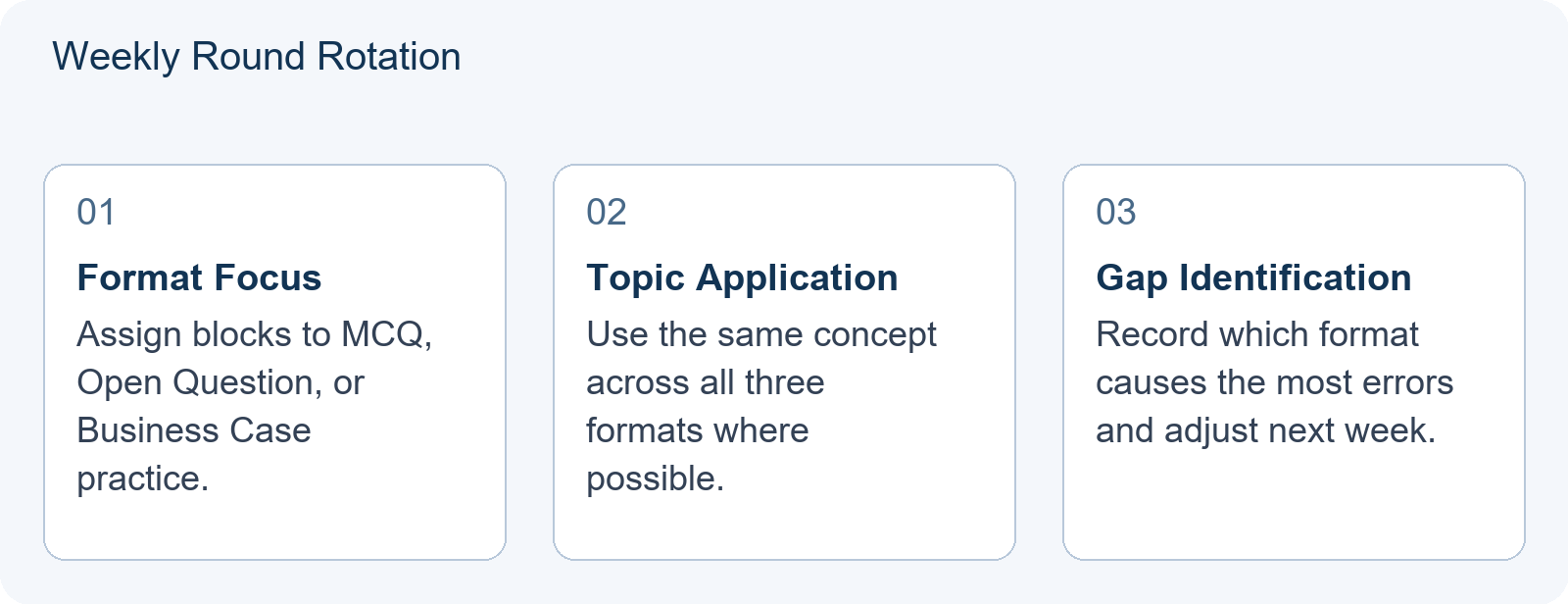
A practical weekly block can be organised by format rather than only by topic. Instead of writing “study microeconomics,” write “practise ten MCQs on market structures, write one Open Question response on elasticity, and outline one Business Case assumption about competition.”
This rotation builds versatility. It also reveals gaps quickly. If a student can define a concept but cannot turn it into a written mechanism, the gap is in Open Question production. If a student can write a strong policy answer but cannot translate the concept into a business assumption, the gap is in case judgement. If a student understands the idea but keeps losing MCQ marks, the gap is precision and speed.
Keep the blocks short and repeated. A round-aware study plan does not need to be elaborate. It needs to force the student to use the same concept in different ways. Over several weeks, that repetition turns a flat syllabus list into a set of usable skills.
Conclusion: From Flat Lists to Strategic Maps
The IEO syllabus is not a checklist that you tick off once. It is a body of economics that must be performed differently in different rounds. MCQ preparation rewards precise recall and clean calculation. Open Question preparation rewards structured explanation, correct graphs, and policy judgement. Business Case preparation rewards realistic assumptions, clear trade-offs, and coherent recommendations.
When students search for an IEO syllabus, they usually want certainty. The useful answer is not a longer list. The useful answer is a map: this topic, trained this way, for this output. Once you can label each topic by the round demand it serves, your study time becomes more targeted, your practice becomes more diagnostic, and your performance across formats becomes more consistent.
Frequently Asked Questions
Does the IEO syllabus change every year?
This guide does not reproduce an official exhaustive syllabus. Treat any topic list as a starting map, and use round-specific practice to decide what to prioritise rather than assuming every item carries equal weight.
Is the Business Case round harder than the Open Questions?
They test different skills. Open Questions require rigorous explanation and graphical precision. The Business Case requires strategic judgement, realistic assumptions, and persuasive communication. A student strong in theory may still need practice in case ambiguity, while a practical thinker may still need depth in written analysis.
How much time should I spend on MCQ preparation?
MCQ practice deserves regular timed blocks because it rewards speed and precision. But do not neglect written and case work. A balanced plan uses MCQ practice to tighten recall, Open Question practice to deepen mechanism, and Business Case practice to test whether concepts can support a decision.