The team business case is the part of the IEO that asks you to decide something. The other two parts we can verify — a 40-question finance and economics multiple-choice paper and five open questions of which four are scored — reward analysis. The case, delivered in English by a team, rewards analysis that lands on a recommendation someone could act on. That needs a different toolkit from the one your economics course gave you, and it is small enough to learn properly.
What a case asks that a problem set does not
We have written elsewhere about how the case round is structured, rehearsed and delivered. This piece is about the substance underneath: what you actually calculate and argue once the material is in front of you. Treat the two as a pair, because a well-rehearsed delivery of an empty analysis is a very visible failure.
The shift from academic economics to business analysis catches most students in the same place. An economics question typically hands you a clean model and asks what follows. A case hands you a messy situation, some of it irrelevant, and asks what a decision-maker should do about it by a particular date, under constraints, with money attached. Three things change:
- You must choose what to ignore. A case contains material that does not bear on the decision. Selecting is part of the work, and a team that analyses everything runs out of time before it recommends anything.
- Every claim needs a number or a stated assumption. “Demand would probably rise” is an economics sentence. “A 10% price cut lifts volume by roughly a fifth on our assumed elasticity, which turns the contribution positive above about four thousand units” is a business sentence.
- There has to be a verdict. A balanced discussion that stops short of a recommendation has not answered the question. This is the single most common structural failure we see in team rehearsals.
Note that we are describing what makes an argument defensible, not what any published rubric awards. The weighting of the parts and the marking criteria are matters for the organisers; confirm current details on ieo-official.org.
Unit economics: the calculation that anchors everything else
If your team learns one piece of machinery, learn this one. Unit economics asks what happens to money on one unit of whatever the business sells, and it is the fastest route from a page of narrative to a defensible number. Price minus variable cost gives contribution per unit. Contribution multiplied by volume, minus fixed costs, gives profit. Almost every recommendation you might make moves one of those four quantities, which makes it a checklist as well as a formula.
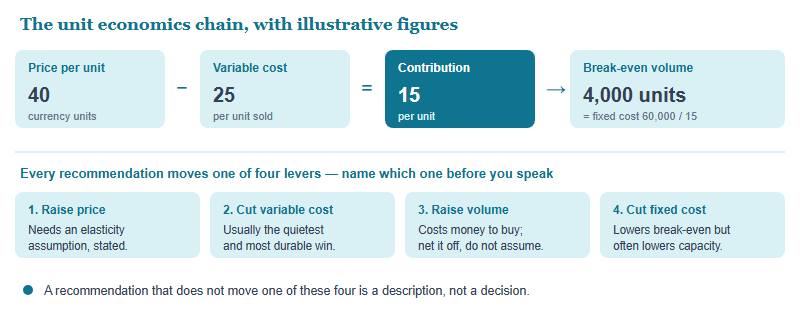
The discipline this imposes is worth more than the arithmetic. When a teammate proposes something during preparation, ask which of the four levers it moves and by how much. Proposals that cannot answer — rebranding, improving the culture, becoming more innovative — are not necessarily wrong, but they are not yet a recommendation, and forcing that question early stops a team spending its preparation window on sentiment.
Cost structure: why the same market supports opposite recommendations
The most common analytical failure in a school case round is treating cost structure as background detail. It is usually the decision. Two firms selling the same product at the same price, with the same total cost at one particular volume, should often do opposite things, because the shape of their costs differs.
The table below sets out an illustrative comparison. Both models sell at 40; both are plausible businesses. Read the last two rows before the first ones.
| Model A: high fixed, low variable | Model B: low fixed, high variable | |
|---|---|---|
| Fixed cost | 120,000 | 40,000 |
| Variable cost per unit | 15 | 30 |
| Contribution per unit (price 40) | 25 | 10 |
| Break-even volume | 4,800 units | 4,000 units |
| Profit at 4,000 units | −20,000 | 0 |
| Profit at 8,000 units | 80,000 | 40,000 |
| Crossover volume | About 5,300 units — below it Model B wins, above it Model A wins | |
| What this implies | Recommend expansion, and defend the demand forecast, because the downside is real | Recommend caution and optionality, and accept a lower ceiling in exchange for survivability |
The crossover row is the analytical move worth practising. Rather than arguing that one option is better, find the volume, price or cost at which the answer flips, then argue about whether the real world sits above or below that point. This converts an argument about opinions into an argument about one number, which is far easier to defend when a panel pushes back. It also gives you a natural sensitivity analysis without producing three scenarios nobody can hold in their head.
Sizing a market when the case gives you almost nothing
Cases routinely ask how big an opportunity is and then withhold the data you would need to answer. This is deliberate, and the expected response is a transparent estimate rather than a confession that the information is missing. Build it two ways.
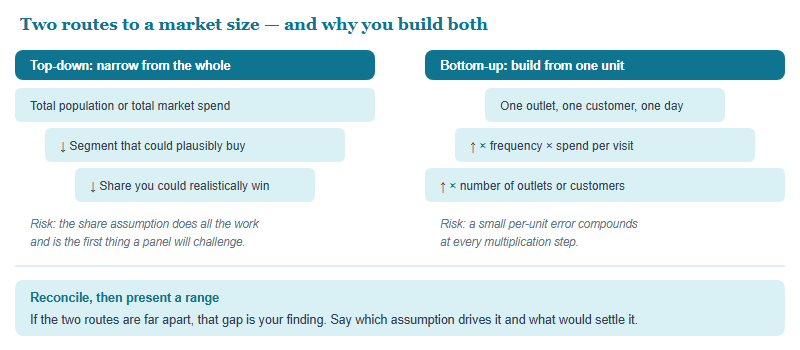
Presenting a range with a named driving assumption is stronger than presenting a single confident number, and it is much stronger than presenting two numbers without saying which you believe. If your top-down estimate is triple your bottom-up estimate, say so, name the assumption responsible, and state what evidence would resolve it. Panels tend to probe exactly there, and a team that has already opened the question is in a far better position than one defending a figure it has not stress-tested.
Bridging back to the economics you already know
None of this replaces your economics. It gives it somewhere to land. The bridges below are the ones that come up most often, and they are worth rehearsing as sentences rather than as concepts, because the case round is spoken.
- Elasticity becomes the pricing argument. Any recommendation to change price is an elasticity claim. State the assumed responsiveness, and check whether contribution rises or falls once volume moves.
- Opportunity cost becomes the do-nothing option. Every case has a status quo, and it deserves to be evaluated rather than dismissed. A team that has priced the do-nothing option argues from a stronger position.
- Sunk cost discipline becomes a recommendation to walk away. Cases often include a costly past investment as bait. Money already spent should not appear in a forward-looking decision, though a team should say plainly that it is excluding it and why.
- Externalities and stakeholders become the objection you pre-empt. A recommendation that is profitable and socially indefensible will be challenged. Naming the affected party before you are asked shows judgement.
- Marginal thinking becomes scale. The right size of a decision — how many stores, how much capacity — is a marginal question, not an all-or-nothing one.
Two failure modes to design against
The first is analysis without a verdict. A team presents a clean market sizing, a cost breakdown, a stakeholder map, and then stops. This usually happens because the analysis was divided among members and nobody owned the conclusion. The fix is structural: assign the recommendation to one person at the start of preparation, and have every other workstream report into it.
The second is sensitivity theatre — three scenarios, each with its own numbers, and no statement about which is likely. This looks rigorous and communicates nothing. The disciplined alternative is the crossover approach above: one recommendation, one number at which it would flip, and one sentence on which side of that number reality probably sits.
Both are preparation problems rather than presentation problems, which is why they belong in the analytical phase of a season plan. In our 12-week preparation plan the case work sits in the final block, and this toolkit is what that block should be practising on. If you are earlier than that and still deciding whether the competition suits your team, start with what the IEO actually is and confirm the current format on ieo-official.org before you build a preparation schedule around it.
Frequently asked questions
Do I need business studies to handle the IEO case round?
No. The toolkit is small — unit economics, cost structure and estimation — and it can be learned in a few weeks of deliberate practice.
How much of the total mark is the case worth?
We do not assert the weighting of the parts. The competition has three published parts; confirm current marking arrangements on ieo-official.org.
What if the case gives no numbers at all?
Estimate transparently. Build top-down and bottom-up, present a range, and name the assumption doing most of the work in your figure.
Is a balanced answer safer than a firm recommendation?
A case is normally built towards a recommendation rather than an open discussion, and that is how we teach it, but what the round formally requires and how it is marked are the organisers’ to state – confirm on ieo-official.org.
This is an independent guide operated by Hanlin Education for China-based international-school students. We are not affiliated with, endorsed by, or sponsored by the International Economics Olympiad Association. Competition rules, dates, eligibility and formats change — confirm current details on ieo-official.org. Factual errors are corrected within 7 working days of notification.