The team business case is the round of the International Economics Olympiad (IEO) where preparation shows most. To win it, run a repeatable method: read the case closely, frame the real problem, analyse it with economics, land on one decisive recommendation, and present and defend it in confident English before the panel of judges. Judges reward clear structure, evidence-based reasoning and a decision — not a data dump.
Where the business case fits in the IEO
The IEO has three parts: an individual Finance & Economics multiple-choice test (40 questions, per the official site), a set of individual open questions (five given, four graded), and a team business case presented in English before a panel of judges. The first two are solo and score your personal knowledge. The business case is the only round where your national team of up to five students works as a unit, and it is the round where rehearsal, role allocation and delivery — things you can genuinely prepare — decide the outcome.
It helps to remember how you got there. You reach the international final by winning your national or regional round, not by applying to the final directly, so by the time a team presents a case it has already earned its place. The IEO was founded in 2018 in Moscow with 13 countries; the 2025 edition in Baku drew 52 countries and territories and 258 participants, and the 2026 host is Shenzhen, China (12–20 July 2026, the ninth IEO). That scale is why a polished, well-drilled case presentation stands out.
One honest caveat up front: we describe what the business case rewards and how to deliver it, not the exact mark split. The business case is clearly a major team round worth a substantial share of the marks, but the IEO does not publish a fixed percentage you can drill against — so treat it as high-stakes and confirm the current weighting and format on ieo-official.org (and our What Is the IEO guide if you are new to the structure). Do not trust any specific percentage you see quoted second-hand.
What judges actually reward
Across case competitions of this kind, panels consistently reward four things. If your preparation targets these directly, you are preparing for the parts you can control:
| What judges reward | What it looks like on stage | How to prepare for it |
|---|---|---|
| Clear structure | A logical spine: problem → analysis → recommendation → risks | Fix a slide/section template you reuse every time |
| Evidence-based analysis | Claims backed by the case's own numbers and a named economic model | Practise pulling data from a case and tying it to a framework |
| A decisive recommendation | One clear course of action, owned and justified — not three options | Force yourselves to choose and defend a single answer in rehearsal |
| Confident English delivery | Clear speech, eye contact, calm handling of judges' questions | Rehearse aloud and time it; run a mock Q&A under pressure |
Notice what is not on that list: the most facts, the fanciest slides, or the longest talk. A team that states the problem plainly, works one model through with the case's data, and commits to a recommendation will out-score a team that recites everything it knows. Judges are listening for judgement.
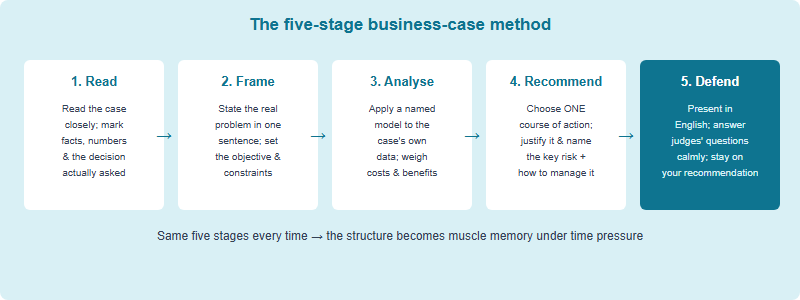
The repeatable method, stage by stage
The value of a fixed method is that it removes decisions on the day. Under a time limit and the eyes of a panel, you do not want to be inventing an approach — you want to be executing one you have run a dozen times. Here is each stage in practice.
- Read the case. Read once for the story, then again with a highlighter. Separate the facts (numbers, constraints, dates) from the noise, and pin down the single decision the case is really asking you to make. Most teams that go wrong here answer a question that was never asked.
- Frame the problem. Write the core problem in one sentence, then state the objective and the constraints. “Should Firm X enter Market Y given a fixed budget and an incumbent rival?” is a frame; “analyse Firm X” is not. A sharp frame is half the marks because everything after it inherits the clarity.
- Analyse with economics. This is where the individual syllabus pays off. Pick a named model that fits — supply and demand, elasticity, cost structures, market structures, game theory for a rival's response, or a simple cost–benefit or breakeven calculation — and run it on the case's own figures. Judges want the case's numbers plugged into a framework, not textbook definitions recited.
- Recommend. Commit to one course of action. State it in a single line, give the two or three reasons it wins, name the biggest risk, and say how you would manage that risk. A confident, defensible “we recommend X” beats a hedged “it depends” every time.
- Present and defend. Deliver it in clear English with a logical spine the judges can follow, then handle the Q&A calmly. Expect to be challenged; treat every question as a chance to show the depth behind your slide, and never abandon your recommendation at the first push-back unless the question genuinely exposes a flaw.
If you want to see how the analytical toolkit maps across all three IEO rounds, our syllabus overview shows why the same economics you learn for the solo papers is exactly what powers the case.
Turning five students into one team
The business case is a team event — each country sends a national team of up to five students plus one or two team leaders — so how you organise the group is itself a source of marks. A team that has assigned roles and rehearsed hand-offs looks calm; a team that improvises looks chaotic, however strong its individuals. Assign clear responsibilities early:
| Role | Owns | Prepared in advance by |
|---|---|---|
| Lead analyst | Choosing the framework and the core numbers | Drilling models on past-style cases |
| Recommendation owner | The single decision and its justification | Practising decisive, one-line answers |
| Risk & sensitivity | What could go wrong and the counter-arguments | Pre-listing likely judge questions |
| Lead presenter(s) | Voice, pace and slide flow in English | Timed run-throughs, out loud |
| Q&A anchor | Fielding and routing judges' questions | Mock Q&A under a clock |
Roles can overlap on a five-person team, and everyone should be able to speak to the recommendation. The point is not rigid job titles; it is that no part of the presentation is nobody's responsibility. The most common team failure is a brilliant analysis that nobody has rehearsed saying out loud.
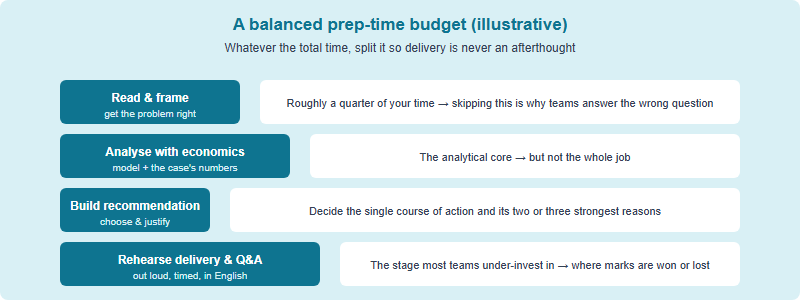
Delivering — and defending — in English
Because the case is presented in English before judges, delivery is a skill in its own right, and for Greater China students it is often the highest-leverage thing to rehearse. Content that is 90% as strong but delivered with clarity and confidence routinely beats content that is stronger on paper but mumbled or over-run. A few habits carry most of the gain:
- Signpost aloud. Say the spine out loud — “First the problem, then our analysis, then our recommendation and its risks.” Judges can only reward a structure they can hear.
- Lead with the recommendation, then support it. A short executive-summary opening tells the panel where you are going, so the analysis lands as evidence rather than suspense.
- Time it ruthlessly. Rehearse to the limit and cut. Running over signals poor prioritisation; finishing clean signals control.
- Prepare the Q&A like a round of its own. Brainstorm the ten questions a sharp judge would ask, and draft crisp answers. “Good question — our sensitivity check shows…” is the sound of a prepared team.
- Stay composed under challenge. If a judge presses, acknowledge, answer, and return to your recommendation. Defending a decision calmly is exactly the judgement the round is testing.
The evidence that this matters is on the podium. At IEO 2025 in Baku, the International Board awarded 133 medals in total (24 gold, 43 silver, 66 bronze), and in the team competition Singapore won gold, Canada took silver, and China and Russia tied for bronze. Those results reward teams that combine real analysis with disciplined, confident delivery — the two halves this method is built to develop. To line up your route to a national round, see the competition page and the regional rounds for Greater China, and remember: you qualify by winning that round, not by applying to the final directly.
Frequently asked questions
How much is the IEO business case worth?
It is a major team round worth a substantial share of the marks, but the IEO publishes no fixed percentage. Confirm the current weighting on ieo-official.org.
Is the business case done as a team?
Yes. Each country sends a national team of up to five students who prepare and present the case in English before a panel of judges.
What do IEO judges reward in the case?
Clear structure, evidence-based analysis using the case's own data, one decisive recommendation, and confident English delivery under questioning.
How do you qualify to present a case at the final?
By winning your national or regional round; you do not apply to the international final directly. The 2026 final is in Shenzhen, 12–20 July.
This is an independent guide to the International Economics Olympiad for Greater China students, operated by Hanlin Education; NOT affiliated with, endorsed by, or the official site of the International Economics Olympiad Association (ieo-official.org). Rules, eligibility, dates and the host city are set by the organiser and change each year — always confirm current details on the official channels; corrected within 7 working days.