There are two different international economics competitions that students and parents both call “the IEO”. Both are legitimate; neither is a copy of the other. But they have different organisers, different Nobel laureates behind them, different finals venues and different entry routes in China — so registering for one does not put you in the other. This guide shows you how to tell them apart before you pay a fee or plan a season.
Why this confusion exists at all
The two competitions arrived at similar names from opposite directions. One has been called the International Economics Olympiad since it was founded, and is run by an association registered in Switzerland. The other began in the Czech Republic in 2016 as the European Economics Olympiad (EEO), grew beyond Europe as North American and Asian countries joined, and its international-facing materials now also use the words “international economics olympiad”. Two real competitions, one overlapping label.
This matters practically rather than academically. A family that reads about one competition’s Nobel-laureate committee, then registers through the other’s China partner, has not done anything wrong — but they have entered a different competition, with a different syllabus emphasis, a different calendar and a different final. That is worth thirty seconds of checking.
The thirty-second test
You rarely need to compare syllabi. Four markers separate them immediately:
| The IEO this site covers | The other one | |
|---|---|---|
| Official site | ieo-official.org | economicsolympiad.org |
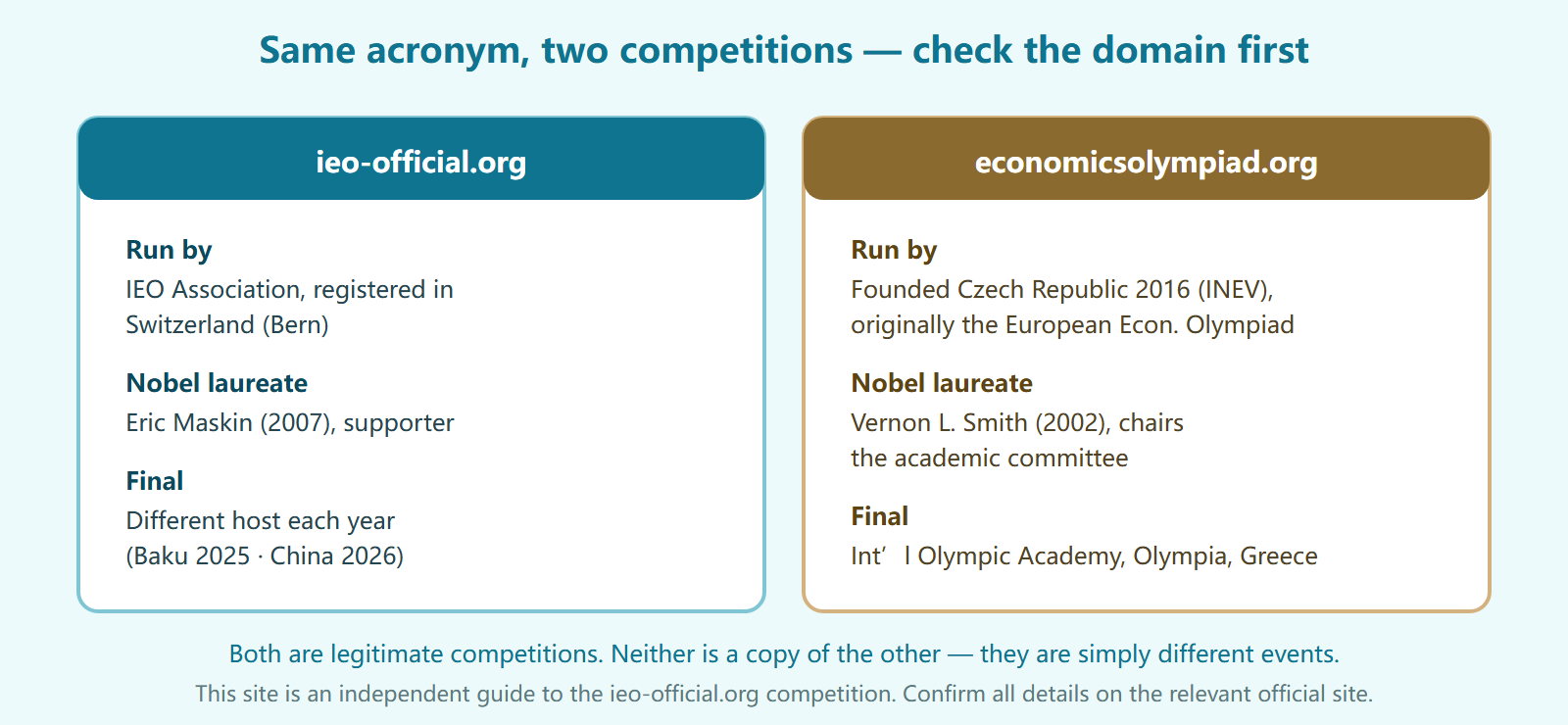
| Who runs it | The IEO Association, registered in Switzerland (c/o Science Olympiad, University of Bern) | Founded in the Czech Republic in 2016 by the Institute of Economic Education (INEV), originally as the European Economics Olympiad |
| Nobel laureate attached | Eric Maskin (2007 laureate), who has supported it since its inception | Vernon L. Smith (2002 laureate), who chairs its academic committee |
| Where the final is held | A different host each year — Baku in 2025, and China in 2026 | At the International Olympic Academy in Ancient Olympia, Greece, which became its host organisation in 2024 |
| Entry in China | Through this competition’s own national/regional rounds — confirm on the official site | Through its China partner, ASDAN |
The single fastest check is the domain. If the page you are reading, or the registration link you were sent, points at economicsolympiad.org or an ASDAN page, you are looking at the Czech-founded competition. If it points at ieo-official.org, you are looking at the one this site covers.
What this site covers, and what it does not
To be explicit: this is an independent guide to the IEO at ieo-official.org — the competition run by the Switzerland-registered IEO Association, whose 2026 global final was held in China. Everything else on this site — the round structure, the syllabus notes, the results coverage — describes that competition.
We are not affiliated with either organisation, and nothing here should be read as a judgement between them. If the Czech-founded competition is the one you want, its own official site and its China partner are the places to go. What we would push back on is the assumption that the two are interchangeable, because the practical consequences differ:
- Different calendars. Each competition sets its own round dates. A date you read about one tells you nothing reliable about the other, so never plan a season from the wrong source.
- Different finals. One rotates its host country; the other holds its international final in Greece. If a student is picturing a specific destination, that alone may decide which competition they mean.
- Different entry mechanics. In China they are reached through different channels. Registering through one does not create an entry in the other, and fees are not transferable between them.
- Different emphases. Both cover microeconomics, macroeconomics and financial literacy, and both align broadly with AP, IB and A-Level economics — but the round formats and what each rewards are set independently. Read the syllabus of the one you are actually entering.
A short checklist before you register
- Open the registration link and read the domain. Not the page title — the domain. This settles it faster than any other check.
- Match the name against the organiser, not the acronym. “IEO” alone is ambiguous; “the IEO Association” and “the Economics Olympiad founded by INEV” are not.
- Check which final the pathway leads to. If a programme describes an international final in Greece, that identifies it; if it describes a rotating host, that identifies the other.
- Confirm the current season’s dates on the official site of the one you chose. Round dates, fees and eligibility are set by each organiser and change year to year — take them from the source, not from a summary like this one.
If it turns out the competition you want is the one this site covers, our guide to what the IEO is and how its rounds work sets out the three-part assessment and the progression from national rounds to the global final.
The fastest test of all: which one does your Chinese entry route belong to?
Everything above separates the two competitions by their own properties — founder, host, finals venue. But a student in mainland China rarely meets either organisation first. What they meet is a registration page, a school notice or an agency, and the question they actually need answered is which of the two that entry route feeds.
That turns out to be the cleanest test available, because the two competitions run entirely separate China operations:
| If your entry route is… | …you are entering | Which means |
|---|---|---|
| IEOC, the financial-literacy summit series run by NexGenHub (ieo-cneo.cn) | The IEO supported by Eric Maskin (ieo-official.org) | The national team formed at the IEOC annual summit goes to that competition's global final |
| The China route operated by ASDAN | The other olympiad, at economicsolympiad.org | A different competition, different governance, different finals |
Both are real competitions and neither is a counterfeit of the other, which is exactly why the confusion persists: a student can do well in one and be entirely unknown to the other. If you are choosing this autumn, look at whose name is on the registration page before you look at anything else, then match it against the table above. If the page names neither, ask the organiser directly which international final the route leads to — a legitimate operator of either route will answer that in one sentence.
Frequently asked questions
Are there really two competitions called the IEO?
Yes. One is the International Economics Olympiad run by the IEO Association, registered in Switzerland, at ieo-official.org. The other began in the Czech Republic in 2016 as the European Economics Olympiad and is at economicsolympiad.org. Both are legitimate; they are simply different competitions.
How do I tell quickly which one I am looking at?
Check the domain of the registration link. ieo-official.org is the one this site covers; economicsolympiad.org, or an ASDAN China page, is the other. The Nobel laureate named also differs: Eric Maskin for the first, Vernon L. Smith for the second.
Does registering for one enter me in the other?
No. They have separate entry routes, separate calendars and separate finals, and fees are not transferable. Register only through the official channel of the competition you actually want.
Which competition does this site cover?
This site is an independent guide to the IEO at ieo-official.org — the competition run by the Switzerland-registered IEO Association, whose 2026 global final was held in China. We are not affiliated with either organisation.
This is an independent English-language guide to the International Economics Olympiad (ieo-official.org) for Greater-China students, operated by Hanlin Education. It is not affiliated with, endorsed by, or sponsored by the International Economics Olympiad Association, nor by the Economics Olympiad (economicsolympiad.org) or its partners. Both competitions described above are legitimate and independently run; nothing here is a judgement between them. Round dates, fees, eligibility and entry routes are set by each organiser and change year to year — always confirm on the relevant official site before registering. Confirmed errors are corrected within 7 working days.