There is no personal entry form for the main IEO — the national-team competition, known as the MainTrack. A Sending Organization applies on behalf of a country or territory, runs its own contestant selection, appoints Team Leaders and finds the money to get everyone there. The IEO also runs an official OpenTrack: a free, fully online parallel category you register for yourself, individually or as a self-formed team of two to five, covering the same Economics & Finance and Business Case rounds but awarding certificates of participation only — OpenTrack contestants are not eligible for medals or trophies. Check ieo-official.org/opentrack for the current cycle. This article is about the MainTrack pipeline, because understanding it — its deadlines, its costs and its hard locks — explains far more about why students do or do not get to compete for a medal than any study plan does.
The part most guides skip: you are not the applicant
Clause 3.1 of the IEO 2026 Annual Regulations is unusually blunt about what applying means. A Sending Organization that applies as a team agrees to the IEO Articles, the IEO Regulations of Competition and that year's Annual Regulations, and in doing so guarantees three things: to organise the contestants' selection process, to support the team including finding the means to fund transportation and accommodation, and to find and appoint Team Leader(s).
Read that list again from a student's point of view. The body that decides whether you are on the team is also the body that must pay to fly you there and take responsibility for you while you are away. That is why national routes are often smaller, more selective and more school-linked than students expect — and why “how do I register?” is the wrong first question. The right one is “which organisation sends a team from my territory, and what is its selection process?” Our regions page is where to look that up. If you are still orienting yourself, start with our overview of what the IEO is and how it is structured.
Applications go to the IEO Central Office and are reviewed by the IEO Executive Board under the Regulations of Competition and the Application Guideline. The Central Office confirms receipt within two working days — and the regulations state explicitly that this confirmation is not approval. A receipt is a receipt.
The application calendar: three stages, then two hard locks
The IEO runs a one-year application process with three staged deadlines. Sending Organizations may apply at any stage — the stages are not sequential hurdles, they are three chances to board the same train. For the 2026 edition the dates were:
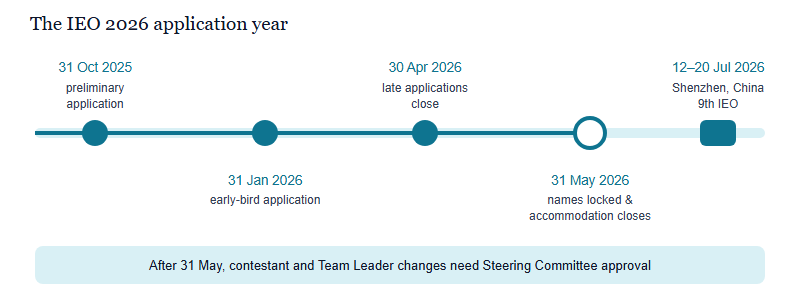
The date that matters most to an individual student is 31 May, and it matters for two separate reasons at once. It is the deadline for submitting the names and details of contestants and Team Leaders to the Steering Committee, and it is also the day accommodation booking closes. After it, changes to the named team are possible only with Steering Committee approval, and the regulations warn that accommodation near the venue can no longer be guaranteed.
In practice this means a national selection process has to finish comfortably before the end of May. If you are wondering why your territory's round sits where it does in the calendar, this is usually the reason: everything upstream is compressed by a fixed downstream lock. One exception is worth noting — where visas are required, the Central Office may request participant details earlier than the standard deadline in order to meet visa requirements.
What it costs, and who pays which part
Costs are host-dependent and change every edition, so treat the following as the published 2026 Shenzhen figures rather than a permanent price list. What is durable is the shape of the split: the host organisation absorbs the competition, and the sending side absorbs the travel.
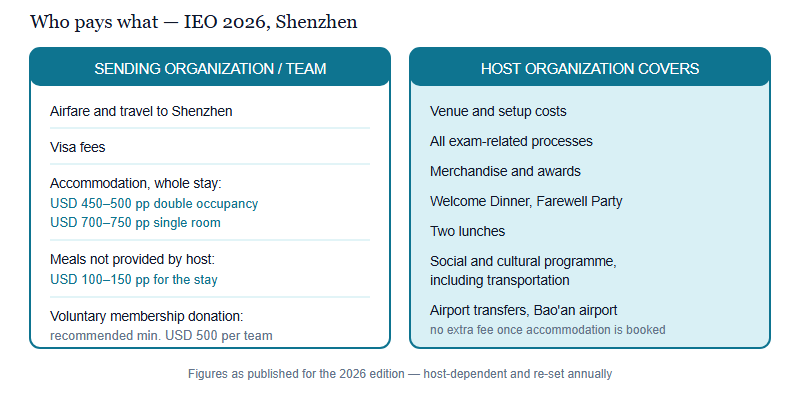
Three details in the fine print change how a team should budget:
- Accommodation is booked through the host, not independently. The 2026 regulations required all bookings to go through the Host Organization, and noted limits on the rooms available — another reason the May lock is real rather than nominal.
- A team picks one accommodation option for everyone. Mixed arrangements were not allowed, so a team cannot split into some students in twin rooms and others in singles.
- The membership donation is voluntary. It is described as encouraged support for the IEO's long-term development with a recommended minimum per team — not a compulsory entry fee. Do not confuse a recommendation with a requirement, in either direction.
Refunds sit with the Steering Committee rather than the Central Office, and the 2026 policy was itself only due to be settled by the end of May. If your family is committing money to flights early, that asymmetry is worth knowing about in advance.
On-site by default for national teams: the MainTrack online exception is narrow
Students sometimes assume there is a remote option. For national teams competing on the MainTrack in 2026 there effectively was not, other than by exception. The regulations describe the IEO as primarily an on-site competition, with teams strongly encouraged to attend in person, and online participation authorised only by the Executive Board case by case, on a motivated request from the Sending Organization. Read that as a rule governing team competition rather than remote participation as such — the separate OpenTrack ran fully online and was open to anyone.
| Grounds on which online MainTrack participation could be approved (2026) | Evidence standard |
|---|---|
| The team represents a country or territory that has never participated in the IEO | Executive Board approval, case by case |
| Travel is impossible for two or more selected contestants and/or all team leaders due to verified force majeure — natural disaster, extreme weather, armed conflict, political instability, security risks | Reasonable documentary evidence, e.g. official notices |
| Travel is impossible for two or more contestants and/or all team leaders due to visa denial or documented political or diplomatic constraints | Embassy correspondence or similar |
| The Sending Organization faces unexpected, documented financial hardship | Bank letters or comparable documentation |
Two structural conditions came attached. Approved teams had to compete entirely in one format — no hybrid teams — and all members had to sit proctored exams together in a single room. The design intent is obvious: preserve exam integrity and keep the team a genuine team, which matters most for the collaborative component. That component is unpacked in our guide to the team business case round.
Visas, arrival windows and what the week looks like
Once participant details are submitted, an official invitation letter is issued to participants, and the Steering Committee undertakes best efforts to support the visa process for those who need one. For Greater China teams travelling domestically this is a non-issue; for teams crossing borders it is the single most common reason details get requested early.
The published 2026 agenda also tells you something useful about pacing, because the competition is not a single exam day:
| Date (2026) | Programme item | What it implies for a team |
|---|---|---|
| 12 July | Arrivals | Expected arrival day; early or late arrival needed Steering Committee discussion at least three weeks ahead |
| 13 July | Opening Ceremony | No assessment — use it to acclimatise |
| 14 July | Economics and Finance Tests | The individual written load lands on a single day |
| 15 July | Cultural activities | A genuine gap between the written tests and the team task |
| 16 July | Business Case Preparation | A dedicated preparation day precedes the presentation |
| 17 July | Business Case Presentations | Delivery in English before an international jury |
| 18 July | Moderation | A formal review stage after assessment |
| 19 July | Educator Forum and Closing Ceremony | Results stage; forum was in-person only |
| 20 July | Departure | Expected departure day |
The most actionable line in that table is 16 July. A full preparation day sits between receiving the business case task and presenting it, which means the skill being tested is not improvisation — it is how well five people can organise, divide and rehearse work under a deadline. Teams that have never practised that division of labour discover it on the day. Teams that have built it into their preparation, as in our 12-week plan, do not.
What to do with this if you are a student
You cannot control most of the pipeline above. You can, however, act on four things:
- Identify your Sending Organization first. Everything — selection, funding, deadlines — flows from it. Ask which organisation applies for your territory and when its selection runs; our registration page sets out how entry works, and the regions page covers routes by territory.
- Work backwards from the May lock. If names must be final by the end of May, your selection round is earlier still. Plan your preparation against that date, not against July.
- Raise money questions early, not late. Travel and accommodation are the sending side's responsibility. A family that learns this in June has fewer options than one that learns it in October.
- Do not treat any figure here as current. Host city, costs and deadlines are re-set each edition. Verify against the Annual Regulations for the year you intend to enter.
Frequently asked questions
Can I register for the IEO myself?
Not for the main national-team competition — there applications come from a Sending Organization, which also runs contestant selection and appoints Team Leaders. The IEO does also run an OpenTrack, a free online parallel category you register for yourself; it awards certificates of participation rather than medals. Confirm current arrangements on ieo-official.org.
Is there an entry fee?
The 2026 regulations describe a voluntary membership donation with a recommended minimum per team, plus travel and accommodation costs.
Does the IEO offer online participation?
The national-team MainTrack is primarily on-site: online participation required Executive Board approval on narrow, documented grounds, with no hybrid teams. The separate OpenTrack is fully online and open to all, with certificates of participation rather than medals.
When is the real deadline for a student?
Effectively your national selection, since names were locked with the Steering Committee by 31 May 2026. Confirm current dates on ieo-official.org.
This is an independent guide operated by Hanlin Education for China-based international-school students. We are NOT affiliated with, endorsed by, or sponsored by the International Economics Olympiad Association. Deadlines, fees and participation rules are re-published for each edition and are host-dependent — confirm current details on ieo-official.org before making travel or financial commitments. Errors reported to us are corrected within 7 working days.