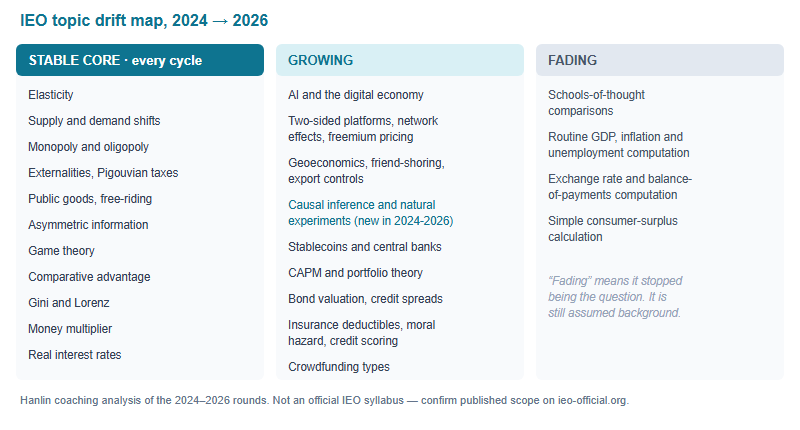
Across the 2024 to 2026 IEO rounds, the content splits into three tiers. A stable core of about eleven ideas appears every year. A growth band — artificial intelligence and the digital economy, geoeconomics, empirical method, and modern finance — has expanded fast. And a fading band of routine computation and doctrinal comparison has thinned out. Prioritise accordingly, but do not chase last year's paper.
This map is our own analysis of the 2024, 2025 and 2026 rounds, compiled by Hanlin coaches working with students through those cycles. The IEO Association does not publish a weighted topic breakdown, so nothing here is an official syllabus — confirm the published scope for your cycle on ieo-official.org. For the structure the topics sit inside, start with what the IEO is and how the three components work.
Before the map itself, it is worth understanding why an olympiad drifts when a school syllabus does not. A school syllabus is a contract: published, stable for years, designed so a teacher can plan a two-year course against it. An olympiad paper is not a contract. It is written each cycle by economists who are reading the current literature and the current policy argument, and who want to test whether a candidate can think rather than whether a candidate has memorised a fixed list.
That difference produces predictable drift in both directions. Topics alive in research and policy get pulled in. Topics that have hardened into routine mechanical exercises — the kind a calculator and a formula sheet handle — get squeezed out, because they no longer discriminate between a strong candidate and a drilled one. Neither movement is ever announced. You infer it from the papers, which is exactly what the rest of this article does.
The stable core: eleven ideas that appeared in every cycle
Start here, because this is the part of the map that does not move. Across 2024, 2025 and 2026 the eleven ideas below recurred consistently, and every single one of the 2026 open questions was built on at least one of them.
There is a reason this particular set is so durable. Each item is a general-purpose tool rather than a topic: elasticity is how you talk about responsiveness anywhere; game theory is how you talk about strategic interaction anywhere; externalities and Pigouvian correction are how you talk about any gap between private and social cost. Tools like these can be pointed at a context that did not exist when the tool was invented, which is precisely what an examiner writing about orbital data centres needs them to do. Topics tied to a specific measurement procedure cannot be redeployed that way — and, as the fading column shows, those are the ones that thin out.
What grew, and why each one grew
The growth band is not random. Each entry has an obvious reason for arriving, which also tells you the depth at which it is likely to be tested.
| Growth area | What specifically shows up | Depth you actually need |
|---|---|---|
| AI and the digital economy | Two-sided platforms, network effects, freemium pricing, AI as an input with unusual cost structure | Enough to model it: near-zero marginal cost, cross-side externalities, why a platform prices one side at zero |
| Geoeconomics | Friend-shoring, export controls, security-motivated trade restriction | Standard trade theory plus the ability to add a non-economic objective and analyse the trade-off honestly |
| Causal inference and natural experiments | New within our 2024-2026 window: identification language, quasi-random variation | Conceptual, not technical — know what identification means and why correlation arguments fail |
| Stablecoins versus central-bank policy | Private money, monetary control, the transmission mechanism | Link it to the money multiplier and to central-bank objectives you already know |
| CAPM, portfolio theory, bond valuation, credit spreads | Risk and return, diversification, discounting, why spreads move | Working knowledge including the arithmetic — this is the deepest of the growth areas |
| Insurance, moral hazard, credit scoring, crowdfunding | Applied information economics in consumer finance settings | Recognition plus the ability to name the information problem and the mechanism that addresses it |
Two observations are worth extracting. First, the finance cluster grew hardest and grew deepest — CAPM, bonds and spreads were not decorative mentions but computational content. Second, causal inference arrived as a way of thinking rather than as econometrics. Nobody needed to run a regression; candidates needed to recognise when a comparison identifies something and when it does not.
What faded — and what “faded” does not mean
Four things thinned out noticeably: comparisons of schools of economic thought, routine computation of GDP, inflation and unemployment figures, exchange-rate and balance-of-payments arithmetic, and simple consumer-surplus calculation.
The temptation is to delete them from your revision. Do not. “Faded” here means something specific: these topics stopped being the question and became assumed background. A 2026 item might hand you a real interest rate or an inflation figure and expect you to use it correctly inside a larger problem. It simply will not spend a whole question asking you to compute it.
The right response is a change of emphasis, not deletion. You still need to be fluent enough that a national income identity or a real-versus-nominal adjustment costs you ten seconds rather than three minutes. What you no longer need is to drill those computations as if they were the summit of the paper.
Schools of thought is the one genuine deletion candidate. If your preparation currently includes memorising the Keynesian-versus-monetarist debate as a set-piece essay, that time is better spent on the modelling toolkit the open questions now demand.
The 2026 open questions as a case study: new context, old machinery
The single most useful thing in this map is not either list. It is the relationship between them. In 2026, every open question paired a growth-band context with a stable-core tool. The contemporary topic supplied the story; the classical model did the work.
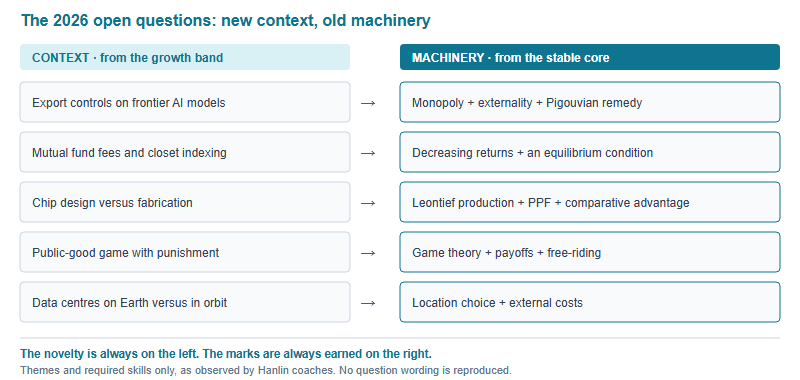
This is why a topic list alone is a weak preparation tool. A student who memorises “two-sided platforms” as a topic still freezes when a question about orbital data centres appears, because orbital data centres were not on the list. A student who has internalised that unfamiliar contexts are wrappers around a small set of models asks a different question — which model is this? — and gets to work.
How to use this map without over-fitting
Three rules keep a drift map useful rather than dangerous.
- The core is not optional and never gets cheaper. The eleven stable ideas earn marks in every cycle regardless of what the wrapper is. If any of them is shaky, fix that before you touch the growth band. Our twelve-week plan front-loads exactly this for a reason.
- Treat the growth band as a reading habit, not a syllabus. You cannot pre-learn every contemporary context that might appear — nobody predicted orbital data centres. What you can do is read enough good economics journalism and commentary on AI, trade policy and financial markets that no such context is genuinely alien. Twenty minutes a day beats a memorised list.
- Weight the finance cluster higher than feels natural. Of everything in the growth band, modern finance is the one requiring real computational fluency, and it is the one most Greater China candidates have least exposure to. That combination makes it the highest-return study hour available.
A rough allocation follows from those three rules: the majority of your study time on the stable core until it is genuinely automatic, a meaningful minority on the growth band with finance taking the largest share within it, and a small maintenance slice keeping the fading topics fluent enough that they never slow you down mid-question. That split is our editorial judgement about where marginal hours pay best. It is not a statement about how the paper is weighted — the IEO does not publish component weightings and we will not infer any.
One final caution about the whole exercise. Three cycles is a short series, and a shift observed once can reverse. Nothing in this map is a prediction about what your cycle will contain, and no analysis of past papers substitutes for the official scope. The map tells you where to place emphasis when your time is finite. It does not tell you what will be on the paper. That distinction matters more than any individual entry above — and it applies equally to the team business case, where the context changes every year by design and only the underlying judgement transfers.
Frequently asked questions
Is this an official IEO syllabus?
No. It is Hanlin's analysis of the 2024 to 2026 rounds. The published scope for your cycle is on ieo-official.org and should be your primary source.
Can I skip the fading topics entirely?
No. They became assumed background rather than the question itself, so you still need fluency — just not heavy drilling of the computations.
Which growth area should I study first?
Modern finance: CAPM, portfolio theory, bond valuation and credit spreads. It grew deepest and is where most Greater China candidates have least exposure.
How much econometrics do I need for causal inference?
Conceptual understanding rather than technique. Know what identification means and why a raw correlation does not establish a causal claim.
This is an independent guide operated by Hanlin Education for China-based international-school students. We are not affiliated with, endorsed by, or sponsored by the International Economics Olympiad Association. Competition rules, dates and formats change — confirm current details on ieo-official.org. Factual errors are corrected within 7 working days of notification.