Two things changed on the 2026 International Economics Olympiad round, and both change how you should prepare. The economics and finance multiple-choice questions, previously set as two separate papers, were merged into one 40-question Economics and Finance paper. And of the five open questions, four required genuine calculation — up from one in each of the two preceding years.
Everything here, including the two changes stated above, is our own analysis of the 2026 global round, written by Hanlin's lead economics coach from working through the round with students. The IEO Association does not publish a year-on-year change log, so treat this as informed observation rather than an official notice, and confirm the format for your own cycle on ieo-official.org. If you have not yet read how the three components fit together, our overview of what the IEO is and how it is structured sets the frame this article assumes.
What changed in the multiple-choice paper
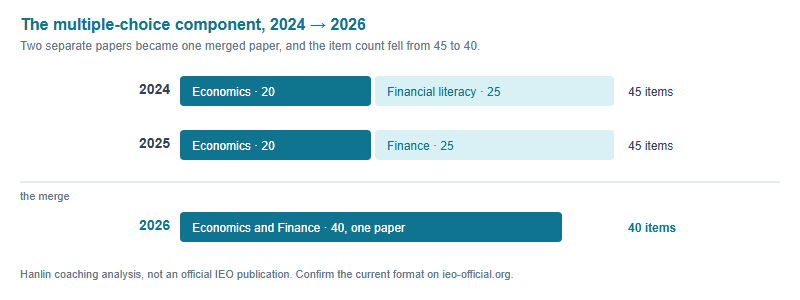
Until 2026, the multiple-choice component arrived as two distinct papers with distinct identities: an economics paper and a financial-literacy paper. In 2026 those became one instrument, and the total item count fell.
| Cycle | Structure of the multiple-choice component | Total items |
|---|---|---|
| 2024 | Two papers — 20 economics items, 25 financial-literacy items | 45 |
| 2025 | Two papers — 20 economics items, 25 finance items | 45 |
| 2026 | One merged Economics and Finance paper | 40 |
Why a merged paper is harder for an uneven candidate
The merge sounds administrative. It is not. Two mechanisms make it materially harder for the very common Greater China profile — strong microeconomic theory, thin finance.
There is no longer a firewall. We do not know how the two papers were ever combined into a candidate's result — the IEO does not publish component weightings, and we will not guess at them. But structurally, two papers let a candidate treat their performance as two separate events: bank the economics paper, contain the damage on finance, move on. One paper removes that psychological and tactical separation. A finance weakness no longer sits in a box; it bleeds through the whole instrument, item by item, mixed in among questions you would otherwise be answering confidently.
Fewer items means broader coverage per item. Forty questions now have to sample the union of what forty-five previously sampled across two papers. Each item therefore carries more of the syllabus behind it. Statistically, a shorter paper covering a wider domain samples more thinly — which means a specific gap is less likely to be averaged away by the sheer number of questions and more likely to show up as a clean, unrecoverable loss on the two or three items where it happens to live.
The practical consequence is unglamorous. If you have been treating finance as a bolt-on module to revise last, the 2026 structure makes that scheduling choice expensive.
The larger change: the open questions became a maths paper
The multiple-choice merge is the visible change. The open-question shift is the bigger one, and it is the change most likely to catch out a student who prepared from a 2024 or 2025 mental model of the round.
| Cycle | Pure calculation or derivation items | Pure prose-argument items | Remaining items |
|---|---|---|---|
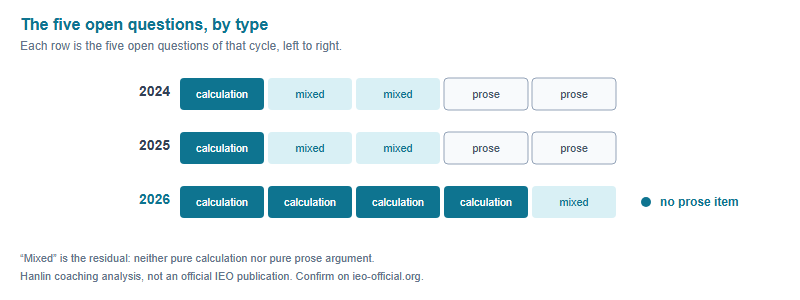
| 2024 | 1 of 5 | 2 of 5 | 2 |
| 2025 | 1 of 5 | 2 of 5 | 2 |
| 2026 | 4 of 5 | 0 of 5 | 1 |
In 2026, nearly every open question required defining a function, differentiating it, or solving simultaneous equations. The essay-shaped question — the one where a well-read student could reason in structured English and score — did not appear at all. That is a genuine discontinuity, not a drift.
One important qualifier: five open questions are set and four are graded. What determines which four count is not something we will assert; confirm that rule officially before you build a strategy around it.
What the five 2026 open questions actually demanded
We will not reproduce question wording, and no past-paper text appears below. What follows is a description of the themes and, more usefully, the technical operation each one required of you.
| Theme | Economic frame | Technical operation required |
|---|---|---|
| Export controls on frontier AI models | Monopoly plus a national-security externality, with a Pigouvian remedy | Set up a monopolist's problem, add an external cost term, derive the corrective instrument |
| Mutual funds, fees and closet indexing | Fund management under decreasing returns to scale, in a zero-net-alpha equilibrium | State an equilibrium condition and do algebra on fees, size and returns |
| Chip design versus fabrication | Leontief production and a heterogeneous-labour production possibility frontier, plus trade policy | Work with fixed-proportions technology, construct a kinked frontier, reason about specialisation |
| Social preferences and a public-good game | Inequality aversion combined with a punishment mechanism | Write payoff functions containing an inequality-aversion term and solve for best responses and thresholds |
| AI data centres on Earth versus in orbit | Industrial location choice with externalities | Compare costs including external costs and derive a location decision rule |
Read that table twice and a pattern emerges. Every context is contemporary — AI, chips, export controls, orbital infrastructure, fund fees. Every underlying tool is standard: monopoly pricing, externalities and Pigouvian correction, fixed-proportions technology, game-theoretic best responses, cost comparison. The novelty is in the wrapper. The machinery is the syllabus you already have, applied faster and with more algebra than school economics ever asks for.
Four things this should change about your preparation
- Stop scheduling finance as a separate module. The merged paper means finance items now sit interleaved with economics items under one clock. Prepare them interleaved too — mixed problem sets, not a finance block in week ten.
- Build the modelling toolkit explicitly. Not “more maths” in the abstract. A specific, drillable list: define a function from a verbal description; differentiate it; set and solve a first-order condition; solve two or three simultaneous equations cleanly; sign-check a comparative static and say what it means. Most IB, AP and A-Level Economics courses never require the first or the last of those.
- Practise the translation move. The recurring 2026 demand was: read an unfamiliar current-affairs setting, identify which standard model it is, and set that model up in symbols within a couple of minutes. Train it deliberately — take any economics news item and force yourself to name the model and write the objective function.
- Do not over-fit to one year. One cycle is one observation. A shift this sharp is a signal about direction, not a promise about 2027. The stable core of the competition — elasticity, externalities, game theory, comparative advantage, monetary basics — has been stable across all three years, and it is what every one of those 2026 questions actually ran on.
If you are building a schedule around this, our twelve-week preparation plan for the three parts gives you the skeleton; the change above mainly affects how you fill the individual-round weeks, not the plan's shape. Note also that none of this touches the team business case, which remains a judgement-and-delivery test in English rather than a modelling one — a useful thing to know if maths is your weakness and you are choosing where to contribute to a team.
On where this analysis comes from: our coaches worked with students through this cycle's national selection process, and at the 2026 global final students we coached were on the China teams, where a student took an individual gold, on the Hong Kong team, whose student recorded an individual gold and the second-highest individual total on the official individual results, and on the US team where a student took an individual bronze. Results are de-identified and reported per Hanlin; individual results vary and past outcomes do not predict future ones. We mention it only to be clear that the observations above come from inside the round rather than from reading a syllabus.
Frequently asked questions
Has the IEO officially announced these format changes?
Not that we have seen. This is our coaching analysis of the 2026 round. Treat it as observation and confirm the current format on ieo-official.org.
Did the 2026 multiple-choice paper really have 40 questions?
Yes, in a single merged Economics and Finance paper. Formats can change between cycles, so verify the structure officially before yours.
Do I still need to write in English for the open questions?
Yes. Calculation items still need setup, definitions and interpretation written clearly. Only the pure prose-argument item disappeared in 2026.
Will the 2027 paper look like 2026?
Nobody can say. Treat 2026 as a signal about direction, keep the stable core solid, and confirm each cycle's format on the official site.
This is an independent guide operated by Hanlin Education for China-based international-school students. We are not affiliated with, endorsed by, or sponsored by the International Economics Olympiad Association. Competition rules, dates and formats change — confirm current details on ieo-official.org. Factual errors are corrected within 7 working days of notification.