Most candidates prepare as though the medal is the hard part. The arithmetic says otherwise. At the 2025 International Economics Olympiad final in Baku, 258 competitors from 52 countries collected 133 medals — slightly more than half the field. But those 258 places were shared across teams of up to five students, drawn from 52 countries and territories. The genuinely narrow gate is national selection, long before anyone flies anywhere.
The five gates, and which one is actually narrow
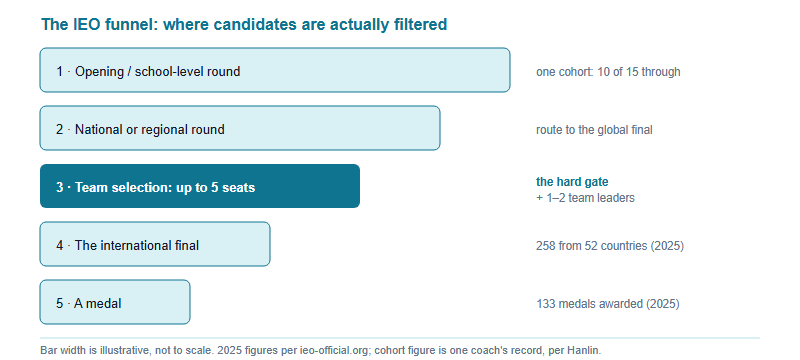
A Greater China candidate passes through a sequence of filters, and they are not equally hard. Reading them in order changes where you spend your hours:
- Gate 1 — the opening or school-level round. Your entry point into the season, run through whichever organisation is sending candidates in your region.
- Gate 2 — the national or regional round. Winning through here is the published route to the international final.
- Gate 3 — team selection. A national team is up to five students plus one or two team leaders. This is where a large field compresses into a handful of seats.
- Gate 4 — the international final itself. Three parts: multiple-choice questions on economics and financial literacy, five open questions of which four are graded, and a team business case delivered in English — confirm the current question counts for your cycle on ieo-official.org.
- Gate 5 — the medal. Awarded at the final, in gold, silver and bronze bands.
Two of these five gates can be described numerically from published figures. The others vary by sending organisation and by cycle, so nothing in this article should be read as a quota or a prediction — confirm your own round's rules on ieo-official.org and with whoever registers candidates in your region. If the structure itself is new to you, start with our overview of what the IEO is and how the season is built.
What the 2025 final looked like as arithmetic
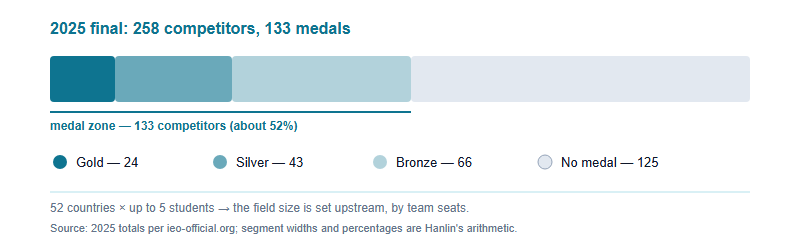
The 2025 final in Baku drew 258 participants from 52 countries, and 133 medals were awarded: 24 gold, 43 silver and 66 bronze. Singapore took the team gold. Turn that into proportions and the picture is not the one most students carry in their heads.
| Outcome at the 2025 final | Count | Share of the 258 competitors |
|---|---|---|
| Gold | 24 | about 9% |
| Silver | 43 | about 17% |
| Bronze | 66 | about 26% |
| Any medal | 133 | about 52% |
| No medal | 125 | about 48% |
Three things follow. First, at the final slightly more than half the field took a medal — but the largest single group, 125 competitors, still went home without one, so arriving guarantees nothing. Second, gold is genuinely scarce: roughly one competitor in eleven. Third, and most usefully, divide 258 by 52 and you get an average of just under five competitors per country, which is consistent with most delegations arriving at or near the maximum team size of five.
That last number is the one worth sitting with. The size of the global field is essentially set by the number of participating countries multiplied by five. It does not expand because your country happens to have a deep pool of strong economics students. A country with two thousand serious candidates and a country with forty send the same five.
Five seats: the gate almost nobody trains for
Team selection is where a season is actually won or lost, and it is the gate students think about least. The published team structure is up to five students plus one or two leaders. Whatever the size of your domestic field, it resolves to that number.
We cannot honestly convert this into a percentage. Entrant counts for national and regional rounds are not something we can verify, and they differ by territory and by year — anyone quoting you a precise national pass rate should be asked for their source. What we can say is structural, and it is enough to change your planning:
- Your real competition is domestic. Global statistics tell you almost nothing about your odds. The people standing between you and a seat sit in the same time zone, often the same city.
- The compression is at Gate 3, not Gate 5. Once you are in the hall at the final, roughly half the field medals — the regulations cap total medals at no more than half the contestants, so treat it as close to a coin flip rather than a safe bet. Getting into the hall is the achievement.
- Selection criteria are set locally. Which round counts, how team members are chosen from qualifiers, and what the deadlines are come from your sending organisation, not from us. Ask them in writing, early.
- Team skills are not a post-selection problem. A national team has to produce a live English business case together, often on a short runway. Candidates who arrive able to do that are worth more to a team than candidates who arrive with a marginally higher written score.
What one coaching cohort's conversion actually looked like
The figures below come from the teaching record of a single economics coach on our team, de-identified, per Hanlin. They describe one coaching cohort. They are not a company-wide total, not an official statistic, and not the same thing as the national-team and global-round figures published elsewhere on this site. The numbers are small, the two cycles measure different gates, and results vary — nothing here is a forecast of what any individual student will achieve.
| Cycle | Progression within that cohort | What followed |
|---|---|---|
| 2026 | 10 of 15 students advanced from the opening round to the national round, with three golds, one silver and three bronzes at that stage | Two students selected for the Chinese national team, one for the Hong Kong team, one into a New Zealand team candidate camp, two through to the Singapore round |
| 2025 | 14 of 22 advanced from the national round | At the global round, one student placed fifth individually with a gold and a Best in Economics; a Hong Kong student took an individual bronze |
| 2024 | — | One silver at the global round; a top-three placing in the Hong Kong region and 27th globally |
Across the rounds this cohort entered in 2026, the awards recorded were one gold and one bronze at team level, two teams taking silver in the business presentation, and five individual bronzes. Which specific round each award came from is not broken out here, and we are deliberately not aggregating it with anything else — the point of showing it is the shape, not a headline count.
The shape is this: roughly two-thirds of a prepared cohort cleared the round in front of them, then a much smaller number converted into national-team seats. That only a handful of an already-selected, coached group reached a national team is a useful reality check against the assumption that steady work automatically produces a place. It is also a reason not to treat a non-selection as a failed year: several students in that cohort still reached ranked international rounds by other routes.
For context on the source: the coach in question holds a master's in social enterprise from Hult International Business School's San Francisco campus, teaching certification across the College Board, Cambridge International and IB systems, and recognised coach status for the IEO, NEC, FBLA and Conrad programmes.
What the numbers should change about your preparation
If the compression point is Gate 3, four practical consequences follow.
- Calibrate to the round that selects you, not to the final. Studying to the standard of the international paper is not wasted, but the paper that decides your season is the domestic one. Find out from your sending organisation which round carries selection weight, and build your mock schedule around that date.
- Start the team-facing skills before you have a team. The business case is a live, English-language, judged performance, and it is the component that most often separates teams whose written scores are close. Reported 2026 team totals had the top two within roughly three points on a scale near 120 — confirm the standings on ieo-official.org, but the direction is clear: at the top, margins are thin and the case matters. Our guide to building and delivering the business case works perfectly well as solo preparation.
- Spend the marginal hour on breadth, not depth. The Economics and Finance material spans micro, macro and applied topics including trade and personal finance — confirm the published syllabus scope on ieo-official.org. At selection stage, one weak strand costs more than a strong strand gains — the merged format rewards the candidate with no soft spot.
- Plan in cycles, not in one shot. Eligibility is age-based, so a Year 11 candidate who misses selection may still be age-eligible next cycle — confirm the rules on entering more than once with your sending organisation and on ieo-official.org. Treat cycle one as calibration and build a twelve-week block around your next round; our 12-week plan for the three parts is written to be counted backwards from whatever date you are given.
None of this makes the IEO easier. It makes it legible. The student who understands that the field is set by five seats per country, and that the medal distribution at the final is comparatively generous, will spend their autumn very differently from the student who imagines a global tournament of thousands where only a handful are rewarded.
Frequently asked questions
Is it really easier to medal than to make the team?
Structurally, yes. At the 2025 final 133 medals went to 258 competitors, but those competitors came from 52 national teams of up to five.
What percentage of national-round entrants get selected?
We cannot verify entrant counts, and they vary by territory and year. Ask your sending organisation directly rather than trusting a quoted figure.
Are the cohort numbers a prediction for my results?
No. They are one coach's de-identified record for small groups, per Hanlin. Results vary and no outcome is guaranteed.
If I miss team selection, is the season wasted?
Not necessarily. Students in that cohort still reached ranked international rounds by other routes; confirm which routes are open to you.
This is an independent guide operated by Hanlin Education for China-based international-school students. We are not affiliated with, endorsed by, or sponsored by the International Economics Olympiad Association. Competition rules, dates, eligibility and results change — confirm current details on ieo-official.org. Factual errors are corrected within 7 working days of notification.