International economics is one of the bodies of material the IEO's Economics and Finance questions draw on, alongside microeconomics and macroeconomics — confirm the published scope on ieo-official.org. It is also the strand Greater China candidates most often under-prepare, because school courses place it last and exam season arrives first. Four blocks carry almost all of it: trade theory, protection, exchange rates and the balance of payments — plus the geoeconomics material built on top of them.
Where the strand sits, and why it is under-prepared
The Economics and Finance component of the competition is not a micro paper with a macro annexe. It spans several bodies of material, and international economics is the one with the least classroom time behind it for most candidates. IB, A-Level and AP economics courses all cover open-economy material, but typically in a final unit taught under time pressure — and, in the AP case, split across two separate courses that a student may not have taken both of.
One of our economics coaches, who is certified across the College Board, Cambridge International and IB systems, describes a consistent pattern in marked work: students can draw a tariff diagram from memory but cannot say who actually bears the tariff when the importing country is large enough to move the world price. The diagram was memorised; the incidence question was never asked in class. International economics on the IEO asks the incidence question.
A second reason the strand repays attention is that it is where the growth has been. Across recent rounds, our own reading of the material is that geoeconomics — tariff conflict, export controls, supply-chain relocation, industrial policy — has expanded, and all of it is built on the four blocks below. You cannot analyse an export-control question without the trade theory underneath it. For how the strand fits into the competition as a whole, see our overview of what the IEO is and how the three parts work.
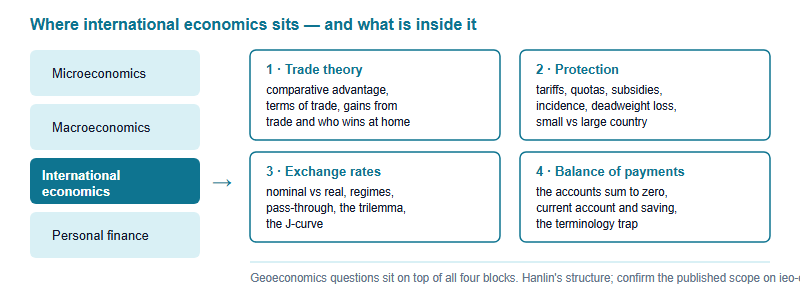
Blocks 1 and 2: trade theory, and who actually pays for protection
Comparative advantage is the most confidently mis-stated idea in school economics. The common error is to answer with absolute advantage — the country that produces more of something. The correct test is opportunity cost. Work the standard two-country, two-good case:
| Output per worker-hour | Cloth | Wine | Opportunity cost of 1 cloth | Opportunity cost of 1 wine |
|---|---|---|---|---|
| Country A | 6 units | 3 units | 0.5 wine | 2 cloth |
| Country B | 2 units | 2 units | 1 wine | 1 cloth |
Country A is better at everything, and it still gains from trade. It gives up only half a unit of wine to make a cloth, where B gives up a whole unit; so A exports cloth and B exports wine. Mutually beneficial terms of trade must lie strictly between the two opportunity costs — here, between 0.5 and 1 unit of wine per cloth. Any exam question offering a rate outside that band is offering a trade one country will refuse. That band is the single most testable fact in the block.
Protection is where the marks separate. Four points, in the order they are usually examined:
- A small country bears its own tariff. If the importing country is too small to affect the world price, the domestic price rises by the full amount of the tariff. Consumers lose more than producers and the government gain together; the difference is deadweight loss, made up of a production distortion and a consumption distortion.
- A large country can push part of the burden abroad. If it imports enough to depress the world price, foreign exporters absorb part of the tariff through worse terms of trade. This is the origin of the “optimal tariff” argument — which the standard answer immediately qualifies with retaliation and the collapse into a trade war that leaves both worse off.
- A quota is not a tariff with a different name. Same quantity restriction, different destination for the money: a tariff raises government revenue, while a quota creates rents that go to whoever holds the licences, unless the licences are auctioned.
- A production subsidy is the cheaper way to protect. If the policy goal is to sustain domestic output, a subsidy distorts production but leaves the consumer price alone, so it avoids the consumption distortion a tariff creates. Examiners like this comparison because it rewards the student who reasons from welfare rather than from slogans.
Block 3: exchange rates and the open economy
Start with the convention, because more marks are lost here than to any concept. If you quote the exchange rate as units of home currency per unit of foreign currency, a rise in that number is a depreciation of the home currency; under the opposite convention it is an appreciation. The real exchange rate then adjusts the nominal rate for relative price levels — on the first convention, nominal rate multiplied by the foreign price level over the domestic price level. Write down your convention before you write anything else. An answer that is internally consistent and states its convention will read as competent even where the marker prefers the other one.
Three further ideas cover most of what the block asks:
- The policy trilemma. A country cannot simultaneously hold a fixed exchange rate, free capital movement and an independent monetary policy. It can have any two. This single frame explains currency boards, capital controls and the constraints on monetary union members, and it converts a memory question into a reasoning question.
- Pass-through is incomplete. A ten per cent depreciation does not raise import prices by ten per cent. Exporters absorb part of it in their margins, contracts are priced in advance, and some of the value of an imported good is domestic distribution. Treating pass-through as complete produces answers that overstate inflation effects.
- The J-curve, gated by Marshall-Lerner. After a depreciation the trade balance often worsens before it improves: prices move immediately while volumes take time to respond. And it only improves at all if demand is elastic enough — the Marshall-Lerner condition, that the export and import demand elasticities sum to more than one.
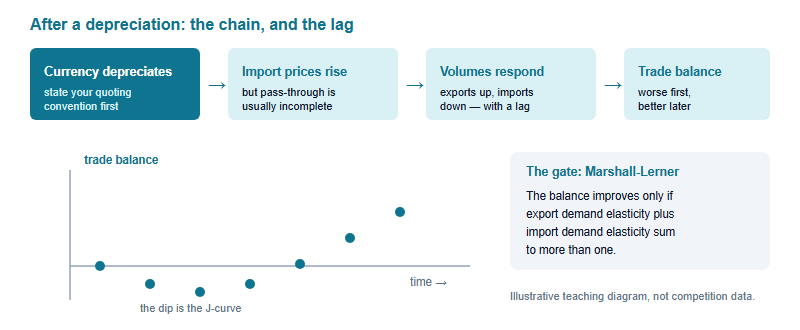
Block 4: the balance of payments identity most candidates get backwards
The balance of payments records every transaction between residents and the rest of the world, and its central property is an accounting one: the accounts sum to zero once errors and omissions and reserve transactions are included. A current-account deficit is therefore not a leak into nowhere. It is matched, by construction, by a net financial inflow — the country is on net borrowing from, or selling assets to, the rest of the world.
Three things follow, and each is a standard question:
- The terminology trap. Under the modern international standard, the “capital account” is a small account covering capital transfers and non-produced non-financial assets, while the large one recording cross-border investment is the “financial account”. Many textbooks — especially older ones — use “capital account” loosely for the whole thing. Read the stem's definition before answering, and define your own terms in an open response.
- The saving-investment link. The current-account balance equals national saving minus domestic investment. That reframes the deficit question usefully: a deficit can reflect weak saving, or strong investment, and those imply very different judgements.
- “Deficit equals bad” is not an answer. The economically literate response asks what the borrowing funds, whether it is in domestic or foreign currency, and how it is financed — stable long-term direct investment or short-term flows that can reverse. Sudden-stop episodes are about the composition of financing, not the headline number.
Geoeconomics, the three parts, and a two-week catch-up
Contemporary geoeconomics questions — tariff escalation, export controls on advanced technology, supply-chain relocation, industrial subsidy programmes, critical-minerals dependence — are not a fifth block. They are applications of the first four. An export-control question is a trade-theory question about specialisation and the cost of unwinding it. A reshoring question is a protection question about who pays. Candidates who have the blocks handle novel policy material calmly; candidates who have only memorised current events have nothing to reason with when the example is unfamiliar.
The strand then surfaces in all three parts of the competition, in different registers:
| Where | What it looks like | What is actually rewarded |
|---|---|---|
| Multiple choice | Short items on comparative advantage, tariff incidence, exchange-rate direction, balance-of-payments classification | Speed and precision; knowing the direction of an effect without deriving it |
| Open questions | Longer prompts that combine a calculation with a policy judgement | A labelled chain of reasoning, correct arithmetic, and a stated qualification |
| Business case | Firms and sectors exposed to tariffs, currency movements or supply-chain risk | Applying the framework to a specific decision, then defending it aloud |
If this strand is your gap, two focused weeks close most of it. Week one: trade and protection. Day one on comparative advantage until you can build the opportunity-cost table from raw output figures in under two minutes; day two on the terms-of-trade band; days three and four on tariff and quota welfare analysis for both small and large countries; day five on the subsidy comparison. Week two: the open economy. Two days on nominal and real exchange rates with the convention written out every single time; one day on the trilemma applied to three real regimes; one day on the J-curve and Marshall-Lerner; one day on the balance-of-payments accounts and the saving-investment identity.
Finish each day with one written paragraph applying that day's tool to a current policy story — that paragraph is simultaneously open-question practice and business-case preparation, since the case round rewards exactly this move from framework to specific decision. If you are fitting this into a longer schedule, it slots naturally into the content-building phase of our twelve-week plan.
Frequently asked questions
Is international economics really a separate strand?
It is one of the bodies of material the Economics and Finance questions draw on, alongside micro and macro. Confirm the published scope on ieo-official.org.
Which quoting convention should I use for exchange rates?
Either, provided you state it and stay consistent. Most lost marks here come from switching convention halfway through an answer.
Do I need to follow trade news daily?
No. Learn the four blocks first. Current examples are only useful once you have a framework to apply to an unfamiliar case.
Is a current-account deficit a problem?
Not automatically. It equals saving minus investment; what matters is what the borrowing funds and how stable the financing is.
This is an independent guide operated by Hanlin Education for China-based international-school students. We are not affiliated with, endorsed by, or sponsored by the International Economics Olympiad Association. Competition rules, dates, syllabus scope and formats change — confirm current details on ieo-official.org. Factual errors are corrected within 7 working days of notification.