Starting an IEO team at a school that has never entered is an administrative problem before it is an academic one. The delegation is capped at five students plus one or two leaders, and you reach the international final by qualifying through a national or regional round. So the first job is not revision. It is identifying who enters teams from your territory, and getting your school to commit one named adult and a calendar.
August is the right month to do this. The 2026 international final was held in Shenzhen from 12 to 20 July 2026, which means the cycle you are joining is the next one, and the qualifying stage that feeds it sits somewhere in the school year ahead. Exact dates for any given cycle and territory should be confirmed on ieo-official.org.
The thing you are competing for is a seat, not a score
Most first-time teams get this backwards. They start with content — reading lists, past questions, a study group — and only later discover that entry runs through a body that enters teams from their territory, with its own deadline that may already have passed. The competition structure we can verify is a small one: a delegation is up to five students plus one or two leaders, and you arrive at the international final by winning through a national or regional round.
For scale, the 2025 final in Baku listed 52 countries and 258 participants — roughly five per territory, which is what a five-student cap implies. Whatever your national field looks like, the narrowing happens at home, long before anyone books a flight. That is why a school with no history in the competition should spend its first fortnight on routing and permissions rather than on economics.
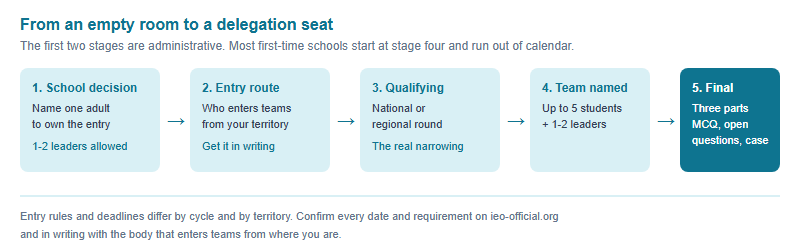
Four decisions to settle before you recruit a single student
Run these in order. Each one can kill the cycle on its own, and each is cheaper to fix in August than in March.
- The route. Find the body that enters teams from your territory and ask it, in writing, how a new school registers. If you cannot establish a route, nothing downstream matters. Start from ieo-official.org rather than from a screenshot forwarded into a parent group chat.
- The adult. One or two leaders may accompany a delegation. Your school needs to name one person early — not because the academic load falls on them, but because someone must own deadlines, permissions, travel authority and the parent-facing communication. A team with five strong students and no named adult is not a team.
- The calendar. You are planning against a shape, not a date: a qualifying stage during the school year and an international final in the middle of the calendar year. The 2026 final ran 12-20 July. Treat next cycle’s dates as unknown until they are published, and check them on ieo-official.org before you promise families anything.
- The language. The team business case is delivered in English. If your school cannot supply a room and an adult for English rehearsal, you have found a real constraint now rather than the week before the final. Our guide to the business case round sets out what that rehearsal has to cover.
Picking five: a role map, not five of the same student
The most common selection error is choosing the five highest economics grades in the year group. That produces a team that is strong at the same things and blind in the same places — usually deep on microeconomic diagrams, thin on finance, and untested at speaking under questioning.
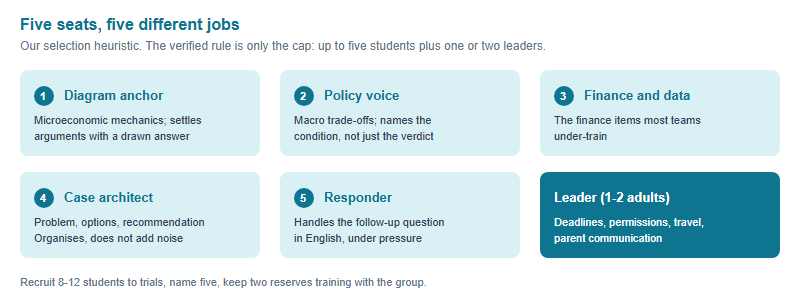
The table below is our editorial framework, not an official structure. The rules we can verify cap a delegation at five students plus one or two leaders and say nothing about internal roles; treat this as a selection heuristic and confirm current rules on ieo-official.org. Its value is that it tells you what to test for in an afternoon of trials rather than reading transcripts.
| Seat | What they own | Signal to look for | How to test it in one afternoon |
|---|---|---|---|
| Diagram anchor | Microeconomic mechanics; the drawn explanation that settles an argument fast | Draws before talking; labels axes without prompting | Give an unfamiliar market shock; ask for a diagram and a 60-second explanation |
| Policy voice | Macro and policy reasoning; the trade-off framing in open answers | Says “it depends on” and then names the condition | Ask a normative question and score whether both sides get an argument |
| Finance and data | The finance and financial-literacy items; interest, risk, returns, statements | Comfortable with compounding and percentages under time pressure | Ten quick numeric items, no calculator debate, hard stop at time |
| Case architect | Structure of the team business case: problem, options, recommendation | Organises other people’s ideas rather than adding a sixth idea | Give a messy one-page brief; ask for a three-slide skeleton in 20 minutes |
| Responder | Answering the unfriendly follow-up question in English | Stays specific when challenged; concedes cleanly and moves on | Two minutes of hostile questioning after a two-minute pitch |
Recruit wider than five. A first-cycle school should try to run trials with eight to twelve students, name five, and keep two reserves who train with the group. Students drop out for reasons that have nothing to do with economics — exam clashes, illness, a parent who says no to travel in July.
A 90-day set-up sequence
This is a school build sequence, not a study plan; the academic sequencing sits in our 12-week preparation plan for the three parts, which you can run in parallel from about day 45.
| Window | Objective | Concrete output by the end of it |
|---|---|---|
| Days 1-15 | Route and permission | A named leader, a written reply from the entering body, a deadline written on the school calendar |
| Days 16-45 | Recruit and select | 8-12 students through trials; five named; two reserves; a weekly meeting slot that survives exam weeks |
| Days 46-75 | Build the academic base | Coverage of micro, macro and the finance and financial-literacy items; one full timed sitting; an error log per student |
| Days 76-90 | Rehearse the case and clear paperwork | Two full case rehearsals with hostile questioning in English; documents and consents settled, and any costs confirmed with the entering body |
The order matters more than the durations. Schools that push paperwork to the end discover consent or passport problems at the point when the students should be rehearsing.
The nine questions to put in writing during days 1-15. Send these to the entering body as a numbered list and keep the reply. Verbal answers in a group chat are not a basis for a school commitment, and answers can change between cycles.
- What is the registration deadline for this cycle, and what is the earliest date we can register?
- Does our student meet the age rule — under 20 on 30 June — and how is that evidenced?
- What are the fees, what do they cover, and when are they payable?
- How is the qualifying round run, and is it sat at school or at a centre?
- How are the five team places allocated after the qualifying round?
- Can a student enter as an individual if the school cannot field a full team?
- What is required of the accompanying leader, including travel?
- Are reserves permitted to train and travel, and under what conditions?
- What language support, if any, exists for the team case round?
Five ways a first cycle actually fails
None of these are academic failures. Each one is common enough that a new school should treat it as a checklist item.
- Route left late. The team studies for two months and discovers the entry window closed. Fix: settle the route in the first fortnight.
- No named adult. Everyone assumes the economics teacher is doing it. Fix: name one person in writing, with a deputy.
- Five identical students. The team is strong on diagrams and cannot handle the finance items or the questioning. Fix: select on the role map, not on grades.
- The case treated as a slide-making exercise. Beautiful decks, no recommendation, no defence under questioning. Fix: rehearse the questions, not the slides.
- English never tested standing up. Students who write fluent English freeze when they must argue in it. Fix: every rehearsal ends with two minutes of unscripted challenge.
If your school is starting from nothing, the honest first-cycle goal is a clean entry and a qualifying attempt with five properly selected students — not a medal. Schools that treat the first cycle as infrastructure usually field a much better second one. For the competition’s overall shape and what the three parts involve, start with our explainer on what the IEO is.
Frequently asked questions
How many students can our school send?
A delegation is up to five students plus one or two leaders. How places are allocated after qualifying should be confirmed with the entering body in your territory.
Do we need a teacher who has done the IEO before?
No. The leader role is largely organisational — deadlines, permissions, travel and communication. Confirm what your entering body requires of leaders.
Can a student enter alone if we cannot field five?
We cannot verify this from the public rules, and it may vary by territory. Ask the body that enters teams from your area in writing.
When should a school start for the next cycle?
Now. The 2026 final ran 12-20 July 2026, so the qualifying stage for the next cycle sits in the school year ahead; check dates on ieo-official.org.
This is an independent guide operated by Hanlin Education for China-based international-school students. We are not affiliated with, endorsed by, or sponsored by the International Economics Olympiad Association. Competition rules, dates, entry routes and formats change — confirm current details on ieo-official.org. Factual errors are corrected within 7 working days of notification.