The December preliminary is a written paper you sit online. The spring National Round is not a longer version of it. According to the 2027 China-route handbook we hold, the annual summit runs thematic economics sessions, a business-plan presentation, a social-innovation showcase, a case poster board, career and data-science workshops, and a timed pitch reserved for the SENIOR division. Preparing only by drilling questions leaves half of that unrehearsed.
Two stages on the same route that ask for different things
Most students planning a cycle picture one continuous escalator: sit a paper, score well, sit a harder paper, score well again. On the Greater China route that picture is wrong at the second step, and the mistake is expensive because it shapes an entire autumn of preparation.
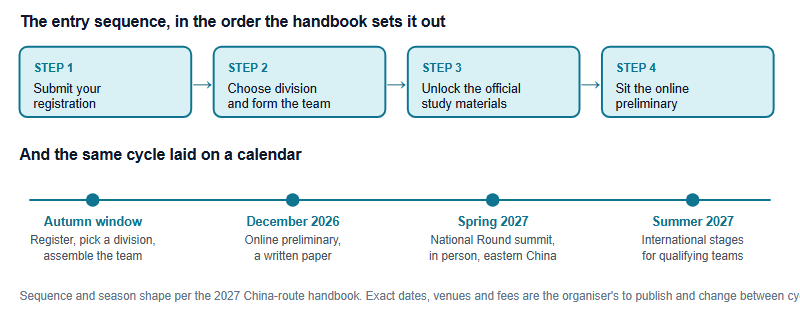
Start with the order of operations, because it surprises people. The handbook sets out entry as four steps, and the sequence — not just the list — is the point:
- Submit your registration for the cycle.
- Choose your division and complete team formation. SENIOR and JUNIOR-HL are team divisions of three to five students in the handbook we hold; JUNIOR-SL can be entered as a team or individually.
- Unlock the official academic materials — the handbook describes a study-support package including a syllabus, a glossary, curated reading and practice.
- Sit the online preliminary, run nationwide and online, in December.
Read that again in order. You choose a division and find teammates before you sit anything, which means you commit without a score to guide you. And the official study materials arrive at step three, not step one, so the weeks before you register are weeks you spend on general economics rather than on anything route-specific. If you are still assembling the basic map of how the route connects to the international olympiad, our overview of what the IEO is and how it is structured is the place to start.
The summit programme, item by item
Here is what the handbook lists for the National Round. We have set it out plainly, with what each item appears to demand and which parts of ordinary exam preparation actually transfer. Two honest caveats before you read it: we hold a handbook, not a running order, so we cannot tell you how long any of these last or how they are weighted; and programmes change between cycles.
| Programme item | What it asks of you | Who it applies to | What transfers from written prep |
|---|---|---|---|
| Thematic economics and finance sessions | Following applied content in a lecture setting and using it later the same day | All divisions | Almost everything — this is the part your paper preparation was for |
| Business-plan presentation | A structured team argument delivered to an audience | All divisions | The economics; almost none of the delivery |
| Social-innovation showcase | Framing a problem worth solving, not just an answer worth marking | All divisions | Little — this rewards problem selection |
| Case poster board | Compressing an analysis into something a passer-by reads in ninety seconds | All divisions | The content; none of the compression |
| Career-exploration workshop | Participation and questions rather than performance | All divisions | Not a performance format — treat it as input |
| Data-science and AI workshop | Working with data and tools alongside other students | All divisions | Quantitative comfort transfers; software familiarity helps |
| Timed pitch (champion round) | Argument under a hard clock, in front of judges | SENIOR division only, per the handbook | Only the underlying analysis |
| Adventure Night | The social programme | All divisions | Nothing, and that is fine |
Count the rows that are unambiguously written-exam skills. One. Count the rows that require you to stand up and talk to people who can interrupt. At least three. That ratio is the whole argument of this article.
Three different ways to present, and the poster is the one nobody rehearses
Teams treat presenting as a single skill. The summit programme suggests it is three, and they compress information at wildly different ratios.
The full presentation is the format most teams practise, and it is the most forgiving. You control the order, you can build an argument in stages, and a weak section can be rescued by a strong one that follows it. Its failure mode is the ten-slide throat-clearing opening in which nothing has yet been claimed.
The timed pitch inverts the risk. Under a hard clock the ordering has to be decided before you start: conclusion first, then the reason, then the evidence, then the caveat — and if you are cut off after the second item you have still said something complete. Teams that lead with methodology risk running out of time before they reach the recommendation, and a recommendation the room never hears cannot do any work for you. The handbook reserves this champion round for the SENIOR division.
The poster is the format almost nobody prepares, and it is the one that punishes exam habits hardest. A poster is read, not performed. The reader chooses the order, arrives without context, and leaves whenever they like. That imposes three rules that a slide deck does not: the headline must state a finding rather than a topic (“Phase the zone over six years” beats “An analysis of the development zone”); there must be exactly one visual doing real work; and every paragraph must survive being read on its own. If you have prepared for the international team business case, much of that thinking carries over — our guide to building and delivering the team business case covers the analytical spine that all three formats share.
Why the summit is not a scaled-down international final
This is the comparison that reorganises most people's preparation, so it is worth being precise about which facts come from where.
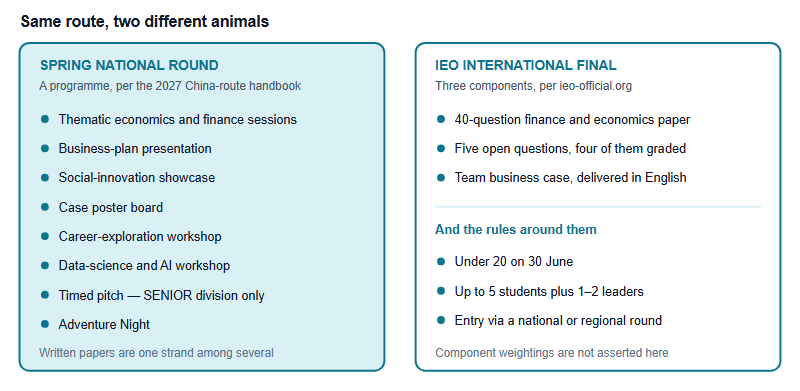
The international olympiad's structure is published by the IEO Association and we treat it as verified: three components — a 40-question finance and economics multiple-choice paper, five open questions of which four are graded, and a team business case delivered in English. Eligibility is an age test, competitors being under 20 on 30 June, and a country is represented by a team of up to five students plus one or two leaders, entering through a national or regional round. We do not assert how those three components are weighted against each other; that is the organiser's to publish, and you should read it there.
Now put the two side by side. The international final is an examination plus one team artefact. The National Round, as the handbook describes it, is a multi-format event in which examination is one strand among several. They are not the same competition scaled up and down. They are two different tests of two overlapping skill sets, arranged in sequence.
One more structural fact worth holding onto: the handbook we hold describes SENIOR as the division carrying the national-team route, and the organiser's China-route site states that the year's Team China emerges from the IEOC series of events. So the summit is not only an event; for one division it is also a selection. That does not change what you should study. It changes how seriously you should take the formats that are not written papers, because those are the formats in which selectors are watching you work with other people.
What to do with the autumn, given all of that
Our own recommendation — editorial judgement, not the organiser's guidance — is to run two tracks in parallel from the moment you register, with the written track dominant until the December paper is behind you.
- Written track (the majority of your hours until December). Micro, macro and personal finance to the depth your division demands, plus timed multiple-choice practice. This is the track our twelve-week preparation plan is built around, and it is the right dominant priority because the preliminary is the stage the handbook puts first — check with the organiser how it determines who continues.
- Artefact track (a couple of hours a week, no more, before December). One habit is enough: every time your team studies a real economic decision, spend fifteen minutes turning it into a one-page poster with a finding as the headline. You are not building a portfolio. You are building the reflex of stating a conclusion before an explanation.
- Then flip the ratio in January. Once the preliminary is done, the next test is a multi-format event, and the scarce skill is delivery under observation rather than another hundred practice questions.
And before you commit anything to a calendar, go and check four things with the organiser rather than with us: the current registration window and fee, the preliminary date and format, the National Round dates and venue, and whether the programme still looks like the one described above. Everything with a year attached to it is perishable, this page included. The structural split — a written preliminary and a multi-format National Round — is what the handbook we hold describes for this cycle.
Common questions
Is the National Round just a harder version of the December preliminary?
No. The preliminary is a written paper; the handbook describes the National Round as a summit with presentations, a poster and workshops.
Do I need a team before I sit the preliminary?
Yes on the team divisions. The handbook puts division choice and team formation before the preliminary, so you commit without a score.
Which division gets the timed pitch round?
The handbook we hold reserves the champion timed pitch for the SENIOR division. Confirm the current programme with the organiser.
Does the international final have the same programme?
No. The final is three components: a 40-question paper, five open questions with four graded, and a team business case in English.
This is an independent guide operated by Hanlin Education for China-based international-school students. We are not affiliated with, endorsed by, or sponsored by the International Economics Olympiad Association. Programme items, division rules, dates and fees on the China route come from a handbook we hold and change between cycles; international rules, eligibility and format are the IEO Association's to publish. Confirm current details on ieo-official.org and with your sending organisation before acting on anything here. Errors are corrected within seven working days of being reported.