For students preparing for the International Economics Olympiad (IEO), understanding how to correct market failures caused by externalities is a common preparation topic in economics competitions. This article addresses a narrow reasoning challenge: comparing three policy instruments—tax, subsidy, and quantity limit—through original teaching illustrations rather than abstract theory alone. No official IEO syllabus documentation confirms the frequency or weighting of these topics in competition materials.
The Core Distinction: Price vs. Quantity
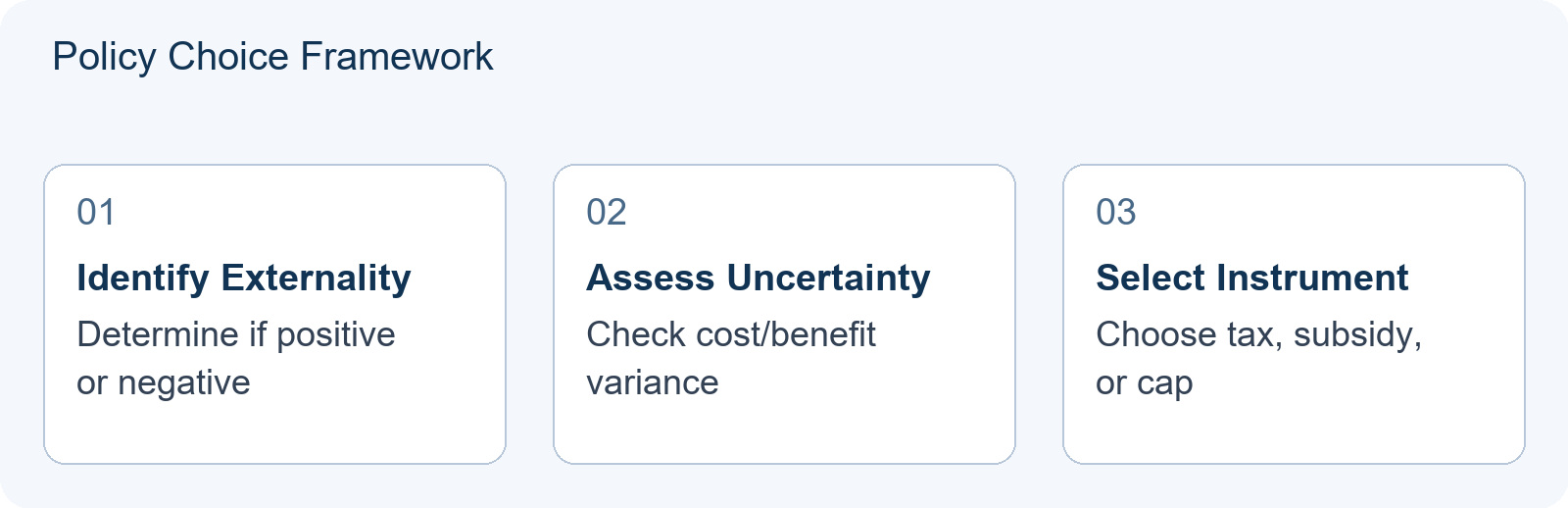
Externalities occur when the production or consumption of a good affects third parties not involved in the transaction. A negative externality (e.g., pollution) leads to overproduction, while a positive externality (e.g., education) leads to underconsumption. The primary difficulty in open-response questions lies in choosing the right tool to align private incentives with social costs or benefits.
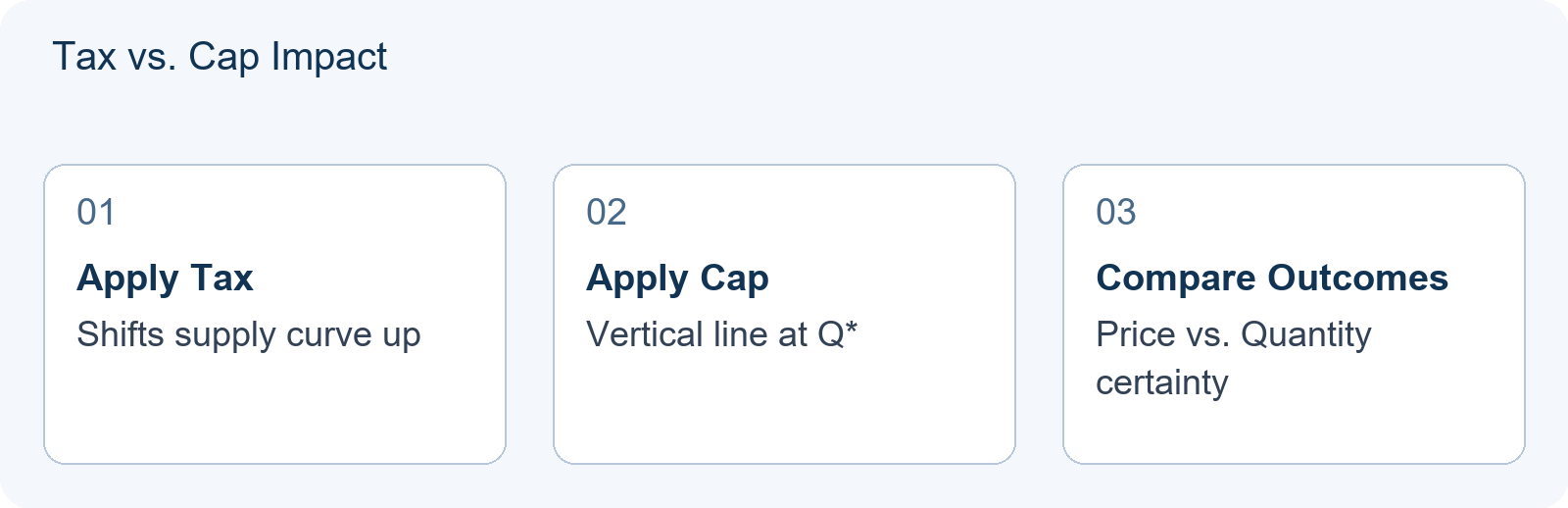
A Pigouvian tax internalizes the cost of a negative externality by raising the price faced by producers. A subsidy lowers the effective price for consumers or producers to encourage activity that generates positive externalities. A quantity limit (or cap-and-trade system) directly restricts the physical amount of the harmful activity, regardless of price fluctuations.
Teaching Illustration 1: The Pollution Tax
The following case is an original teaching illustration, not an official IEO past paper or confirmed competition problem. All numerical values are invented for pedagogical purposes.
Consider a factory emitting carbon dioxide. The marginal social damage (MSD) of each ton of CO2 is estimated at $50 in this invented scenario. Without intervention, the factory produces where its marginal private cost (MPC) equals marginal revenue, ignoring the $50 external cost.
If the government imposes a $50 per-ton tax, the factory’s MPC shifts upward by $50. The new equilibrium occurs where the taxed MPC equals marginal revenue. This reduces output to the socially optimal level. However, if the MSD is uncertain—for example, if scientific consensus varies between $30 and $70 in this illustration—the tax might be too low or too high, leading to residual inefficiency.
Teaching Illustration 2: The Subsidy for Vaccines
The following case is an original teaching illustration, not an official IEO past paper or confirmed competition problem. All numerical values are invented for pedagogical purposes.
Vaccination creates a positive externality by reducing disease spread. Suppose the marginal social benefit (MSB) exceeds the marginal private benefit (MPB) by $20 per dose in this invented scenario. If the government offers a $20 subsidy, the effective price for consumers drops, increasing demand to the socially optimal quantity.
Here, the challenge differs from the tax case. If the supply curve is highly elastic, the subsidy may primarily benefit producers rather than expanding coverage significantly. Conversely, if demand is inelastic, the subsidy might not increase uptake enough to justify the fiscal cost. Students should analyze elasticity to determine whether a subsidy or a direct provision (like free clinics) is more efficient.
Teaching Illustration 3: The Quantity Cap
The following case is an original teaching illustration, not an official IEO past paper or confirmed competition problem. All numerical values are invented for pedagogical purposes.
Imagine a fishery facing overfishing due to the tragedy of the commons. The government sets a total allowable catch (TAC) of 10,000 tons in this invented scenario. Unlike a tax, this limit fixes the quantity regardless of market prices. If demand spikes, the price rises sharply, but the ecological outcome remains stable.
This approach is often preferred when environmental thresholds are strict (e.g., species extinction risks). However, it lacks flexibility. If technology improves, allowing higher sustainable yields, the fixed cap prevents economic gains unless the regulator updates the limit—a process prone to political delay.
Diagnostic Table: Choosing the Right Instrument
| Criterion | Tax/Subsidy | Quantity Limit |
|---|---|---|
| Price Stability | High (price adjusts to clear market) | Low (price can fluctuate wildly) |
| Outcome Certainty | Low (depends on elasticity estimates) | High (exact quantity is fixed) |
| Administrative Cost | Moderate (requires monitoring transactions) | High (requires enforcement of caps) |
| Best For | Diffuse pollutants, consumer goods | Strict ecological thresholds, scarce resources |
Common Preparation Mistake
A frequent error in open-response questions is assuming that a tax always leads to the same outcome as a quantity limit. While both can achieve the same equilibrium quantity under perfect information, they behave differently under uncertainty. Students should practice analyzing scenarios where marginal abatement costs vary across firms. In such cases, a uniform tax may lead to inefficient distribution of reductions, whereas a cap-and-trade system allows firms with lower abatement costs to sell permits, achieving the target at lower total cost.
Targeted Practice Sequence
To master this topic, learners should follow a structured approach:
- Step 1: Identify the type of externality (positive/negative) and its source (production/consumption).
- Step 2: Sketch the standard supply-demand diagram with MSB/MSC curves.
- Step 3: Apply each instrument (tax, subsidy, cap) and observe the shift in curves or constraints.
- Step 4: Evaluate the impact on deadweight loss, administrative burden, and equity.
For guidance on selecting the appropriate IEO preparation pathway, see IEO OpenTrack: Is This the Right Starting Route for Your Preparation?. Students without prior economics coursework may find additional foundation-building strategies in IEO Preparation for STEM Students: Starting Without School Economics. For practice material scarcity concerns, consult IEO Past Papers: How to Build Practice When Official Materials Are Scarce.
Next Steps for Learners
The specific skill to demonstrate next is the ability to defend a policy choice under uncertainty. Instead of memorizing definitions, practice writing short essays arguing why a quantity limit might be superior to a tax in a scenario involving irreversible environmental damage. This critical thinking aligns with the analytical depth expected in economics olympiad environments generally, though no official IEO marking criteria are available to confirm this alignment.
Frequently Asked Questions
Is a Pigouvian tax always better than a quantity limit?
No. A tax is better when marginal abatement costs are known and stable, providing price certainty. A quantity limit is preferable when the environmental threshold is strict and uncertain, ensuring the exact outcome.
How do subsidies affect positive externalities?
Subsidies lower the effective price for consumers or producers, shifting the demand or supply curve to increase activity toward the socially optimal level. Their effectiveness depends heavily on price elasticity.
What is the main risk of using a quantity cap?
The main risk is price volatility. If demand increases, the fixed supply causes sharp price spikes, which can harm consumers and create political pressure to relax the cap prematurely.