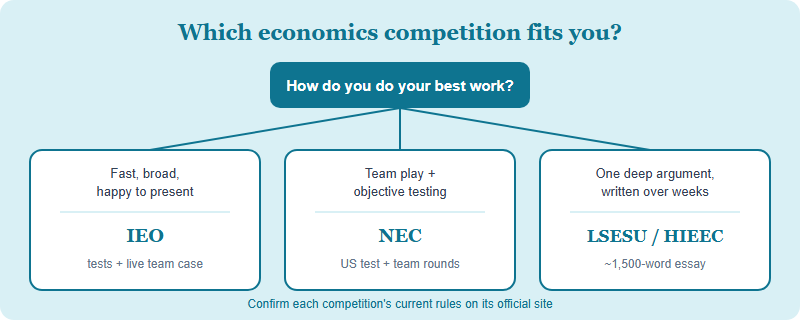
The honest answer is that these are three different sports. The International Economics Olympiad (IEO) is an international olympiad built from timed individual economics and finance tests plus a live team business case; the NEC (National Economics Challenge) is a US test-and-team competition; and the LSESU and HIEEC prizes are single ~1,500-word economics essays. Pick by which one your strengths actually reward.
Why “which is best” is the wrong question
Greater China families often ask us to rank these competitions. We push back, because they do not sit on a single ladder — they test genuinely different abilities. A student who is fast, broad and comfortable presenting will shine in one format and struggle in another; a student who thinks slowly and writes beautifully is the mirror image. The useful question is not “which competition is hardest?” but “which competition rewards the way I already work — and which one stretches me in a direction I want to grow?”
To choose well you need to see each one at the level of format: what you actually do on the day, alone or in a team, timed or over weeks, writing or speaking. Everything else — the prestige, the “does it help admissions” question — flows from getting that fit right first. Below we keep each competition at format level and, for the ones that are not our subject, point you to their official sites for the current rules.
The IEO: an olympiad, not an exam and not an essay
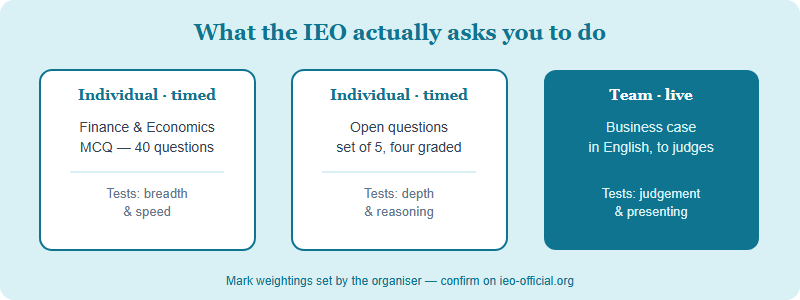
The IEO is run by the IEO Association (based in Bern, Switzerland, and supported by Nobel laureate Eric Maskin) and was founded in 2018 in Moscow. It is annual and open to high-school students who are under 20 on 30 June of the Olympiad year. What makes it distinctive is that it is built from three parts, and they pull in different directions:
- an individual Finance & Economics multiple-choice test (40 questions, per the official materials) — this rewards breadth and speed;
- an individual set of open questions (a set of five, of which four are graded) — this rewards depth and clean reasoning;
- a team business case presented in English before a panel of judges — this rewards applied judgement and communication under pressure.
That third part is the reason the IEO is not an exam. You compete as a national team of up to five students (with one or two team leaders), and you reach the international final not by applying directly but by winning your national or regional round. The exact split of marks between the finance component and the business case is set by the organiser and changes — describe it qualitatively (finance and the live case both carry real weight) and confirm the current weightings on ieo-official.org. For a fuller walkthrough see our guide to what the IEO is and to the team business case.
The IEO moves host cities each year: 2024 Hong Kong, 2025 Baku, and the ninth edition in 2026 in Shenzhen, 12–20 July 2026. If you are in Greater China, the Shenzhen edition makes this an unusually accessible olympiad this cycle — but you still qualify through a national or regional round, not by signing up for the final.
NEC and the essay prizes, at format level
Now the siblings. We keep these at format level on purpose: their specific rules, dates and fees change, so treat the summaries below as the durable shape and confirm each competition’s current rules on its official site.
NEC — the National Economics Challenge, run by the US Council for Economic Education. Like the IEO, it is a test-plus-team competition, but its centre of gravity is different: it is a US competition organised around micro, macro and world-economy content, combining objective testing with team rounds. If you like the IEO’s team energy and its mix of timed testing, NEC is its closest cousin in feel — the honest contrast is simply that the IEO is an international olympiad with a live business case, while NEC is a US test-and-team competition.
The LSESU Economics Society Essay Competition and HIEEC (the Harvard International Economics Essay Competition, run by a Harvard student economics club) are a different animal entirely: each is a single economics essay competition, typically a written argument of around 1,500 words. There is no timed test and no live presentation. You pick a prompt, and over weeks you build one long, original, well-referenced argument. These reward the deep single-argument writer — the student who would rather spend a month perfecting one thesis than answer forty questions in an hour.
Put plainly: the IEO and NEC ask “can you perform across tests and, for the IEO, defend a case live?”; the essay prizes ask “can you write one genuinely good economics essay?” Both are worth doing — but they are not interchangeable.
Side by side: which format is which
Here is the whole comparison in one view. Read across your own strengths — do you win on speed and presence, or on the quality of one sustained written argument?
| IEO | NEC | Essay prizes (LSESU / HIEEC) | |
|---|---|---|---|
| Type | International olympiad | US test + team competition | Single-essay competition |
| Core format | Individual finance/economics tests + open questions + live team business case | Objective tests + team rounds (micro / macro / world economy) | One ~1,500-word written economics argument |
| Solo or team? | Both — individual tests, team business case (up to five) | Team competition | Individual writer |
| Timed or over weeks? | Timed on the day | Timed on the day | Written over weeks |
| Rewards the student who… | Is fast & broad and can present under pressure | Enjoys team play and objective testing | Builds one deep, original written argument |
| Host / organiser | IEO Association (Switzerland) | US Council for Economic Education | Harvard student club (HIEEC) / LSESU |
| Check current rules at | ieo-official.org | the competition’s official site | each competition’s official site |
Sibling formats are summarised at a high level; always confirm each competition’s current rules, dates and eligibility on its own official site.
Match the competition to the student
Strip away the branding and it comes down to a self-assessment. Which of these sounds most like you?
- “I think fast, I like variety, and I don’t mind speaking to a room.” The IEO is built for you. The multiple-choice and open questions reward broad, quick command, and the team business case rewards the confidence to defend a recommendation out loud. Our microeconomics guide shows the kind of breadth the tests expect.
- “I love team competition and objective, testable content.” NEC is the natural home — a US competition with the team dynamic and the micro/macro/world-economy testing you enjoy. (It also pairs well as a complementary season if the IEO is your main target.)
- “I’d rather disappear for a month and come back with one excellent essay.” The LSESU or HIEEC essay prizes reward exactly that — sustained, original written argument, not speed or presentation.
A practical note for Greater China students: these are not mutually exclusive. A common, sensible path is to make the IEO your flagship (especially with the 2026 final in Shenzhen) while entering an essay prize in the same year to develop your writing — the two skill sets reinforce each other. What we would not advise is choosing a format that fights your strengths just because it sounds prestigious. To see how you actually reach the IEO final from the region, read our qualification path.
Frequently asked questions
Is the IEO the same kind of competition as NEC?
Similar energy, different scope. Both mix testing with team rounds, but the IEO is an international olympiad with a live business case; NEC is a US test-and-team competition.
How is the IEO different from an economics essay prize?
The IEO is timed tests plus a live team case. LSESU and HIEEC are single ~1,500-word written essays — no timed test, no presentation.
Can I enter more than one in the same year?
Often yes — many students run the IEO as their flagship and enter an essay prize too. Check each competition’s calendar and rules on its official site.
Which should a Greater China student pick?
Pick by strengths: fast, broad, presents well → IEO; team + objective testing → NEC; deep single argument → an essay prize.
This is an independent guide to the International Economics Olympiad for Greater China students, operated by Hanlin Education; NOT affiliated with, endorsed by, or the official site of the International Economics Olympiad Association (ieo-official.org). Rules, eligibility, dates and the host city are set by the organiser and change each year — always confirm current details on the official channels; corrected within 7 working days.