A workable 12-week IEO prep plan front-loads economics and finance fundamentals in weeks 1–4, layers timed open-question practice through weeks 5–8, and reserves weeks 9–12 for the team business case and English presentation — the part most Greater China students under-rehearse. Count backwards from your national or regional round, not from a fixed date, and confirm your round's timing on the official channels.
Why 12 weeks, and why count backwards from your round
The International Economics Olympiad is not one exam you can cram; it is three different assessments bundled together. Each rewards a distinct skill, so a single “study economics harder” approach leaves you lopsided — usually strong on recall and weak on the live business case. Twelve weeks is enough to build genuine breadth, then convert it into depth and performance, without burning out.
The most important framing decision: anchor every week to “weeks before your round,” not to a calendar date. Greater China students qualify by winning a national or regional round, and those dates move each cycle — so “Week 1” below means “twelve weeks before you sit that round.” If your round is closer than twelve weeks away, compress the early phases rather than skip the business-case rehearsal at the end. Always confirm your round's date and format on ieo-official.org and with your regional organiser before you lock the plan in.
One more honest caveat up front: the exact mark weightings of the three parts are set by the organiser and can change, so this plan does not assume a fixed split. It allocates study time by difficulty and rehearsal-cost — the business case needs shared calendar time you cannot recover late — and you should confirm the current weightings on ieo-official.org before deciding where to push hardest.
The three parts this plan has to balance
Before the week-by-week shape, be clear on what you are training for. These are the durable facts; treat everything time-bound as “confirm on official.”
| Part | Format (per the official) | What it tests | Where it lives in the plan |
|---|---|---|---|
| Finance & Economics MCQ | 40 multiple-choice questions across economics and finance | Breadth & speed of recall | Built weeks 1–4, kept warm to Week 12 |
| Open Questions | A set of 5 open questions, of which 4 are graded | Depth & structured reasoning | Core focus weeks 5–8 |
| Team Business Case | A case solved as a team and presented in English before judges | Applied judgement + communication under pressure | Rehearsed weeks 9–12 |
Two structural facts shape how you should train. First, the business case is a team event — a national team is up to five students — so it needs shared rehearsal time that individual study cannot substitute for. Second, the qualitative reality is that the finance-flavoured questions and the business case both reward applied, real-world reasoning, not just definitions — but do not assume a specific percentage weight for either; confirm the current shares on ieo-official.org.
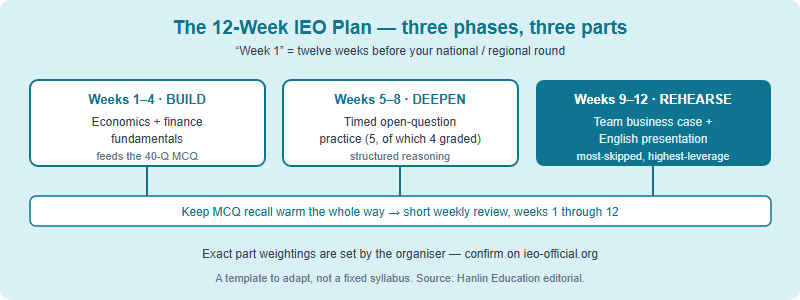
Weeks 1–4: build the economics and finance base
The first month is about breadth, because the 40-question MCQ rewards recognising the right concept fast across both economics and finance. If your foundations are shaky, no amount of open-question drilling later will paper over it. Work systematically rather than by mood.
- Week 1 — core microeconomics. Supply and demand, elasticity, marginal analysis, market structures, and welfare. Start from our microeconomics syllabus guide so you cover the right ground rather than a random textbook order.
- Week 2 — core macroeconomics. National income, inflation, unemployment, monetary and fiscal policy, and the basic open-economy picture. Aim to explain each concept in two plain sentences before moving on.
- Week 3 — financial literacy and finance basics. Interest, present value, risk and return, diversification, and how to read a simple financial statement. This is the material many economics-only students neglect, and it is exactly where the finance-flavoured questions live.
- Week 4 — consolidate and self-test. Sit a full timed 40-question set under exam conditions, mark it honestly, and log every miss by topic. Those logged gaps become your targeted review list — do not just re-read everything.
By the end of Week 4 you should have one artefact: a short, ranked list of your weakest topics. That list, not a vague sense of “I'm behind on macro,” is what you carry into the next phase.
Weeks 5–8: layer in open-question depth
The open-question part — a set of five, of which four are graded — is where breadth turns into depth. Here you are not recognising an answer; you are constructing one with clear steps, correct economics, and a defensible conclusion. The habit to build is structure: define, reason, conclude.
- Week 5 — technique. Practise laying out an answer explicitly: state the concept, apply it, and state the implication. Reward yourself for showing the reasoning, not just landing the number.
- Week 6 — applied economics. Tackle questions that put a concept into a real scenario (a tax, a shock, a policy choice). This is the reasoning muscle the business case will also use.
- Week 7 — finance-flavoured problems. Bring the Week 3 finance base into open-question form — valuation logic, trade-offs, and interpreting data. Keep confirming the syllabus scope so you practise in-scope material.
- Week 8 — timed sets and review. Do full open-question sets against the clock, then review with a teacher, mentor, or strong peer who can tell you where your reasoning was thin. Keep sitting a short MCQ review each week so recall does not decay.
A realistic note: this is the phase students most often stretch, because depth is slower to build than recall. If you fall behind schedule, protect Week 8's timed practice — performing under time pressure is a separate skill from knowing the material.
Weeks 9–12: rehearse the team business case (the part most students skip)
This is the phase that separates finalists from strong test-takers, and it is the one Greater China students most often under-invest in. The team business case is presented in English, before judges, as a team of up to five — which means it needs shared calendar time that no individual can create alone. Booking that team time is the single most-skipped step in IEO prep.
- Week 9 — assemble the team and a method. Agree roles (who frames the problem, who runs the numbers, who owns the recommendation, who handles Q&A) and a repeatable structure for attacking any case: situation, analysis, options, recommendation.
- Week 10 — full practice cases. Run at least two complete cases end to end, each with a strict time box for solving and presenting. Record yourselves; watching it back is uncomfortable and extremely useful.
- Week 11 — presentation polish and English delivery. Tighten slides or notes, drill transitions between speakers, and rehearse the English out loud — pace, signposting, and handling a judge's follow-up. Fluency of delivery, not just correct content, is what carries a room.
- Week 12 — dress rehearsal + light review. Do one full mock in front of a mock panel (a teacher or advisor asking hard questions), then taper. Keep MCQ and open-question skills warm with short, low-intensity review — do not try to learn anything new in the final week.
Because the exact weighting of the business case is set by the organiser and can vary, confirm its share on ieo-official.org before deciding how aggressively to prioritise these weeks. But even where the point weight is modest, this is the hardest part to improve at short notice — which is precisely why it earns dedicated, protected time here.
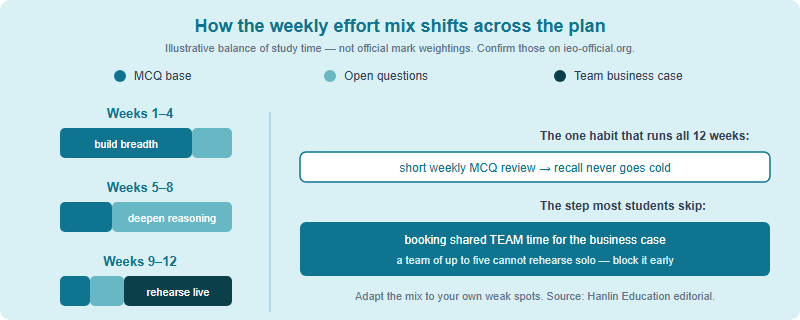
Adapting the template to your situation
This is a template, not a prescription. Three common adjustments:
- Less than 12 weeks? Compress the build phase (combine Weeks 1–2 of economics into a faster review if your foundations are already solid), but do not cut the final business-case rehearsal — that is the phase with the least substitute.
- Already strong on theory? Shift earlier into open-question and case practice, and use the MCQ review purely to keep recall sharp rather than to learn from scratch.
- Weak on English delivery? Start light presentation practice in Week 5 instead of Week 9, so the final weeks refine rather than build fluency from zero.
Whatever you adjust, keep the plan anchored to your actual round. To sanity-check which round you sit and roughly when, start from our qualification-path guide and then verify current-year timing on the official channels — the durable rule for Greater China students is that you reach the international stage by winning your national or regional round, and its date drives everything above.
Frequently asked questions
When should I start the 12-week plan?
Count backwards twelve weeks from your national or regional round, not from a fixed date. Confirm your round's timing on ieo-official.org.
Which part should I prioritise?
Build MCQ breadth first, then open-question depth, then the team business case — exact mark weightings are set by the organiser, so confirm them on ieo-official.org.
Why rehearse the business case so late and so hard?
It's a team event presented in English before judges; it needs shared rehearsal time you cannot recover, and it's the hardest part to improve last-minute.
Can I follow this plan with fewer than 12 weeks?
Yes — compress the early fundamentals, but keep the final business-case and presentation rehearsal intact, since it has the least substitute.
This is an independent guide to the International Economics Olympiad for Greater China students, operated by Hanlin Education; NOT affiliated with, endorsed by, or the official site of the International Economics Olympiad Association (ieo-official.org). Rules, eligibility, dates and the host city are set by the organiser and change each year — always confirm current details on the official channels; corrected within 7 working days.