The IEO 2026 international final is happening right now: Shenzhen is hosting the world’s qualifying teams from 12 to 20 July 2026. If you are a Greater China student aiming at the next cycle, this week is not just a spectator event — it is the single richest source of free preparation intelligence you will get all year. Here is what to watch, what to record, and how to convert finals week into a head start, without waiting for results.
What is actually happening in Shenzhen this week
The International Economics Olympiad’s annual final brings together teams that qualified through their national or regional rounds. Each country or region fields a team of up to five students plus one or two team leaders, and every competitor had to be under 20 on 30 June to be eligible. In 2026, for the first time the final is being held in Shenzhen — a short trip for Greater China observers who, in previous years, would have had to follow a final in Baku (2025) or further afield.
To be clear about what we will and will not say: the 2026 final has not finished, so no results, standings, medal counts, or participation figures for Shenzhen exist yet — and you should be suspicious of any page that claims otherwise before the organisers publish them. When official results appear, they will appear on ieo-official.org and the organisers’ channels. Everything in this article is about the structure of the event and how to learn from it, not about outcomes.
What the finalists face this week follows the competition’s established three-part format: a 40-question Finance & Economics multiple-choice exam, a set of five open questions of which four are graded, and a team business case prepared and presented in English before a panel. (If you are new to the competition entirely, read What Is the IEO? first, then come back to this piece.)
The scale you are watching: what 2025 tells us
Since 2026 numbers do not exist yet, the most recent verified benchmark for what an IEO final looks like is Baku 2025: 52 countries, 258 participants, and 133 medals awarded — 24 gold, 43 silver, and 66 bronze — with Singapore taking team gold. Those figures are worth internalising for two reasons. First, they tell you the final is a genuinely international field, not a regional gathering. Second, they tell you that a meaningful share of finalists medal — which reframes the goal: the hard filter is qualifying through your national round, and the final is where preparation quality gets ranked. We analysed what the strongest 2025 teams appeared to do differently in our foundation coverage and the Baku recap; the short version is that medal-level teams treated all three parts as first-class citizens instead of over-indexing on the MCQ.
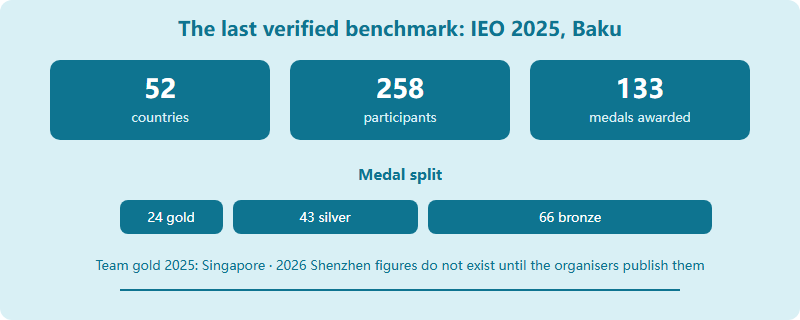
Update, since this piece first ran: the organiser has now published the 2026 figure, so the sentence above no longer has to lean on 2025 alone. The official site currently lists 54 participating countries for 2026, against 52 in 2025 and 50 in 2024, and gives 74 as the total number of countries that have taken part across the competition's history. The trend is the useful part rather than any single year: the field has grown in each of the last three cycles, which is the honest answer to a student asking whether national selection is getting easier. It is not.
Five things to track during finals week (and why each matters)
You do not need to be inside the venue to extract value from this week. Here is a concrete observation checklist — each item feeds directly into next-cycle preparation.
| What to track | Where to look | Why it matters for your cycle |
|---|---|---|
| Official announcements and schedule updates | ieo-official.org and organiser channels | Shows you the real rhythm of a final — exam days, case-prep windows, presentation days — so next year’s calendar holds no surprises |
| The business case theme, once organisers make it public | Official post-event materials | Case themes reveal what analysis judges expect; rehearsing on real past themes beats invented practice cases |
| Results and medal boundaries, when published | Official results pages only | Tells you the competitive density at the top — and gives you honest benchmarks instead of forum rumours |
| Which teams medal, and any released materials about their preparation | Official channels, verified interviews | The closest thing to a syllabus for “what winning preparation looks like” |
| Your own national round’s next-cycle dates | Your national/regional organiser | Qualification runs through national rounds — that date, not the final, is your real deadline |
One discipline note: log what you find with sources and dates. A simple spreadsheet of “claim — source — date checked” will keep you from building next year’s plan on a rumour. Treat unverified Discord and forum numbers the way a good economist treats an unsourced statistic.
Turning observation into a head start: the week-after plan
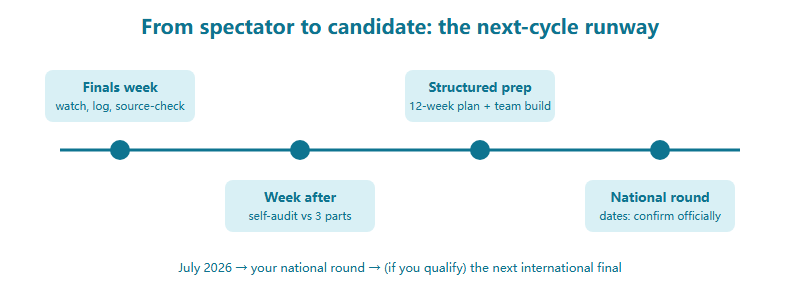
Watching is only worth something if it changes what you do. Here is how to convert finals week into the first week of your own campaign:
- Fix your real deadline. The final is the visible summit, but your gate is the national or regional round. Find your round’s registration window and exam date through official channels, and put them in your calendar before anything else.
- Audit yourself against the three parts. Score yourself honestly: Could I handle a 40-question finance-and-economics MCQ today? Could I write four graded open answers? Could I present a business case in English to a panel? Most students discover exactly one glaring weakness — usually the business case for solo-study types, or written answers for test-prep types.
- Start the structured clock. A term-length runway is realistic for a well-prepared student; our 12-week prep plan maps the three parts week by week, and starting it in the summer after watching a final gives you slack most candidates never have.
- Recruit your team early. The business case is a team event, and teams of up to five need time to develop division of labour — who models, who structures, who fronts the Q&A. Teams assembled the month before a round present like it.
- Re-check everything against the official site when the season opens. Formats, dates, and rules are the organisers’ to set and change; build your plan on ieo-official.org, not on what last season looked like.
A home-region final: why Shenzhen matters for Greater China students
There is a softer, but real, effect of the final being hosted in Shenzhen: proximity makes the competition concrete. For years, Greater China students experienced the IEO final as a distant livestream event in another time zone. This year the event is in the same region, in a city many of our readers can point to on a commute map. That does not change the economics on the exam papers, but in our coaching experience it changes motivation — a competition you can picture is a competition you prepare for seriously. If the Shenzhen final puts the IEO on your radar for the first time, treat that as the useful outcome of the week, then channel it into the checklist above rather than into refreshing unofficial result rumours.
And a final repetition, because it is the claim most likely to be corrupted in your social feeds this week: until the organisers publish them, there are no 2026 results. Bookmark ieo-official.org, wait for the official word, and spend the intervening days on step one of your own plan.
Frequently asked questions
When and where is the IEO 2026 international final?
Shenzhen, China, 12–20 July 2026 — running this week. For schedule details and any updates, rely on ieo-official.org and the organisers’ channels.
Have the IEO 2026 results been announced?
Not at the time of writing — the final is still in progress. Treat any medal counts or standings circulating before official publication as unverified.
Can students attend or watch the final without competing?
Access arrangements are set by the organisers and hosts, so confirm on ieo-official.org. Even without venue access, official announcements and post-event materials carry most of the learning value.
How do I compete in the next IEO cycle from Greater China?
Qualification runs through your national or regional round, with eligibility under 20 on 30 June. Find your round’s official dates, then work backwards with a structured plan of roughly 12 weeks.
This is an independent guide operated by Hanlin Education for China-based international-school students. It is not affiliated with, endorsed by, or sponsored by the International Economics Olympiad Association. Always confirm current rules, dates, and formats on ieo-official.org. If you spot an error, we correct verified inaccuracies within 7 working days.