The IEO is worth serious consideration for students applying to economics, finance, or business programmes — not because any competition guarantees an offer (none does), but because its three-part format demonstrates a rare combination: quantitative breadth, written reasoning, and English-language teamwork under pressure. This article takes an honest look at what the International Economics Olympiad signals to admissions readers, what it does not, and how to present it credibly.
First, the honest disclaimer: no competition is a golden ticket
Let us set the frame before the analysis. No olympiad — not the IEO, not any mathematics or science olympiad — guarantees admission anywhere. Admissions offices at selective universities read applications holistically: grades and predicted scores carry the most weight, and activities are context, not currency. Anyone who tells you a medal “gets you in” is selling something.
What a well-chosen competition can do is answer a question every admissions reader silently asks about an economics applicant: has this student engaged with the subject beyond the classroom, and at what level of rigour? That is the honest ceiling of the admissions value — and it is still a meaningful ceiling, because most applicants to economics programmes present nothing beyond coursework and a generic essay about supply and demand.
What the IEO’s structure actually demonstrates
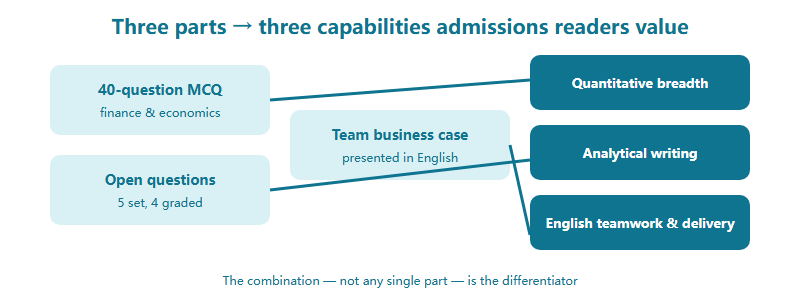
The IEO is an international olympiad for high-school students, organised by the IEO Association (based in Bern, and supported by Nobel laureate Eric Maskin), with participants qualifying through national or regional rounds. Its format has three parts: a 40-question Finance & Economics multiple-choice exam, five open questions of which four are graded, and a team business case delivered in English. (New to the competition? Start with our foundation guide to the IEO.)
Each part maps onto a capability that economics and business programmes explicitly value:
- The MCQ paper signals breadth across economics and finance — unusual among school-level competitions, most of which test one or the other. For applicants to finance-flavoured degrees, this is a directly relevant differentiator.
- The open questions signal written analytical reasoning — the skill closest to what undergraduate economics actually demands in essays and problem sets.
- The business case signals structured teamwork and spoken English in front of a judging panel. For international students applying to English-medium universities, a documented instance of presenting analysis in English under pressure is worth more than another line of solo test scores. Our business case guide explains what this round involves.
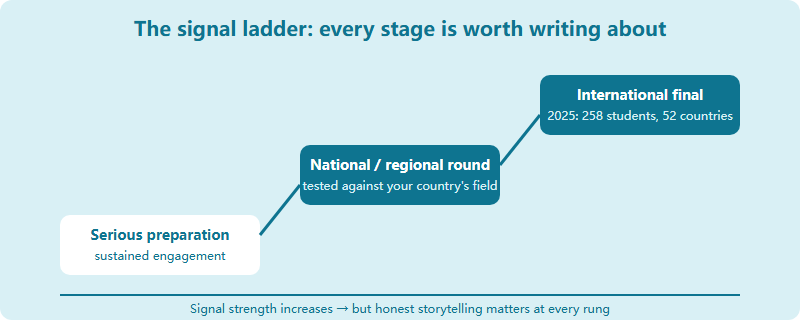
There is also a selection signal in the funnel itself. Reaching the international final means passing a national or regional round first — a filter admissions readers understand intuitively. For scale: the 2025 final in Baku drew 258 participants from 52 countries, with 133 medals awarded (24 gold, 43 silver, 66 bronze) and Singapore taking team gold. Numbers for future finals will differ; cite only the cycle you competed in, from official results.
How to present the IEO at each application touchpoint
The same credential lands very differently depending on how it is written up. Here is how the IEO can appear across the main components of an application — whether you reached the final or stopped at a national round.
| Touchpoint | Weak presentation | Strong presentation |
|---|---|---|
| Activity list | “Participated in economics olympiad” | Name the round reached, the team role in the business case, and one concrete responsibility (e.g. built the recommendation slide, led Q&A) |
| Personal statement / essays | “Winning taught me perseverance” | One specific intellectual moment: an open question that changed how you think about a policy, a case assumption your team debated |
| Interview (Oxbridge-style or alumni) | Reciting your medal colour | Being ready to re-derive the economics of a question you faced — interviewers probe depth, not trophies |
| Teacher recommendation | Teacher unaware you competed | Brief your referee on what you prepared and how, so the letter can corroborate independent study |
| Supplementary evidence | Unverifiable claims | Only claims that match official results published by organisers; never inflate a round or a rank |
The pattern across all five rows: admissions readers reward specificity and intellectual content, not the credential label. A national-round participant who writes vividly about one open question will usually out-present a finalist who lists a medal and says nothing about the economics.
Who gets the most admissions value from the IEO
The IEO’s signal is not equally valuable for every applicant profile. Based on our editorial read of how the format maps to degree demands, three profiles benefit most:
- Economics and PPE applicants who need evidence of analytical engagement beyond the syllabus. The open-questions round is the closest school-level analogue to undergraduate economics work.
- Finance and business-school applicants who can point to the finance half of the MCQ and the business case as directly major-relevant experience — a combination essay competitions do not offer.
- Students with strong grades but thin activity sections, for whom one rigorous, internationally benchmarked competition beats five shallow club memberships.
Conversely, be realistic about opportunity cost. If you are already deep into a research project, an established essay-prize pipeline, or another olympiad, adding the IEO late in the cycle may dilute rather than strengthen your narrative. Depth in one credible activity almost always reads better than breadth across many. And check the practicalities early: eligibility runs to under 20 on 30 June, teams can include up to 5 students plus 1–2 leaders, and you must qualify through your national or regional round — confirm your local round’s dates and rules on ieo-official.org before you commit a season to it.
Building the credential: a realistic timeline
If the admissions logic persuades you, work backwards from your application deadlines. Qualification runs through national or regional rounds, so your first fixed point is your local round’s registration window and exam date — both set locally and best confirmed through official channels rather than assumed. From there, a structured preparation cycle of roughly one school term is realistic for a student with solid school economics; our 12-week IEO prep plan lays out how to cover all three parts without letting the MCQ crowd out writing and presentation practice.
Two sequencing notes for applicants specifically. First, if you are applying in the autumn of your final school year, a final held in July (as the 2026 final in Shenzhen is, running 12–20 July) lands just before applications — convenient timing if you qualify, but do not build your entire narrative on a result you do not yet have. Write your application around the preparation and the national round, and let any international result be upside. Second, keep every claim verifiable: rounds reached, roles played, results published. Admissions offices can and do check, and one inflated line can discredit an otherwise strong file.
Frequently asked questions
Does an IEO medal guarantee admission to a top economics programme?
No. No competition guarantees admission. The IEO is context that strengthens an application narrative; grades, predicted scores, and overall fit still carry the most weight.
Is the IEO useful if I only reach the national round?
Yes, if you present it with specificity: what you prepared, the round you reached, and one intellectual takeaway. Specific engagement usually reads better than a bare credential.
Which majors does the IEO signal best for?
Economics, PPE, finance, and business programmes — the MCQ covers finance and economics, the open questions mirror analytical writing, and the English business case maps to business-school demands.
When should I start preparing if I want it on my application?
Work backwards from your national round date, which is set locally — confirm it via official channels. A focused term of preparation (about 12 weeks) is a realistic baseline for a student with solid school economics.
This is an independent guide operated by Hanlin Education for China-based international-school students. It is not affiliated with, endorsed by, or sponsored by the International Economics Olympiad Association. Always confirm current rules, dates, and formats on ieo-official.org. If you spot an error, we correct verified inaccuracies within 7 working days.