Before you enter the International Economics Olympiad (IEO) from Greater China, it helps to understand two things the head-term guides skip: entrants are sorted into divisions by level, and only some divisions can progress all the way to the global final. The rest compete through regional and invitational rounds (such as the Singapore and Hong Kong international invitationals). This guide maps that structure so you enter the right division and know where it can take you. As always, this is an independent guide — confirm current divisions, rules and dates on the official IEO channels (ieo-official.org).
The divisions, by level
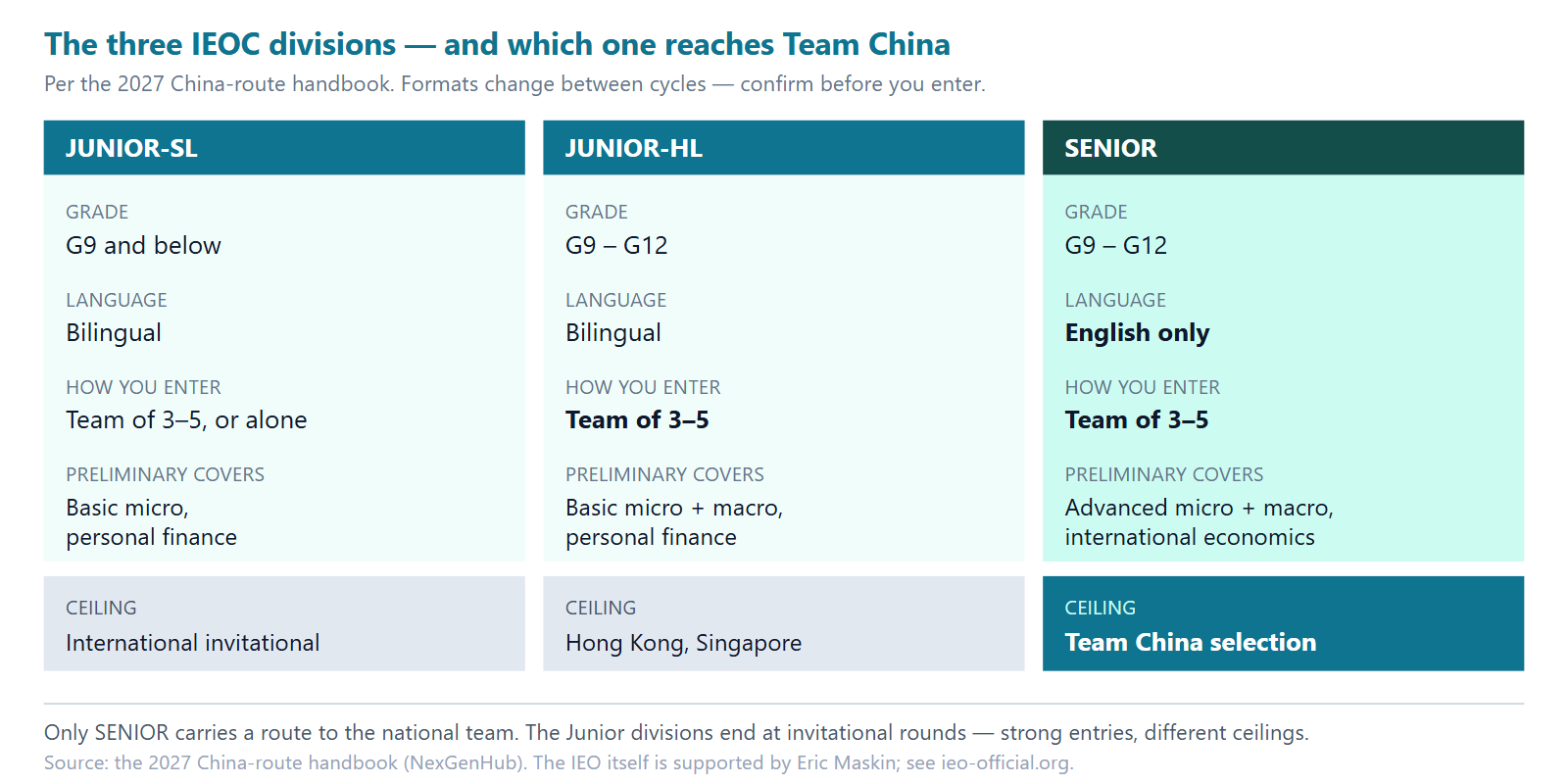
Within the Greater China route — run as the IEOC financial-literacy summit series — entrants are grouped into three divisions. The differences that matter are the level of economics assumed, the language you sit in, whether you need a team, and — critically — which division can reach the national team:
| Division | Grade | Language | How you enter | Preliminary covers | Ceiling |
|---|---|---|---|---|---|
| JUNIOR-SL Rookie (Regular) |
G9 and below | Bilingual | Team of 3–5, or individually | Basic microeconomics, personal finance | International invitational rounds |
| JUNIOR-HL Rookie (Senior) |
G9–G12 | Bilingual | Team of 3–5 | Basic micro and macro, personal finance | Hong Kong and Singapore invitationals |
| SENIOR Professional |
G9–G12 | English only | Team of 3–5 | Advanced micro and macro, international economics | National team selection |
Three practical consequences follow. First, if your goal is the global final, SENIOR is the only division that carries a route to the national team — the Junior divisions are real competitions with real international invitationals, but different ceilings. Second, the Junior divisions are sat bilingually and SENIOR is English-only, so a student whose economics is ahead of their English has somewhere sensible to start. Third, and most often missed: you form your team before you sit the preliminary, not after — the published entry sequence is register, choose a division and complete your team, unlock the academic materials, then sit the online preliminary. JUNIOR-SL is the one division you may enter alone.
All entrants must be under 20 on the eligibility date. The division structure above is as set out in the 2027 China-route handbook; formats have changed between cycles before, so confirm the current definitions on the official channels before you commit a team to one.
Regional and invitational rounds
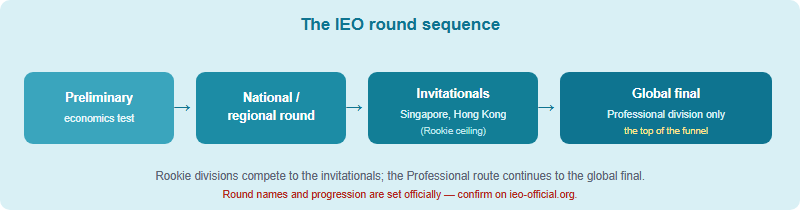
One reason the IEO confuses newcomers is that “the IEO” is not a single sitting. A Greater China entrant progresses through a sequence — a Preliminary, then a national/regional round, and for some divisions an international invitational (the Singapore and Hong Kong invitationals are the best-known), with the global final as the top of the funnel for the Professional route. Two takeaways:
- The invitationals are real, ranked international rounds in their own right — not warm-ups — and are where many strong Rookie-division students earn their headline result.
- The global final is the ceiling for the Professional division only. If reaching it is your goal, that constrains your division choice from the start.
For the competition's three international components in detail, see our guide to what the IEO is and the business-case round.
How honours are awarded at the Preliminary
At the Preliminary economics test, honours are typically awarded in three separate ways — which is why two students with similar scores can come away with different-looking results:
| Honour | Basis | Approx. share (confirm officially) |
|---|---|---|
| Individual achievement certificate | Individual total at or above a set score (around 70 out of 100 in a recent cycle) | ~35–40% |
| Team total honour | Team total in the top band (first / second / third) | ~ top 20% |
| Individual subject honour | Individual total in the top band (first / second / third) | ~ top 15% |
Treat those cut-offs as a recent-cycle guide, not a fixed rule: score thresholds and percentages are set by the organiser each year and can move. The structural point is durable — there are separate individual and team honours, so it is worth understanding which one your division and goals point toward.
Choosing your division
Work from your goal backward. If you want a shot at the global final, enter the Professional division and prepare for its case-analysis and team element as well as the written test. If you are newer to economics or in a lower grade, a Rookie division is a strong, well-matched entry point — with international invitationals as a genuine target rather than a consolation. Either way, get the division right first: it decides both the level you are tested at and the ceiling you can reach.
The season, end to end
Until now this site has described the Greater China route in the abstract, because the calendar was not published in a form we could point at. The 2027 handbook sets it out, and the shape is worth internalising early, because the first deadline is the one students miss:
| Stage | When | Where | What happens |
|---|---|---|---|
| Registration | Early-bird closes 1 October | Online | Register, pick a division, form your team |
| Preliminary round | December 2026 | Online, nationwide | Micro, macro and personal finance, scoped to your division |
| Annual summit the national round |
Spring 2027 | Eastern China | Economics and finance papers, a business proposal presentation, a social-innovation showcase, data-science and AI workshops, a case poster, and a timed pitch round for the champion teams in SENIOR |
| International showcase | Summer 2027 | Hong Kong, Singapore, Australia and others | Strong teams travel to invitational rounds |
Read that calendar backwards and the planning problem becomes obvious. The summit is where the national team is chosen, the preliminary sits in December, and team formation happens before that — so a SENIOR entrant who starts looking for two or three teammates in November has already lost the autumn. Dates and fees are as published in the 2027 handbook; confirm them on the official channels before you plan around them.
Where the route has led
The China-route organiser publishes an alumni page, which is the closest thing to an outcome record this pathway has. Read it for what it shows — that students who went deep on this route were serious enough to reach national teams and international invitationals — and not as a claim about admissions. No competition result causes an offer, and nobody, ourselves included, can tell you what any single line here contributed:
| Alumnus | Now at | Competition record as published |
|---|---|---|
| Khow X | Harvard University | Malaysian national team, IEO 2025; individual bronze at the 2025 global final |
| Eric X | University of Pennsylvania | Chinese national team, IEO 2025; individual gold at the 2025 global final |
| Le L | University of Cambridge | Chinese national team, IEO 2025; individual gold at the 2025 global final |
| Ziyue X | Stanford University | Chinese national team, AAEO 2024 |
| Yiqiu Z | University of Oxford | Chinese national team, AAEO 2024 |
| Zixin Y | Carnegie Mellon University | Chinese national team, AAEO 2025 |
| Donglin L | University of Chicago | Former Singapore-round entrant; led a school economics society |
| Zhengjun S | The University of Hong Kong | Hong Kong invitational; individual distinction, 2026 |
| YIWEN S | Imperial College London | IEOC 2025 participant |
Two things in that table are worth noticing rather than skipping. Almost every entry runs through a national team or an international invitational rather than through the preliminary alone — which is the practical argument for choosing the division whose ceiling matches your ambition. And the routes are plural: an invitational in Hong Kong or Singapore appears about as often as the global final does. Names and destinations are as published by the organiser.
Frequently asked questions
How many divisions does the IEO have in Greater China?
Entrants are typically sorted into three: Rookie (Regular), Rookie (Senior) and Professional, by level of economics. Confirm the current definitions on ieo-official.org.
Which IEO division can reach the global final?
The Professional division is the route toward the global final; it adds case analysis and a team element to the written test. The Rookie divisions compete through regional and invitational rounds.
What are the Singapore and Hong Kong invitationals?
They are ranked international invitational rounds within the IEO structure — real competitions where many Greater China students earn a headline result, distinct from the global final.
How are IEO honours decided?
At the Preliminary, honours are awarded separately for individual achievement, team total, and individual subject placing. Exact score thresholds and percentages are set officially each year.
This is an independent guide to the International Economics Olympiad for Greater China students, operated by Hanlin Education. It is not affiliated with, endorsed by, or the official site of the International Economics Olympiad Association (ieo-official.org). Division definitions, round structures, dates and honour thresholds are set by the organiser and the regional programme and change each year — always confirm current details on the official channels. Confirmed errors are corrected within 7 working days.