The Open Questions round is the middle part of the International Economics Olympiad’s three-part format: five open-ended prompts, of which four are graded, sitting between the 40-question Finance & Economics multiple-choice paper and the team business case. It is the part where writing quality — not just knowing the answer — determines your score, and it is the part Greater China candidates most often under-train. This guide breaks down how the round works and how to prepare for it.
Where the Open Questions sit in the IEO’s three-part format
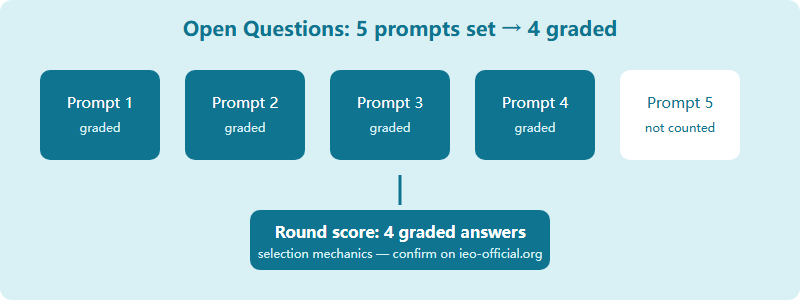
According to the IEO’s own description of its format, the competition consists of three parts: a 40-question multiple-choice exam covering finance and economics, a set of five open questions of which four are graded, and a team business case presented in English before a panel. (For a full orientation to the competition, start with our foundation guide, What Is the IEO?.)
Each part rewards a different skill. The MCQ rewards breadth and recall under time pressure. The business case rewards teamwork, structure, and spoken English. The Open Questions round is the only part that rewards individual written economic reasoning — the ability to take a prompt, build an argument with correct economic mechanisms, and communicate it clearly on paper. How the parts are weighted in the overall score is not something we will assert here; confirm the current scoring rules on ieo-official.org, because organisers can adjust details between seasons.
The “five set, four graded” structure is worth pausing on. It means the round has built-in slack: not every prompt you face will count equally against you. Exactly how the four graded questions are determined in the current cycle — and how much time you get — should be confirmed on the official site before you sit any round. What matters for preparation is the strategic consequence: you are not required to be equally strong on every prompt, but you cannot afford to be weak on two.
Why this round punishes MCQ-style preparation
Most Greater China candidates arrive at the IEO from a background of test-prep economics: multiple-choice drills, definition memorisation, and formula recall. That background is genuinely useful for the 40-question MCQ paper. It transfers poorly to open questions, for three reasons.
- Open prompts rarely have a single “correct” answer. They typically ask you to analyse, evaluate, or apply — which means the grader is scoring your reasoning chain, not a final letter choice. A memorised definition earns you the first sentence, not the answer.
- Partial credit flows to visible mechanisms. An answer that says “price rises” earns less than one that shows why the price rises: which curve shifts, what the agents in the model are doing, and what assumptions the conclusion depends on. If your working lives only in your head, the grader cannot award it.
- Time discipline is different. On an MCQ you can guess and move on. On an open question, ten minutes spent on a doomed approach is ten minutes of writing you cannot recover. Deciding your line of attack before writing is a trainable skill, and untrained candidates skip it.
The practical implication: if your 12-week preparation consists only of question banks, you are training one part of a three-part competition. Our 12-week IEO prep plan allocates dedicated weekly blocks to written answers for exactly this reason.
The anatomy of an answer that scores
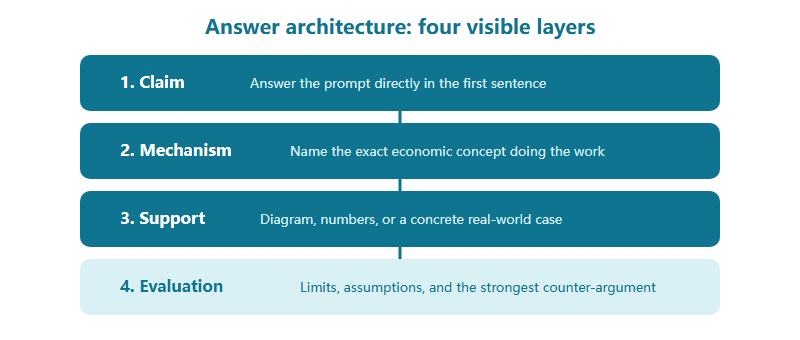
There is no published universal rubric we can quote for every IEO season, so treat what follows as editorial coaching — a structure that maps to how economics writing is generally assessed at olympiad and pre-university level — rather than an official marking scheme. Strong open-question answers tend to have four visible layers:
- Claim. One or two sentences that directly answer the prompt. Graders read many scripts; the answer that states its position in the first line is easier to reward than the one that buries it in paragraph three.
- Mechanism. The economic engine of your answer: the model, the incentive, the constraint. This is where you name the concept precisely — adverse selection, not “information problems”; crowding out, not “government spending effects.”
- Support. A diagram, a worked numerical illustration, or a real-world example that makes the mechanism concrete. One well-labelled diagram frequently communicates more than a paragraph.
- Evaluation. The layer most school-trained candidates omit: what your conclusion depends on, when it would reverse, and what the strongest counter-argument is. Evaluation signals that you understand the model’s limits, which is precisely what distinguishes olympiad-level answers from textbook recitation.
How the round compares with the other two parts
Seeing the three parts side by side clarifies what each demands — and why a candidate can be strong in one and weak in another.
| Dimension | Part 1: MCQ (40 questions) | Part 2: Open Questions (5 set, 4 graded) | Part 3: Business Case (team) |
|---|---|---|---|
| Core skill | Breadth, recall, speed | Written economic reasoning | Teamwork, structure, spoken English |
| Format | Individual, selected response | Individual, constructed response | Team of up to 5, presented to a panel |
| What costs you marks | Gaps in syllabus coverage | Unstated mechanisms, no evaluation | Weak delivery, unclear recommendation |
| Best training method | Timed question sets | Weekly written answers with feedback | Rehearsed mock presentations |
| Prep resource | Syllabus-based drilling | This guide | Business case guide |
Note that the table describes skill demands, not score weightings. The relative weight of each part in the final ranking is set by the organisers — check the current rules on ieo-official.org rather than assuming any split.
A six-step training loop for written answers
Here is the weekly loop we recommend to Greater China students preparing for national or regional rounds, most of whom have never had their economics writing assessed before:
- Pick one prompt per session. Past olympiad-style questions, pre-university essay prompts, or questions you construct from news events all work. Depth beats volume.
- Plan for five minutes before writing. Identify the mechanism, sketch the diagram, decide the evaluation point. If you cannot name the mechanism in the plan, you are not ready to write.
- Write under a self-imposed time cap. Because official timing varies by round and season, train at a demanding pace and confirm actual conditions on the official site.
- Grade your own script against the four layers. Claim present in line one? Mechanism named precisely? Support concrete? Evaluation genuine rather than decorative?
- Get one external read per week. A teacher, a well-prepared peer, or a coach. The single most common blind spot — reasoning that lives in your head instead of on the page — is invisible to self-review.
- Rewrite the weakest answer. Rewriting one script well teaches more than drafting three new mediocre ones.
English deserves a note. The IEO’s business case is delivered in English, and international-round materials are in English, so building the habit of writing economics in English kills two birds: it prepares your open-question scripts and feeds directly into the vocabulary you will need for the team business case. Write your practice answers in English from week one, even if your school economics course runs bilingual.
Frequently asked questions
How many open questions are graded on the IEO?
The format sets five open questions, of which four are graded. Confirm the current selection mechanics and timing for your round on ieo-official.org, as details can change between seasons.
Is there an official rubric for IEO open questions?
We do not quote one. Train against a general structure — claim, mechanism, support, evaluation — and treat any specific marking details as something to confirm on the official site.
Should I write open-question answers in English?
For international-level preparation, yes. The business case is presented in English, so English economics writing pays off across at least two of the three parts. Your national round’s language rules are set locally — confirm with your round organiser.
How is the Open Questions round weighted against the MCQ and business case?
We deliberately do not assert weightings. The organisers set scoring rules each season; check ieo-official.org for the current breakdown before you plan your preparation.
This is an independent guide operated by Hanlin Education for China-based international-school students. It is not affiliated with, endorsed by, or sponsored by the International Economics Olympiad Association. Always confirm current rules, dates, and formats on ieo-official.org. If you spot an error, we correct verified inaccuracies within 7 working days.