The IEO opens with a 40-question Finance & Economics multiple-choice paper — the one part where knowing the content is not enough, because the format itself decides how many of your marks you actually collect. This guide is about exam craft: how to pace 40 questions, when to calculate and when to move on, how to use elimination, and which official rule you must check before you sit down.
Where the multiple-choice paper sits in the IEO
The IEO is a three-part competition: a 40-question Finance & Economics multiple-choice round, a set of five open questions of which four are graded, and a team business case delivered in English. The multiple-choice paper is the individual, closed-form part — every question has a defined correct answer, and there is no examiner to reward partial reasoning. That makes it the most “trainable” of the three: the same techniques that help you through any well-designed multiple-choice paper apply here. If you have not yet mapped the whole competition, start with what the IEO is and then come back to sharpen this part.
Because it is closed-form, the multiple-choice round is where careless students bleed marks they could have kept. The knowledge is often there; the paper punishes poor time management, misread questions, and unforced calculation errors. Fixing those is faster than learning new economics.
Confirm the rules before you optimise anything
Multiple-choice strategy depends entirely on the scoring rules, and those rules are set by the organisers — not by how other competitions work. Before you build any tactic, confirm the following on ieo-official.org or with your regional organiser, and do not assume:
- Is there negative marking? Whether wrong answers are penalised completely changes your guessing strategy. If there is no penalty, you never leave a blank. If there is one, the maths of guessing shifts. Confirm this — never assume.
- How long is the paper? The time allowed for the 40 questions determines your per-question budget. Confirm the official limit rather than inferring it.
- Are calculators or reference sheets allowed? This decides how you prepare for calculation questions. Check the official rules.
- Is the mark weighting of this part relative to the others fixed? We do not assert the weightings of the three parts — treat that as an official detail to confirm.
Everything below assumes you have checked these. The techniques are robust either way, but the guessing rule in particular can flip depending on the answer.
The four question types you will meet
A well-built economics multiple-choice paper mixes several kinds of question, and each rewards a different response speed. Sorting them on sight is the single most useful skill on this paper. The proportions are decided by the organisers — the diagram below shows the types to expect, not a guaranteed split.
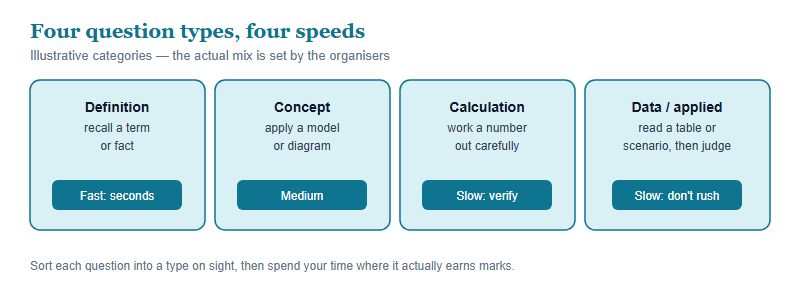
The point is not to memorise categories but to change your instinct. Definition questions should be answered almost reflexively so you bank easy marks and free up time. Calculation and data questions deserve patience, because a rushed arithmetic slip converts a question you understood into a wrong answer. The Finance & Economics label matters here: finance questions can involve interest, present value, or returns, and these are exactly the calculation items where a careless student loses marks they had the knowledge to keep.
A three-pass method for the whole paper
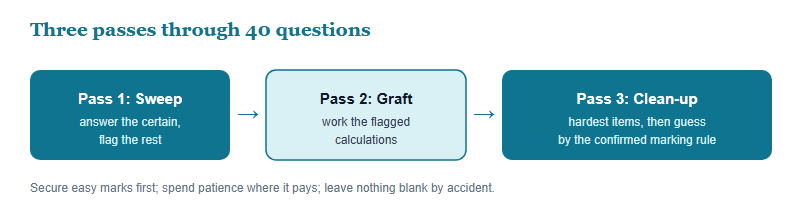
Do not answer 40 questions in the order they appear at a constant speed. Sweep the paper in three passes so that easy marks are secured before hard questions eat your clock.
| Pass | What you do | Why it works |
|---|---|---|
| Pass 1 — the sweep | Answer every question you are sure of; flag anything that needs work and move on immediately | Banks all your certain marks first and gives you a map of what is left |
| Pass 2 — the graft | Return to flagged calculation and concept questions with your remaining time budgeted evenly | You spend patience on questions that reward it, not on ones you had already solved |
| Pass 3 — the clean-up | Resolve the hardest items; then apply your confirmed guessing rule to anything still open | Nothing is left blank by accident, and your guessing follows the official marking rule |
Elimination, calculation discipline, and the classic traps
On a hard question, elimination is your friend. Even if you cannot see the answer immediately, ruling out two clearly wrong options doubles your odds and often surfaces the right one. Watch for distractors built from the most common misconception — a question about a price ceiling, for example, will often offer the answer a student gives if they confuse a shift with a movement.
For calculation questions, impose discipline. Write the formula before you touch the numbers, keep units consistent, and sanity-check the magnitude of your answer — if an elasticity comes out as 40, you have slipped a decimal. For finance items, be precise about whether a rate is annual or per period and whether a value is present or future. These are the small habits that separate a student who knows the economics from one who scores it.
Three traps cost strong candidates marks every year:
- Misreading “not” and “except.” Negatively worded stems flip the correct answer. Underline the negation as you read.
- Anchoring on the first plausible option. Read all options before committing; the best answer is sometimes the last one.
- Over-investing in one hard question. Every question is worth the same on Pass 1 — a five-minute battle for one mark can cost you three easy ones later.
How to train for it
Multiple-choice performance is built through timed practice, not passive review. Do full 40-question sets against a clock so that pacing becomes automatic. After each set, do the part most students skip: analyse your wrong answers by type. If your errors cluster in calculation, drill formulas and arithmetic; if they cluster in concept questions, go back to the underlying model; if they are careless misreads, slow your reading, not your working. Keep an error log so the same mistake does not reappear on the day.
Balance this against the other two parts. The multiple-choice paper is only one leg of the competition, and the open questions and team case reward a different set of skills. The 12-week prep plan shows how to give the multiple-choice round its share of practice without neglecting the analytical and team rounds — the balance most candidates get wrong is over-drilling multiple choice and under-rehearsing the case.
Frequently asked questions
How many questions are on the IEO multiple-choice paper?
The verified format is a 40-question Finance & Economics multiple-choice round. Confirm the current structure and timing on ieo-official.org.
Is there negative marking for wrong answers?
The marking rule is set by the organisers and changes your guessing strategy, so confirm it on the official site — never assume there is or is not a penalty.
Are calculators allowed for the finance calculations?
Whether calculators or reference materials are permitted is an official rule. Check ieo-official.org before deciding how to prepare for calculation questions.
Should I answer questions in order?
No. Sweep for certain marks first, then return to calculation and hard items in later passes so easy marks are never lost to the clock.
This is an independent guide operated by Hanlin Education for China-based international-school students. It is NOT affiliated with, endorsed by, or sponsored by the International Economics Olympiad Association. Competition facts — format, marking rules, timing, and permitted materials — can change; always confirm current details on ieo-official.org. Any error we are notified of is corrected within 7 working days.