What should you actually read to prepare for the International Economics Olympiad? For a self-studying student in Greater China, the answer is a small, deliberate stack: one core textbook, one structured online course, a steady current-affairs habit, and a bank of problems and data. This is not a week-by-week schedule — it is the toolkit that goes on your desk, and how to use each shelf so reading turns into the reasoning the IEO rewards.
Start from the format, not from a pile of books
Before you buy anything, be clear about what you are preparing for. The IEO is a three-part competition: a 40-question Finance & Economics multiple-choice paper, five open questions of which four are graded, and a team business case delivered in English. Your reading has to serve all three — recall for the multiple choice, structured written analysis for the open questions, and applied economic judgement for the case. If the format is still new to you, read our overview of what the IEO is first, then build the reading stack below around it.
One honest caveat up front: the official economics scope is published by the organisers on ieo-official.org, and there is no substitute for checking it. The resources here are an independent guide's suggestions for building genuine economics depth — none of them is “official IEO material,” and you should map anything you read against the official syllabus.
The four shelves
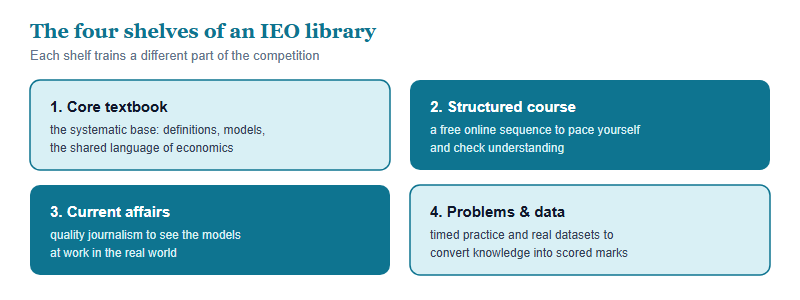
Think of your preparation library as four shelves, each doing a different job. Most students over-invest in one and neglect the others; a balanced stack is what produces an all-round candidate.
Shelf 1: one core textbook, read properly
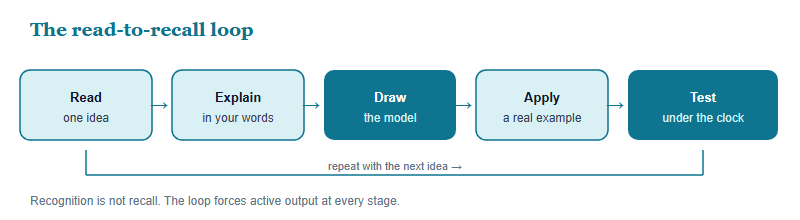
Your foundation should be a single, well-regarded introductory-to-intermediate economics textbook, worked through carefully rather than skimmed. Widely used options at this level include Mankiw's Principles of Economics and Krugman & Wells' Economics; either gives you the systematic vocabulary and the standard models. The mistake to avoid is passive reading. Do not highlight your way through a chapter and call it studied. For each section, close the book and write the definition in your own words, then draw the key diagram from memory. If you cannot, you have not learned it yet.
Because the IEO paper is labelled Finance & Economics, make sure your core reading covers the finance basics too — the time value of money, present value, interest, and risk. A general economics textbook may treat these lightly, so supplement where needed. Do not, however, reproduce or share large passages of any copyrighted textbook; use them to learn, and make your own notes.
Shelf 2: a structured online course for pacing
A textbook gives you content but not a rhythm. A free, structured online course supplies sequence and self-check. The CORE Econ project's open materials are a strong, freely available option that teaches economics through real-world problems, and there are reputable open courseware sequences from major universities. Use a course to keep momentum — a defined next lesson is easier to sit down to than an open textbook — and to expose gaps your textbook glossed over.
Pair the course with active output. After each unit, explain the idea aloud as if teaching it, then apply it to a question. Passive video-watching feels productive and rarely is; the retention comes from doing something with what you watched.
Shelf 3: current affairs, read like an economist
The open questions and the business case both reward candidates who can connect a model to the real world. That skill is built by reading quality economic journalism consistently — publications such as The Economist and the Financial Times, and central-bank and institutional commentary. The goal is not to memorise headlines but to practise a habit: for every article, ask which economic model explains it, what the trade-offs are, and what an economist would predict next.
This is also the cheapest, most current practice available for exactly the reasoning the IEO tests. A central-bank rate decision, an inflation report, or a trade dispute is a live open-question prompt. Keep a short running note of three or four current examples per major topic — a real instance of cost-push inflation, a recent monetary tightening, a live trade policy — and you will never be short of evidence to cite in a written answer or a case.
Shelf 4: problems, past practice, and data
Knowledge you cannot deploy under time pressure earns nothing. The fourth shelf is practice: timed multiple-choice sets, written-answer drills, and real datasets. Where past materials are made available through official or organiser channels, use them — check ieo-official.org for what is provided, and do not assume the existence or contents of any paper you have not verified. Supplement with problem sets from reputable economics courses and with real data from open institutional sources such as the IMF, the World Bank, and national statistics offices, so that reading a table and interpreting an indicator become second nature.
This shelf is where preparation meets the actual scoring. The team business case in particular is rehearsed, not read — our guide to the business case round explains why the case is the part self-studiers most often under-practise, because you cannot rehearse a team presentation alone at your desk.
Turn reading into recall: the study loop
Owning the right resources changes nothing unless you use them actively. Run every topic through the same loop, whichever shelf it came from.
The table below maps each shelf to the part it most directly serves, so you can see at a glance whether your stack is balanced. Remember it is a study aid, not an official statement of what any part contains.
| Shelf | Example resources | Part it most serves |
|---|---|---|
| Core textbook | Mankiw; Krugman & Wells; a finance-basics supplement | Multiple choice; foundations for all three |
| Structured course | CORE Econ open materials; reputable open courseware | Multiple choice & open questions |
| Current affairs | The Economist; Financial Times; central-bank commentary | Open questions & business case |
| Problems & data | Timed sets; official materials on ieo-official.org; IMF / World Bank data | All three, especially scored practice |
Finally, remember that owning resources is not a plan. This roadmap tells you what to put on your desk; for when to use each shelf in the run-up to your round, follow our 12-week prep plan, which sequences reading, written practice, and team rehearsal against the calendar. Combine the two — the right library and a realistic schedule — and self-study becomes genuinely competitive.
Frequently asked questions
Is there an official IEO reading list?
The organisers publish the economics scope on ieo-official.org. The resources here are an independent guide's suggestions for depth, not official materials — map them to the official syllabus.
Which textbook should I start with?
A single introductory-to-intermediate text such as Mankiw or Krugman & Wells, worked actively, plus a finance-basics supplement for the time value of money.
Do I really need to read the news for an economics olympiad?
Yes. The open questions and business case reward connecting models to real events, and quality journalism is the cheapest current practice for that skill.
Where do I find practice papers?
Check ieo-official.org for what the organisers make available, and never assume the contents of a paper you have not verified. Supplement with reputable course problem sets.
This is an independent guide operated by Hanlin Education for China-based international-school students. It is NOT affiliated with, endorsed by, or sponsored by the International Economics Olympiad Association. Named resources are illustrative suggestions, not official IEO materials; the authoritative syllabus and any provided papers are on ieo-official.org, which you should confirm. Any error we are notified of is corrected within 7 working days.