The IEO does not test competition mathematics. It tests about eight families of applied arithmetic — elasticities, index numbers, growth rates, discounting, expected value, marginal conditions, ratios and linear algebra — executed quickly and cleanly under exam pressure. Our coaches' view is that the open questions increasingly turn on genuine calculation rather than description — confirm the published scope for your cycle on ieo-official.org. That shifts what preparation has to look like.
The level this actually is — and what it is not
Students arriving from a strong maths background often over-prepare in the wrong direction, drilling olympiad-style problem solving that never appears. Students arriving from a humanities-leaning economics course under-prepare in the other direction, hoping that a well-argued paragraph will carry a question whose answer is a number.
The realistic description is this. In our coaches' experience little exotic machinery is required: a marginal condition can be handled without calculus, and the statistics rarely go beyond expectations and simple probability weighting — but confirm the published scope for your cycle on ieo-official.org. What is required is that a five-step chain of ordinary arithmetic — convert, deflate, discount, compare, interpret — comes out right the first time, with units attached and a sentence saying what the number means. The difficulty is not conceptual depth. It is error-free execution at speed, on quantities that all look similar and are easy to confuse.
Two rules before you optimise anything. First, confirm the calculator and formula-sheet policy for your round with your sending organisation and on ieo-official.org; do not assume, and do not build a method that collapses if the assumption is wrong. Second, confirm the published time limit for the papers you will sit. Everything below is about the arithmetic itself, which does not change either way. If you are still mapping the structure of the competition, our overview of what the IEO is and how its three parts fit together is the place to start.
The eight calculation families
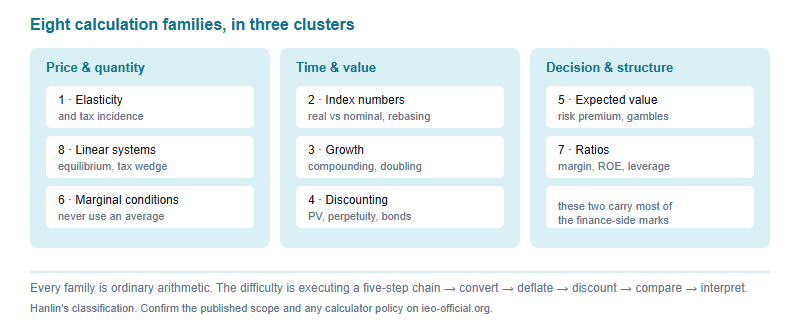
Almost every quantitative demand on the Economics and Finance paper and the open questions reduces to one of eight families. Learn the trap attached to each and you have covered most of the marks that are lost for reasons other than not knowing the economics.
| # | Family | What the task looks like | The classic trap |
|---|---|---|---|
| 1 | Elasticity and incidence | Percentage change in quantity over percentage change in price; who bears a tax | Using percentage points as percentages; forgetting that the more inelastic side bears more of the burden |
| 2 | Index numbers, real vs nominal | Deflating a nominal series, rebasing an index, computing an inflation rate from a price level | Comparing a real figure with a nominal one, or forgetting which year is the base |
| 3 | Growth and compounding | Compound growth over several periods, doubling time, average growth of a series | Averaging growth rates arithmetically when the correct average is geometric |
| 4 | Discounting and valuation | Present value of a cash flow, a perpetuity, a bond as coupons plus face value | Mismatching the rate and the period — an annual rate applied to half-year cash flows |
| 5 | Expected value and risk | Probability-weighted payoffs, comparing a certain sum against a gamble, a risk premium | Treating expected value as the value a risk-averse agent places on the gamble |
| 6 | Marginal conditions | Profit maximisation, hiring to the point where marginal revenue product meets the wage, shutdown rules | Substituting an average for a margin: average cost where marginal cost belongs |
| 7 | Ratios and statements | Margins, return on equity, leverage, liquidity ratios read off a small table | Comparing ratios built on different denominators or different periods |
| 8 | Linear systems | Solving demand and supply for equilibrium, inserting a tax wedge, finding a surplus | Algebraic slips in rearrangement, and dropping the intercept when a curve shifts |
Five errors that cost more marks than missing theory
In our coaches' marked practice work, most lost quantitative marks are not conceptual. The candidate knew what to do and produced the wrong number. Five slips account for most of it:
- Per cent versus percentage point. An unemployment rate moving from 4% to 5% has risen by one percentage point and by twenty-five per cent. Questions are frequently written so that one reading is right and the other is a distractor sitting in the answer options.
- Real mixed with nominal. A nominal wage growth figure compared against a real GDP series produces a confident, wrong conclusion. Before any comparison, label every quantity in your working as real or nominal, in writing.
- Rate and period mismatch. An annual interest rate applied to a quarterly cash flow, or a monthly rate compounded twelve times but quoted as if simple. Convert first, then compute.
- Rounding too early. Rounding an intermediate step to two decimals then compounding it over ten periods can move an answer past the nearest option. Carry the full figure and round once, at the end.
- Base and unit slips. A percentage entered as 8 rather than 0.08; millions read as billions; an index rebased to a different year midway through a table. These are trivial individually and expensive in aggregate.
Notice what these have in common. None of them are fixed by studying more economics. They are fixed by a written habit — labelling units and periods on the page before the arithmetic starts — which takes about ten seconds and is almost universally skipped under time pressure.
Two different disciplines: 40 questions, then open working
The competition asks for the same arithmetic in two very different modes, and they reward opposite instincts.
On the multiple-choice papers, only the final answer is visible to the marker. That makes estimation legitimate and often optimal: if the options are far apart, an order-of-magnitude approximation identifies the right one faster than an exact computation. It also makes the answer options themselves a source of information — distractors are usually built from specific mistakes, so seeing your working land exactly on a distractor is a signal to re-check rather than to relax. Whatever the published time limit for your round, treat any question that exceeds roughly twice your average pace as a flag-and-return.
The open questions invert this. Five are set and four are graded, and there the reasoning is the visible product. Three habits matter: set out the chain in labelled steps so partial credit survives a slip at the end; carry units through every line; and close with one sentence interpreting the number in economic terms — what it implies for welfare, for the policy in question, or for the agent making the decision. A correct figure with no interpretation answers half of what an open question is asking.
Building it: twenty minutes a day, and where it goes in a season
Calculation ability is built the way sight-reading is built: short, daily, deliberately narrow. Long weekend sessions produce far less than twenty focused minutes on weekdays, because the skill being trained is retrieval speed and error avoidance, not comprehension.
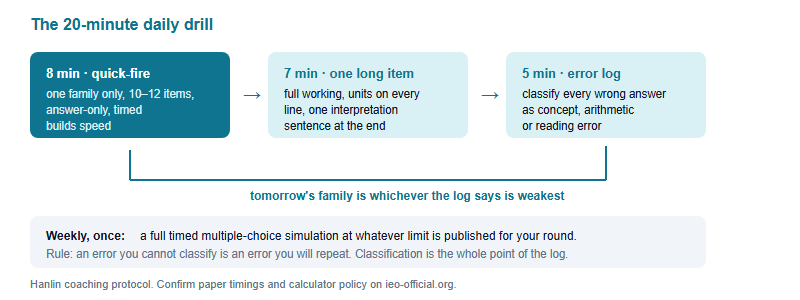
The protocol in the diagram above has three blocks. Eight minutes of quick-fire items from a single family, answers only, against the clock. Seven minutes on one longer item written out in full, with units on every line and a closing interpretation sentence. Five minutes on the error log, in which every wrong answer is classified as a concept error, an arithmetic error or a reading error — and the classification, not the total, chooses tomorrow's family. Once a week, sit a full timed multiple-choice simulation.
The reason the log matters more than the score is that the three error types need completely different fixes. A concept error means going back to the textbook. An arithmetic error means the labelling habit is not yet automatic. A reading error — answering a question adjacent to the one asked — means slowing down on the stem, which is a language problem rather than a maths problem. Students who track a single accuracy percentage learn nothing actionable from it.
Placed in a season, this drill is the base layer that runs continuously, underneath whatever else you are doing. It belongs in weeks one to four of a structured block, alongside content revision, and then it never stops — you keep the twenty minutes even in the weeks given over to the later stages of a twelve-week plan, when attention moves to open-question depth and business-case rehearsal. The quantitative side degrades quickly when left alone, and the cheapest insurance is not letting it.
Frequently asked questions
Do I need calculus for the IEO?
No. Marginal reasoning can be handled without it. Confirm the published scope for your cycle on ieo-official.org before assuming anything is excluded.
Am I allowed a calculator?
Do not assume either way. The policy is set for each round — confirm it with your sending organisation and on ieo-official.org well before the day.
Should I show working on multiple choice?
Only for yourself. Nobody marks it, so estimate when options are far apart — but re-check if your answer lands exactly on a distractor.
How long before I see improvement?
Speed shifts within two to three weeks of daily drilling. Error rate falls more slowly, because it depends on the labelling habit becoming automatic.
This is an independent guide operated by Hanlin Education for China-based international-school students. We are not affiliated with, endorsed by, or sponsored by the International Economics Olympiad Association. Competition rules, formats, timings and calculator policy change — confirm current details on ieo-official.org. Factual errors are corrected within 7 working days of notification.