You do not need a school economics course to enter the IEO. The eligibility we can verify turns on age — under 20 on 30 June — and on qualifying through a national or regional round; we are not aware of any published requirement to be enrolled in an economics class, though entry conditions in your territory should be confirmed on ieo-official.org and with the body that enters teams from where you are. What a maths or science track leaves you is a real head start on some parts of the competition and a genuine hole in others. This is how to tell which is which.
The rules turn on age and qualification, not on your timetable
This matters because the assumption runs the other way in almost every conversation. Students at schools without IB, AP or A-Level economics tend to write themselves out early, on the belief that the competition is a syllabus extension for people already taking the subject. The structure we can verify does not say that. It says the competition has three parts — a 40-question finance and economics multiple-choice paper, five open questions of which four are scored, and a team business case delivered in English — and that you reach the international final through a national or regional round. None of that is gated on a transcript line.
What the timetable does change is your starting point and your build order. A student who has sat two years of economics arrives with vocabulary, a stock of standard diagrams, and practice at writing the kind of argument these papers ask for. A maths or physics student arrives with something different, and often underrates it.
What actually transfers from a maths or science track
The transfer is larger than most students expect, because a good deal of economics at competition level is modelling discipline rather than accumulated facts. The table below is our own mapping, built from the three parts as published; treat it as a diagnostic, not a syllabus.
| What you already have | Where it pays in the IEO | What it does not give you |
|---|---|---|
| Algebra and calculus fluency | Elasticities, marginal reasoning, optimisation, rates of change — the mechanics behind most microeconomic results | Any sense of which model is conventional for a given question |
| Statistics and data handling | Reading tables and charts in questions; handling evidence in the case round | Narrating a causal mechanism in words, which is what open answers reward |
| Physics-style modelling habits | Assumptions → model → prediction → test the assumption. This is exactly how economic argument is built | The institutional detail that determines whether a model applies at all |
| Comfort with compounding and percentages | The finance and financial-literacy items in the multiple-choice paper: interest, growth, risk and return | Financial vocabulary and the conventions behind published figures |
| Lab-report writing | Structure under pressure: claim, evidence, limitation | Practice at normative argument, where there is no correct answer to converge on |
Read down the third column and you have your syllabus. The pattern is consistent: a maths track gives you the machinery and withholds the context. That is a much better position than the reverse, because context can be built in months while quantitative fluency takes years — but only if you attack the right column deliberately rather than assuming exposure will fix it.
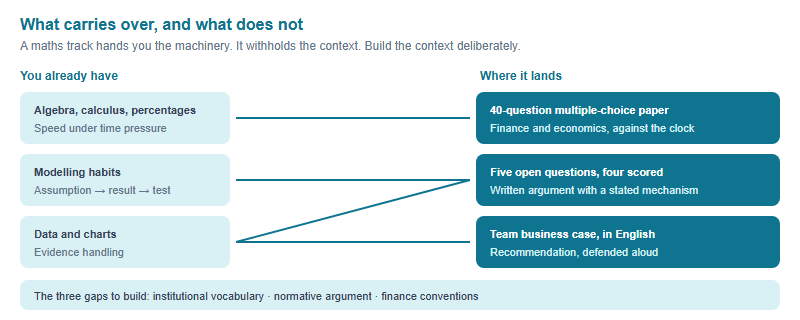
The three gaps, and why they behave differently
Institutional vocabulary. Not jargon for its own sake, but knowing what the words point at: what a central bank actually controls, what a current-account balance is measuring, what a subsidy does to whom. A maths student can often derive the result and still lose marks for not naming it in the language the question is written in. This gap closes fastest — it is finite and it responds to deliberate study.
Normative argument. Science training rewards convergence on the right answer. A large part of economics at this level asks whether a policy is a good idea, where the honest answer is conditional. Students from a pure maths track tend to write half an answer — a correct mechanism with no verdict, or a verdict with no stated condition under which it flips. This gap closes with rubric-driven writing practice, not reading.
Finance conventions. The multiple-choice paper is a finance and economics paper. Compounding arithmetic will not trouble you; the conventions might — what a rate is quoted per, what a statement line means, why two true-looking figures are not comparable. This is the gap school-taught economics students share with you, which makes it the most levelling place to spend time.
Notice that only the first gap is fixed by reading. The other two are fixed by producing work and having it marked, which is why a student without a course needs an adult or a peer to mark against a rubric far more than they need another textbook.
A build order when you are starting without the course
Sequence matters more than volume here. The order below front-loads the vocabulary, because everything downstream — reading questions accurately, arguing, defending a case — depends on it. Run it alongside our 12-week preparation plan rather than instead of it: that plan assumes the content base this sequence builds.
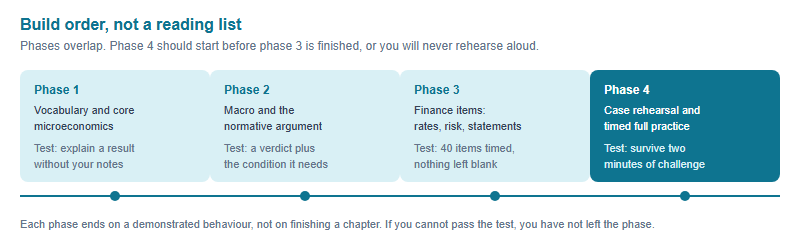
The exit conditions are the point. Students self-studying without a course routinely mistake having read something for being able to produce it under time pressure, and the only correction is a test you can fail. Phase 1 exits when you can explain a result to someone else without notes. Phase 2 exits when your written answers reliably contain both a verdict and the condition under which it reverses. Phase 3 exits when a timed 40-item block leaves nothing blank. Phase 4 exits when you can be challenged in English for two minutes and stay specific.
Use the same logic to decide whether to attempt the coming cycle at all. The self-check below is ours, and it is deliberately behavioural — every row is something you either can or cannot do today, with no credit for having read about it.
| Check | Attempt this cycle if you can | Build first if |
|---|---|---|
| Vocabulary | Read an unfamiliar question and know what every term points at | You are translating the question before you can start it |
| Mechanism | Explain a result as a causal chain, out loud, without notes | You can state results but not the route to them |
| Verdict | Take a position and name the condition that reverses it | Your answers stop at “it depends” with nothing after it |
| Finance | Sit 40 mixed items against the clock and leave nothing blank | The numeric items are where your score swings most |
| English under pressure | Hold a two-minute challenge without losing specificity | You write fluently but freeze when questioned aloud |
Three or more rows in the right-hand column is not a verdict against you — it is a schedule. It says this cycle is for building and the next one is for competing.
Where the science student is quietly the strongest in the room
The team business case is the part where a maths or science background stops being a handicap and starts being an edge. Case work rewards exactly what lab training builds: stating assumptions out loud, showing the calculation behind a recommendation, quantifying the size of an effect rather than asserting that it is large, and conceding cleanly when an assumption is challenged instead of defending it past the point of credibility.
The failure mode to watch is the opposite one — over-modelling. A recommendation that arrives with three scenarios and no decision is worse than a simple recommendation with a number attached and a stated risk. Teams built around a strong quantitative student often lose time to elegance and land without a verdict. Our guide to the business case round sets out the structure that keeps this in check, and it is worth reading before your first rehearsal rather than after it.
One realistic note on timing. If you are starting from no economics at all, treat the coming cycle as a build year and the one after as your competitive attempt, unless you have unusual amounts of time. That is not discouragement; a student who has covered the ground properly once tends to be far more useful to a team in the second year than one who was rushed through it. If you are still deciding whether the competition suits you, start with what the IEO actually is and check the entry conditions for your territory on ieo-official.org before committing a school year to it.
Frequently asked questions
Can I enter the IEO without taking economics at school?
The eligibility we can verify turns on age — under 20 on 30 June — and on qualifying through a national or regional round. Confirm entry conditions for your territory on ieo-official.org.
What transfers best from a maths track?
Quantitative speed, modelling discipline and data handling. What does not transfer is institutional vocabulary, normative argument and finance conventions.
Which gap should I close first?
Vocabulary. Reading questions accurately gates everything else, and it is the gap that responds fastest to deliberate study.
How long does a no-course start realistically take?
Plan a build year before a competitive attempt unless you have unusual time. Rushed coverage tends to show up in the open questions.
This is an independent guide operated by Hanlin Education for China-based international-school students. We are not affiliated with, endorsed by, or sponsored by the International Economics Olympiad Association. Competition rules, dates, eligibility and formats change — confirm current details on ieo-official.org. Factual errors are corrected within 7 working days of notification.