Most students who set out to reach an IEO international final do not get there on the first attempt, and the useful response is not to work harder at the same thing. It is to find out which gate actually stopped you, because the four gates fail for completely different reasons and only one of them is fixed by more revision. With the next cycle now opening, this is the window in which that diagnosis is still worth acting on.
First, work out which gate you actually missed
Students describe the outcome in one sentence — “I did not get in” — and then plan a whole year around a guess about why. The four exits below look identical from the outside and have almost nothing in common underneath.
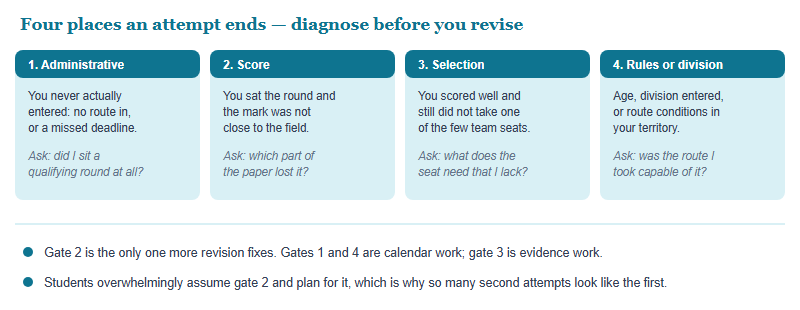
Be honest at gate 3 in particular. A team is small — up to five students plus one or two leaders — so a seat is a scarce good. Selection criteria are set by the body that enters teams from your territory and we do not have them published, but in our own coaching experience the gap for a student who was strong on paper is usually about working in a team in English under pressure: whether you can hold a position while being questioned, whether you make other people's answers better, whether you finish things. None of that improves by doing more past questions.
How many attempts you actually have
The eligibility condition we can verify is age: competitors must be under 20 on 30 June. Work out how many cycles that leaves you and write the number down, because it changes the strategy completely. A student with three cycles remaining can afford a genuine build year. A student with one should be making very different choices about where effort goes.
Division matters here too. In the Greater China route, the 2027 handbook sets out JUNIOR-SL, JUNIOR-HL and SENIOR, and only SENIOR leads to the national team; JUNIOR-HL is entered as a team of three to five. If your last attempt was in a junior division, then in an important sense you have not yet attempted the thing you think you failed at. That reframing matters — the honest read is often not “I tried and fell short” but “I have not yet entered the division that leads where I want to go.” Division rules and entry conditions sit with the organisers, so confirm the current arrangements on ieo-official.org and with the body that enters students from your territory before planning around them.
What changes on a second attempt, and what students merely repeat
A second attempt fails in the same way as the first when it consists of doing the first attempt again with more hours attached. The left column below is what a repeat year usually contains. The right column is what tends to move the outcome.
| What a repeat year usually contains | Why it feels like progress | What actually changes the outcome |
|---|---|---|
| Re-reading the same textbook, further in | Coverage is visible and measurable | Producing answers and having them marked by someone who will tell you they are vague |
| More multiple-choice drilling | The score goes up, week on week | Checking first whether the multiple-choice paper was ever the gate. Often it was not |
| Waiting to be considered again | Selection feels like something done to you | Building a record that makes the seat decision easy: work finished, marked, and visible |
| Adding unrelated competitions for the record | Activity resembles momentum | Choosing events that rehearse the same three parts, so preparation compounds instead of splitting |
| Starting earlier next time | More time obviously beats less time | More time on a misdiagnosed gate changes nothing. Diagnose, then extend the runway |
| Working alone, harder | Solo effort is easy to control | Practising in a team, in English, under questioning — the part our own coaching experience says a seat tends to turn on, though selectors set their own criteria |
The pattern across the right-hand column is that almost everything worth doing involves producing work and exposing it to judgement, while almost everything in the left column can be done privately. That is not a coincidence. Private study is comfortable and it is also where a second attempt quietly becomes a repeat of the first.
Staying competitive during a rebuild year
The hardest part of a build year is that nothing sharpens you like a real contest, and by definition you are not in the one you wanted. The answer is to keep competing at something that rehearses the same three skills: fast finance and economics recall, written argument under time, and defending a position in English as part of a team.
Invitational and regional events can serve that purpose. Our own cohort competed at the 2026 Singapore invitational and came away with an individual seventh place and a team silver. We report that de-identified and as our own tally rather than an official statistic, and results vary between students and between cycles — but the point of citing it is not the placing. It is that a student who spends a rebuild year in real contests arrives at the next selection with evidence, while a student who spends it revising arrives with an assertion. Which events count towards any given route, and whether they carry any formal standing, is a matter for the organisers and the body that enters students from your territory; confirm before assuming.
Use the year to fix the specific gate too. If you exited at gate 2, our 12-week preparation plan is built to be counted backwards from a round rather than run indefinitely. If you exited at gate 3, the work is different: get into a team, take the part nobody wants, and practise the business case round until being questioned in English stops raising your heart rate. Those are not interchangeable programmes, which is the whole argument of this piece.
What you can bank while you rebuild
A build year does not have to end with nothing to show. In the Greater China route, run as IEOC by NexGenHub, honours at the preliminary stage are awarded on two different logics, and knowing which is which keeps you honest about what an award means.
- An absolute threshold. An individual achievement certificate is tied to a preliminary score of 70 or more out of 100. Because it is a threshold rather than a ranking, it is reached by a substantial share of entrants — on the order of 35 to 40 per cent — and it says you cleared a bar, not that you beat a field.
- A relative rank. Team honours go to roughly the top 20 per cent and individual honours to roughly the top 15 per cent, each awarded in three grades. These are positional, so they do say something about the field you were measured against.
Both are worth having and they are not the same currency, which matters when you describe them later. Writing up a threshold certificate as though it were a top-percentage placing is the kind of overstatement that damages an otherwise strong record. Award structures and thresholds are set by the organisers and can change between cycles — treat the figures above as the shape of the scheme and confirm the current details before relying on them.
A runway into the next cycle
The 2027 cycle on the China route has registration open, with the preliminary round falling in December. Exact dates sit with the organisers, so confirm them rather than working from this article — but the shape of the runway is enough to plan against now.
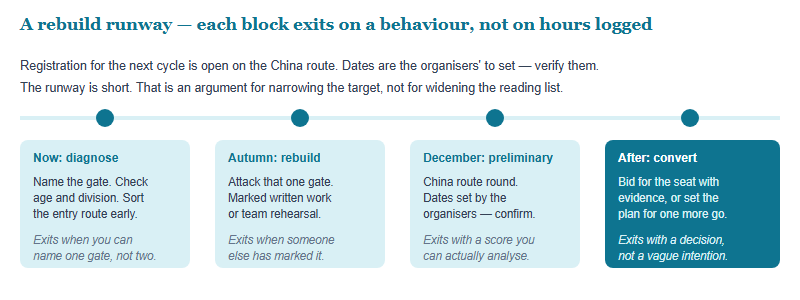
One closing point on expectations. A second attempt is not a guarantee of anything, and no competition result guarantees an academic or admissions outcome. What a well-diagnosed second attempt does reliably produce is a student who can argue in English under pressure, work inside a small team, and defend a number — and those hold their value whether or not the seat comes. If you are helping a younger sibling or teammate start from the beginning of this, our explainer on what the IEO actually is is the right starting point, and current rules, dates and eligibility should always be checked on ieo-official.org.
Frequently asked questions
How many times can I attempt the IEO?
The condition we can verify is being under 20 on 30 June. Count the cycles that leaves you, and confirm route conditions on ieo-official.org.
I scored well but was not selected. What now?
That is a selection gate, not a knowledge gate. Build visible team evidence in English rather than adding more solo revision.
Do junior divisions lead to the national team?
On the Greater China route, the 2027 handbook has SENIOR as the division leading to the national team. Confirm current division rules before entering.
Is a threshold certificate the same as a top-percentage honour?
No. One marks clearing a score bar, the other marks a rank in the field. Describe each accurately when you write them up.
This is an independent guide operated by Hanlin Education for China-based international-school students. We are not affiliated with, endorsed by, or sponsored by the International Economics Olympiad Association. Competition rules, dates, eligibility and formats change — confirm current details on ieo-official.org. Factual errors are corrected within 7 working days of notification.