Three divisions run on the Greater China route into the IEO, and only one of them — SENIOR — leads to the national team. That single asymmetry settles most of the choice. What is left turns on your year group, on whether you can field three to five students, and on whether you are ready to work in English. And you choose in the autumn, before December, not after.
The asymmetry that settles most of the choice
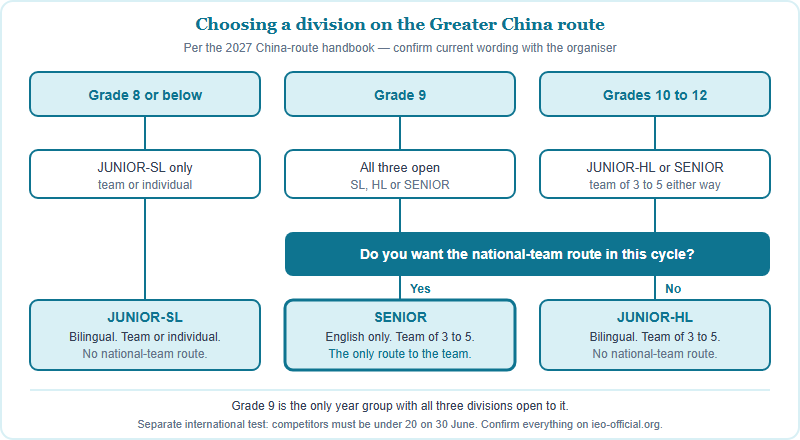
Students almost always approach this question the wrong way round. They ask which division they are most likely to do well in. The more useful first question is blunter: do you want to be in contention for the national team in this cycle, or are you building towards a later one? Everything else follows from the answer, because on the Greater China route the SENIOR division is the only one that leads to the team.
If the answer is yes, the other requirements are not negotiable preferences — they are entry conditions. You need to be in Grades 9 to 12, you need three to five people, and you need to work in English. If the answer is no, the junior divisions are not a consolation prize. For a Grade 8 student, or a Grade 9 student whose economics is six months old, entering a junior division is the sensible on-ramp: a real paper, a real deadline, and a score you can measure yourself against before the cycle that actually matters.
Sitting above all of this is the international eligibility test, which is separate from the route’s grade bands: competitors must be under 20 on 30 June. If you are unclear on what the competition itself consists of once you get there, start with our overview of what the IEO is and how it is put together, then come back to this decision.
The three divisions, as the 2027 handbook sets them out
The table below reflects the 2027 China-route handbook as we reviewed it in August 2026. The China route is operated as IEOC by NexGenHub; the divisions are a feature of that route rather than of the international olympiad itself. Structures move between cycles, so confirm the current wording with your sending organisation before you register.
| JUNIOR-SL | JUNIOR-HL | SENIOR | |
|---|---|---|---|
| Year groups | Grade 9 and below | Grades 9 to 12 | Grades 9 to 12 |
| Working language | Bilingual Chinese and English | Bilingual Chinese and English | English only |
| How you enter | As a team or individually | Team of three to five | Team of three to five |
| Leads to the national team | No | No | Yes — the only division that does |
Read the grade bands carefully, because they overlap in one place and that overlap is the most interesting thing in the table. Grade 9 is the only year group with all three divisions open to it. A Grade 8 student has one option. A Grade 10, 11 or 12 student has two. A Grade 9 student has a genuine strategic decision, and it is the year group we spend the most time talking through.
One warning about sources. Older promotional material circulating in Chinese uses different division names, and some of it describes the junior divisions as individual-only. The handbook we reviewed does not match that description. Where a marketing page and the current handbook disagree, the handbook wins — and if you cannot get hold of the handbook, ask the organiser in writing rather than reasoning from an out-of-date summary. While you are checking, confirm you are looking at the right competition altogether: there is a separate, unrelated olympiad with a near-identical name run by a different organisation. Ours is the one at ieo-official.org.
English in SENIOR is a working condition, not a badge
It is tempting to read “English only” as a difficulty setting, as though the two bilingual divisions were the same contest with a translation attached. They are not, and the reason is what sits at the end of the road. At the international round the team business case is delivered in English. The English requirement in SENIOR is therefore continuous with the destination rather than an arbitrary filter: the division that leads to the team asks you to work in the language the team will work in.
That reframes the self-assessment. The question is not “is my English good enough to sit an exam” but “can I read an unfamiliar economics passage in English at speed, and then argue back against it out loud, under time pressure, in front of people?” Those are different skills, and the second is the one the team business case actually taxes. Reading comprehension you can drill quietly over a term. Arguing in a second language in a room needs rehearsal with other people, which is another reason the team has to exist early.
If reading speed is genuinely your bottleneck right now, a bilingual division buys you a cycle to fix it. Be honest with yourself about what that purchase is, though. It buys a cycle of experience and a measurable score. It does not buy a seat, and it does not shorten the distance to one.
One detail worth pinning down with the organiser: the handbook describes the junior divisions as bilingual and SENIOR as English only, but exactly what is bilingual — the question paper, the study materials, or the answers you are permitted to write — is worth confirming rather than assuming, because those three things can differ from one another.
You commit before you have a score
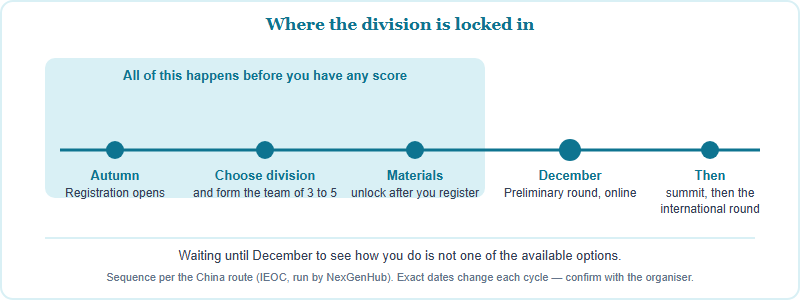
Here is the piece of sequencing that catches the most people. On the China route you register, choose your division and complete your team before the preliminary round, and the study materials unlock after registration. The preliminary itself runs in December. Exact dates move each cycle and should come from your sending organisation, but the order of operations is the part that matters for planning.
Three consequences follow, and none of them are obvious until you have watched a cohort run into them:
- Your preliminary score cannot inform your division. You are choosing on a forecast of your own ability, not on evidence. That argues for choosing on structural facts — your year group, your teammates, your working language — rather than on a hunch about how well you will do in an exam you have not seen.
- Recruiting is a September problem. JUNIOR-HL and SENIOR need three to five people. If two of you are interested today, you have a staffing problem to solve now, not a revision problem. Whether teammates may come from more than one school is exactly the sort of thing to ask the organiser in writing; we would not assume it either way.
- Registering late costs study time, not just admin time. Because the materials unlock on registration, a “let me study first and decide later” plan is self-defeating: it withholds the study material until later. With a December paper, an autumn registration gives you a genuine run-up, and our twelve-week preparation plan is built for exactly that shape of term.
Four ways we see this go wrong in the autumn
These are our own coaching observations rather than anything published by the organiser, and individual experiences vary. They repeat often enough to be worth naming.
- Choosing the bilingual division for comfort, and discovering in spring that the team route was never open. This is the expensive one, and it is expensive precisely because it does not feel like a decision at the time. It feels like picking the sensible option.
- Assuming the division can be switched after the preliminary. Assume it cannot unless the organiser tells you in writing that it can. Plan as though the autumn choice is the choice for the whole cycle.
- Building a team of two and hoping. Three is the floor for both HL and SENIOR. A pair is not a small team; it is an ineligible one.
- Working from last year’s description. Division names and dates have moved on this route, and grade bands are the organiser’s to redraw. Anything with a year attached to it — including what you are reading here — should be checked against the current handbook before you act on it.
If you take one thing away: the division question is not really about difficulty. It is about which door you are still standing in front of in March. Answer the national-team question first and honestly, and the rest of the form fills itself in.
Common questions
Can a Grade 10 student enter JUNIOR-HL?
Per the 2027 handbook JUNIOR-HL covers Grades 9 to 12, so yes — but it does not lead to the national team.
Do I need a team, or can I enter alone?
JUNIOR-HL and SENIOR require a team of three to five. JUNIOR-SL can be entered as a team or individually.
Is the SENIOR division really English only?
Yes. SENIOR is the English-only division, and at the international round the team business case is delivered in English.
When does the 2027 preliminary round run?
In December, on the China route. Exact dates change each cycle, so confirm them with your sending organisation.
This is an independent guide operated by Hanlin Education for China-based international-school students. We are not affiliated with, endorsed by, or sponsored by the International Economics Olympiad Association. Division structures, grade bands, dates and eligibility rules change between cycles — confirm current details on ieo-official.org and with your sending organisation before acting on anything here. Errors are corrected within seven working days of being reported.