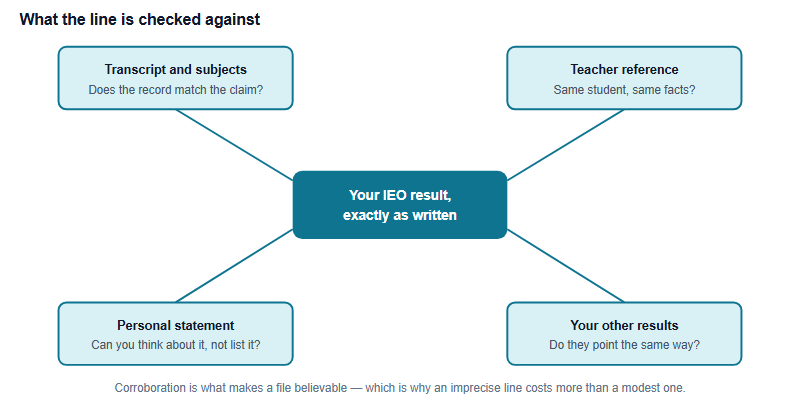
An admissions reader does not assess your IEO result in isolation. They read it against your transcript, the rest of your activity list, your essays and your teachers' references, and the file becomes believable when those things corroborate each other. That is why precision beats inflation: a stage named exactly survives cross-checking, while a stage named generously invites a question you cannot answer.
Why exact naming does most of the work
Think about what a reader can actually verify. They can see whether your predicted grades in economics or mathematics match a claimed olympiad result. They can see whether your activity list, your personal statement and your referee describe the same student. They can see whether the other things on your file point in the same direction. None of these checks is a forensic investigation; they are the ordinary business of reading a file, and they happen quickly.
In that setting, an award is doing one job: corroborating a claim you have already made about yourself. If your file says you are serious about economics, a documented olympiad result is one of several independent things that make that claim credible — alongside the courses you chose, the reading you can talk about, and what your teacher says without prompting. Several results across one profile reinforce one another for exactly this reason.
The failure mode is not modesty. It is a stray word that turns a real, checkable achievement into something the reader cannot line up with anything else. “National champion” where the record shows a preliminary-round honour does not read as a strong result; it reads as a file that needs checking, and that is the opposite of what you wanted the line to do.
Name the stage you actually reached
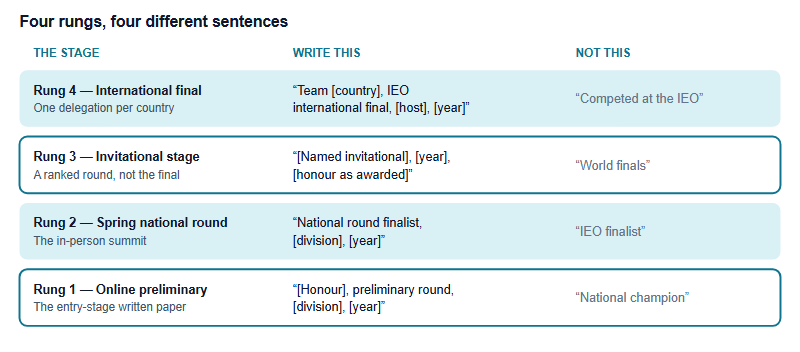
The IEO is not one sitting, and the Greater China route adds stages of its own. That is where most of the naming errors come from — not dishonesty, just a student compressing four stages into one word. Here is the vocabulary, and the phrase we would use for each.
| What you actually did | How we would write it | What students write instead | Why the loose version fails |
|---|---|---|---|
| Sat the online preliminary on the China route and received an honour | “[Honour as awarded], preliminary round, [division], [competition and organiser exactly as printed on the certificate], [year]” | “National award in economics olympiad” | The preliminary is an entry-stage online paper, not the national round; the record will say so |
| Competed at the spring national round / annual summit | “National round finalist, [division], [year]” | “IEO finalist” | “Finalist” unqualified reads as the international final, which is a different event |
| Took part in an international invitational stage | “[Named invitational], [year], [honour if any]” | “World finals” | Invitational stages are real ranked rounds but they are not the annual international final |
| Represented your country at the IEO international final | “Team [country], IEO international final, [host], [year]” | “Competed at the IEO” | Under-claiming: the delegation place is the scarce part and you have hidden it |
| Won a medal at the international final | “[Colour] medal, IEO international final, [host], [year]” | “Gold medallist, International Economics Olympiad” with no stage or year | Ambiguous between an individual medal, a team award and a national-round result |
One addition that costs four words and prevents a whole category of confusion: name the organiser. Two different international economics olympiads use the same acronym, run by different organisations in different countries. “International Economics Olympiad (IEO Association)” on first mention removes the ambiguity permanently. If a reader has met the other competition, an unqualified “IEO” makes them guess, and they may guess wrong. Our overview of what the IEO is sets out which organisation this site covers.
Individual or team — and what the scale of the final actually shows
The international competition mixes individual and team work, so “my IEO result” can mean two quite different things. Two of the three components are sat individually: a 40-question finance and economics multiple-choice paper, and five open questions of which four are graded. The third, the team business case delivered in English, is by definition a group product. If your headline achievement came out of the case, say so — team results are not lesser results, and claiming a group outcome as a solo one is precisely the kind of thing a referee's letter can accidentally contradict.
It also helps to know what part of an international result is genuinely scarce. Take the 2025 final in Baku, which is the most complete record we have checked: 52 countries, 258 participants, and 133 medals awarded — 24 gold, 43 silver and 66 bronze. Set that against the delegation rule, where a country sends a team of up to five students plus one or two leaders, entering through a national or regional round.
Two conclusions follow, and one temptation should be resisted. The conclusions: the seat is the bottleneck, since a country's delegation is capped at roughly five students regardless of how many compete domestically; and the organiser's published totals list 133 medals against 258 participants without saying how many were team awards, with gold the scarce end at 24. The temptation to resist: converting 133 medals and 258 participants into a neat percentage. We cannot tell from the published totals whether team awards sit inside that 133, so any rate we computed would be a guess wearing a decimal point. Do not put a number like that on an application — if a reader asks where it came from, “I worked it out” is a bad answer.
The practical upshot is that “selected for the national delegation” often carries more information than the medal colour that followed it, and students routinely bury the first while polishing the second.
Three places the result appears, and what each can carry
The same achievement has to be written three different ways, because three different documents are doing three different jobs.
The activity list wants facts and nothing else. The fields are short — check the current character limits on whichever platform you are using, since they differ and change — and every character spent on adjectives is a character not spent on the stage, the division, the year and the organiser. Write it as a record entry: what, which stage, which year, run by whom. Resist “prestigious”. If the competition needs you to say it is prestigious, saying so will not help.
The essay wants thinking, not trophies. An award listed twice is worse than an award listed once, and a personal statement that recites your activity list has wasted its only real advantage. What an essay can do that no other document can is show what happened inside your head: the case where your team's recommendation reversed after one number moved; the open question you answered badly and understood afterwards; the moment an economic idea stopped being a diagram. Readers can tell the difference between a student who competed and a student who thought about it.
The reference wants briefing, not scripting. Your teacher writes the letter, but nobody is helped when they get the stage names wrong. Send them a short factual note: full competition name and organiser, exact stage reached, division, year, whether the work was individual or team, and one specific thing they personally observed you doing. That last item is what makes a letter corroborate rather than repeat — and corroboration across documents is exactly what the whole file is being read for.
Five sentences that fail a check
These are the specific over-claims we see most often, with the version we would use instead.
- “Founded by a Nobel laureate.” The official site's wording is that the olympiad is supported by Eric Maskin, the 2007 Nobel laureate in economics. Use the official wording; it cannot be contradicted, and the stronger version can.
- “World finals” for an invitational stage. Invitational stages are real ranked international rounds and worth listing under their own names. Calling one the world final invites a comparison it was never trying to win.
- “Top X% globally” with no source. If the organiser did not publish a percentile for your award, do not compute one. Name the honour exactly as it appears on the certificate and stop there.
- A team result written in the first person singular. “I led the economic analysis in our team's business case” is both accurate and more informative than an implied solo award.
- “IEO” with no organiser named. Two competitions share the acronym. Naming the organiser once removes the ambiguity for the whole file.
If you have not competed yet and you are reading this to work out what would be worth writing later, the honest order of operations is the reverse of what it looks like: decide to do the competition properly, then let the sentence be whatever it turns out to be. Our twelve-week preparation plan is where that starts. A modest line describing a real thing you understood is worth more to a reader than an impressive line describing something you cannot discuss for two minutes if asked.
Common questions
Should I list a preliminary-round honour at all?
Yes, named exactly: honour, preliminary round, division, year. It is a real result. It just is not a national title.
Do I have to say which competition it was?
Yes. Two international economics olympiads share the acronym, so name the organiser on first mention to remove the ambiguity.
Is a team result weaker than an individual one?
No, and the case round is a team component by design. Describe your own contribution rather than implying a solo award.
Can I claim a percentile for my award?
Only if the organiser published one. Do not compute a rate from participant and medal totals; the published figures do not support it.
This is an independent guide operated by Hanlin Education for China-based international-school students. We are not affiliated with, endorsed by, or sponsored by the International Economics Olympiad Association. Nothing here describes or predicts any admission outcome, and no admission statistics are asserted; stage names, honour names and application fields change between cycles and platforms. Use the exact wording on your own certificate, and confirm current competition details on ieo-official.org and with your sending organisation. Errors are corrected within seven working days of being reported.