If you are in Grade 12 now, the 2026-27 IEO season cannot add a new result to a UCAS application due on 15 October, or to a typical November early-round application: on the 2025-26 pattern our organising channels describe, registration runs into November and the preliminary is in December. If you are in Grade 11, the whole season finishes before your autumn 2027 deadlines. Grade 10 gets two complete seasons. Here is the date arithmetic, school year by school year.
Two calendars, and neither moves for the other
Planning an olympiad season around university applications means working with two calendars set by people who never consult each other. One belongs to the competition; the other belongs to UCAS and to each university's admissions office. Neither will shift to suit you, so the useful work is laying one over the other and reading off what exists when.
The competition calendar. The China route into the International Economics Olympiad has its own organiser, and its stage dates are not published by the IEO Association, whose site covers the international edition. If you need that relationship explained first, read our overview of what the IEO is and how it is organised. Our organising channels' September materials describe the season by reference to 2025-26: registration from September into November, a preliminary in December, the China-round study stage in March, and a global stage from April to July, open to students in Grades 7 to 12 who are under 20. For reference, the 2026 international edition ran from 12 to 20 July in Shenzhen under its Annual Regulations; confirm the 2027 edition's dates on ieo-official.org.
The application calendar. For 2027 entry, UCAS applications can be submitted from 1 September 2026. The deadline for Oxford, Cambridge and most courses in medicine, dentistry and veterinary medicine or science is 15 October 2026 at 18:00 UK time. The equal consideration deadline for most other undergraduate courses is 13 January 2027 at 18:00 UK time. The United States has no single calendar: Early Decision and Early Action deadlines commonly fall in November and many Regular Decision deadlines in early January, but every college sets and publishes its own.
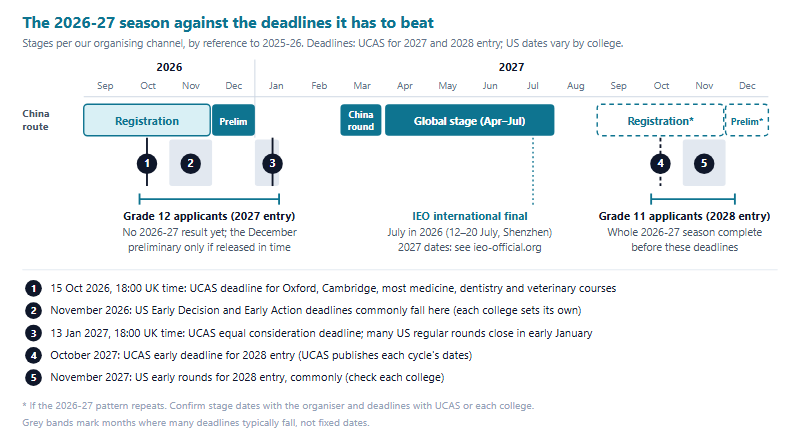
Grade 12: this season arrives after most of your file is read
Start with the uncomfortable arithmetic. Registration is still open when 15 October passes, and the December preliminary comes after every November early round. For most final-year applicants, nothing from the 2026-27 season can be in the file an admissions reader first opens. The one possible exception is a January deadline, and only if the preliminary result has been released before you submit. That release date is the organiser's to give, so ask for it in writing rather than assuming.
Timing matters because of how an award is read. An admissions reader checks a result against your transcript, your activity list, your essays and your referee, and a file becomes believable when those documents corroborate each other. A result that does not exist yet cannot corroborate anything, and describing a season you have only registered for as though it were an outcome invites exactly the check it would fail.
So what can a Grade 12 season do?
- Your application runs on what already exists. Results from earlier seasons go on it, named precisely: the stage, the division, the year and the organiser.
- The preparation is real material. Economics you are genuinely working through this autumn is something you can discuss honestly if you are invited to interview, because it is work rather than a line on a form.
- Later updates, only where invited. Some US colleges accept updates after submission, typically from deferred or regular-round applicants. Check each college's own policy first, and keep any update to one factual line.
- A final-year eligibility check. For the 2026 edition, national-team contestants had to be born after 30 June 2006 and working toward a high school diploma or a similar degree as of 1 December 2025. Those dates are re-set every edition, so confirm the 2027 criteria before counting on a later stage.
None of this is an argument against competing in your final year. It is an argument for being clear about what the season can and cannot do, and for protecting the hours your applications need between September and January.
Grade 11: the one season an application can show end to end
Move one year earlier and the picture inverts. If you apply in autumn 2027, the entire 2026-27 season should be over before you submit anything, on the pattern our organising channels describe: the December preliminary, the March China-round stage and the April-to-July global stage all fall before the October and November deadlines of your cycle. UCAS publishes the 2028-entry dates each cycle, so confirm them when they appear, and, if the season follows that pattern, the order of events holds.
That order is what makes this the decisive season for application purposes. Every document in your file can be finalised after the result exists. Your activity list can state the stage you reached. Your referee can describe what they watched you do while you prepared. Your personal statement can discuss an idea the competition forced you to understand properly. Each is an independent check on the same claim, and a reader who sees them agree has good reason to believe it.
Three planning consequences follow.
- Register in this autumn's window, not next year's. The 2027-28 season would fall in your final year, and it would land after your deadlines exactly as this one does for today's Grade 12.
- Settle your team early. In the China-route handbook we hold, you choose a division and complete team formation before the preliminary, so teammates are a September decision, not a December one. What that team will eventually need to do together is set out in our guide to the team business case.
- Plan the summer around July. The global stage runs to July, which is also when many students draft personal statements. Aim for a first draft before any competition week and an edit after it, rather than writing during it.
If you are starting from school economics, our twelve-week preparation plan fits between now and a December paper.
Grade 10 and younger: two seasons, and a rehearsal you can afford
A Grade 10 student applying in autumn 2028 has two complete seasons before any deadline: this one and 2027-28. That changes what the first season is for. It can be a rehearsal, the season in which you learn the format, find out how far your economics stretches under time pressure, and discover what working with a team to a deadline is really like, without that season having to carry an application.
Two seasons also give a reader something one season cannot: a sequence. A student who competes twice and describes both seasons accurately shows sustained engagement over the same two years in which their transcript is changing, and the two records can be read against each other. That is corroboration across time rather than across documents, and it exists only if the first season happened early enough.
Below high-school age the picture changes again. The IEO's OpenTrack regulations describe students younger than high-school age as not yet eligible for the MainTrack, the national-team competition. For Grades 7 and 8, the realistic entry points are the China route's junior division (JUNIOR-SL covers Grade 9 and below in the handbook we hold) and the IEO's free online OpenTrack, which under its 2026 rules had no age bar and awarded a certificate of participation rather than medals. The application is years away; the value now is foundations.
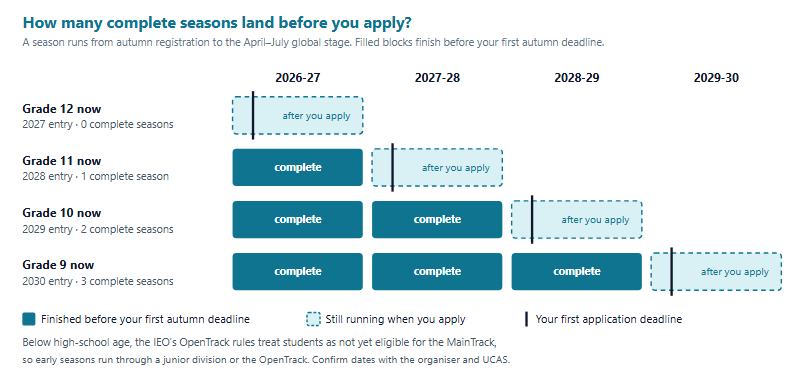
The table below puts all four positions side by side.
| School year now (September 2026) | Applying for | First deadlines to beat | 2026-27 stages finished by then | What this season is for |
|---|---|---|---|---|
| Grade 12 (Year 13) | 2027 entry | 15 October 2026 (UCAS); US early rounds, commonly November; 13 January 2027 (UCAS equal consideration) | None by October or November; the December preliminary only if its result is out before you submit | The economics itself, interview material, and updates where a college invites them |
| Grade 11 (Year 12) | 2028 entry | Autumn 2027 (UCAS and US early rounds; dates published each cycle) | All of it: preliminary, China round and the April-to-July global stage | The season your application can show end to end |
| Grade 10 (Year 11) | 2029 entry | Autumn 2028 | All of it, and the whole 2027-28 season as well | A first full season, with a second to build on |
| Grade 9 and below | 2030 entry or later | Autumn 2029 or later | All of it, with further seasons still to come | Foundations, a junior division, or the OpenTrack |
Four things to confirm before registration closes
- The stage dates. The registration close, the preliminary date and the later stages come from the China-route organiser. Get them from the organiser directly, not from a forwarded screenshot.
- When preliminary results are released. For a Grade 12 student with a January deadline, that single date decides whether this season can appear on the application at all.
- Your real deadlines. The UCAS dates above apply to 2027 entry. For US colleges, read each college's own admissions page rather than a list someone else compiled.
- Eligibility for later stages. Criteria for the international edition are re-published every year in its Annual Regulations. Final-year students especially should read the new version rather than last year's dates.
The competition and the application reward the same habit in the end: knowing exactly what happened and when, and saying so plainly. Sorting out the dates in September is the first place that habit shows.
Common questions
I am in Grade 12. Can a result from this IEO season go on my application?
Only a result that exists before you submit. On the season pattern our organising channels describe, early deadlines pass before the December preliminary, so ask when its results are released.
Which school year gets the most application value from one season?
Grade 11. The whole 2026-27 season, from preliminary to global stage, finishes before the autumn 2027 application deadlines.
What are the UCAS deadlines for 2027 entry?
15 October 2026 at 18:00 UK time for Oxford, Cambridge and most medicine, dentistry and vet courses; 13 January 2027 for most others.
Who sets the China-route stage dates?
The China-route organiser, not the IEO Association. Confirm registration, preliminary and later stage dates with the organiser directly.
This is an independent guide operated by Hanlin Education for China-based international-school students. We are not affiliated with, endorsed by, or sponsored by the International Economics Olympiad Association. China-route stage dates come from our organising channels' materials and change between seasons; application deadlines are set by UCAS and by each university. Confirm current competition details on ieo-official.org and with the organiser. Errors are corrected within 7 working days of being reported.