When preparing for the International Economics Olympiad (IEO), students often encounter the term IEO OpenTrack during the registration phase. A common misconception is that this represents a separate, easier, or purely online version of the contest. In reality, based on official registration pathways, OpenTrack is simply one component of the entry structure alongside the Main Track. It does not change the nature of the questions you will face, nor does it offer a distinct logistical advantage like remote participation.
For prospective participants, the critical decision is not whether to choose OpenTrack for convenience, but how to prepare effectively regardless of the registration label. The IEO challenges students across three rounds, testing knowledge in economics, finance, business case studies, and game theory. Whether you enter via the Main Track or OpenTrack, the intellectual rigor remains identical. Therefore, your preparation strategy should focus on mastering the syllabus and understanding the specific demands of your chosen division.
Clarifying the Registration Pathway
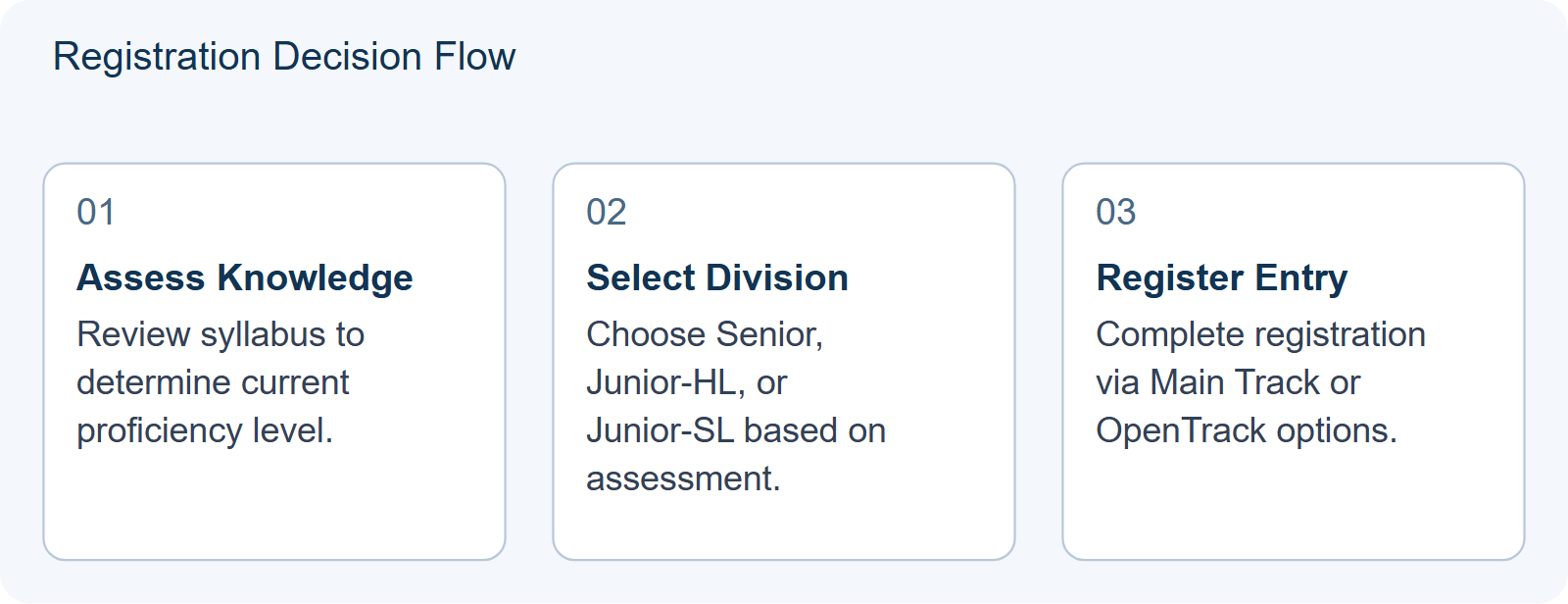
The registration process for IEO typically involves selecting between the Main Track and OpenTrack. While the exact administrative differences may vary by region or year, both paths lead to the same competitive environment. Students should not assume that OpenTrack implies a lack of travel requirements or a different scoring system. Instead, view it as an administrative option provided by the organizers to accommodate different entry scenarios. The core value lies in the content you study, not the button you click during sign-up.
It is essential to verify current-year registration details directly through official channels or trusted independent guides. Do not rely on rumors about “easier” tracks. The IEO is designed to test genuine economic literacy and analytical skills. Attempting to bypass rigorous preparation by seeking a perceived shortcut in registration is a strategic error that will likely result in poor performance during the actual rounds.
Choosing the Right Division
Before worrying about OpenTrack versus Main Track, focus on selecting the appropriate division. The IEO generally categorizes participants into Senior, Junior-HL (Higher Level), and Junior-SL (Standard Level). This choice significantly impacts the depth of material you need to cover.
| Division | Target Audience | Preparation Focus |
|---|---|---|
| Senior | Advanced high school students | Complex macro/micro models, advanced finance |
| Junior-HL | Students with prior econ exposure | Core principles, basic game theory, case analysis |
| Junior-SL | Newcomers to economics | Foundational concepts, logical reasoning, data interpretation |
Selecting the wrong division can be detrimental. If you are new to economics, entering Senior level without adequate background will lead to frustration. Conversely, experienced students might find Junior-SL too basic. Assess your current knowledge honestly. Review past papers to gauge difficulty levels before committing to a division. This self-assessment is far more important than the distinction between OpenTrack and Main Track.
Strategic Preparation Steps
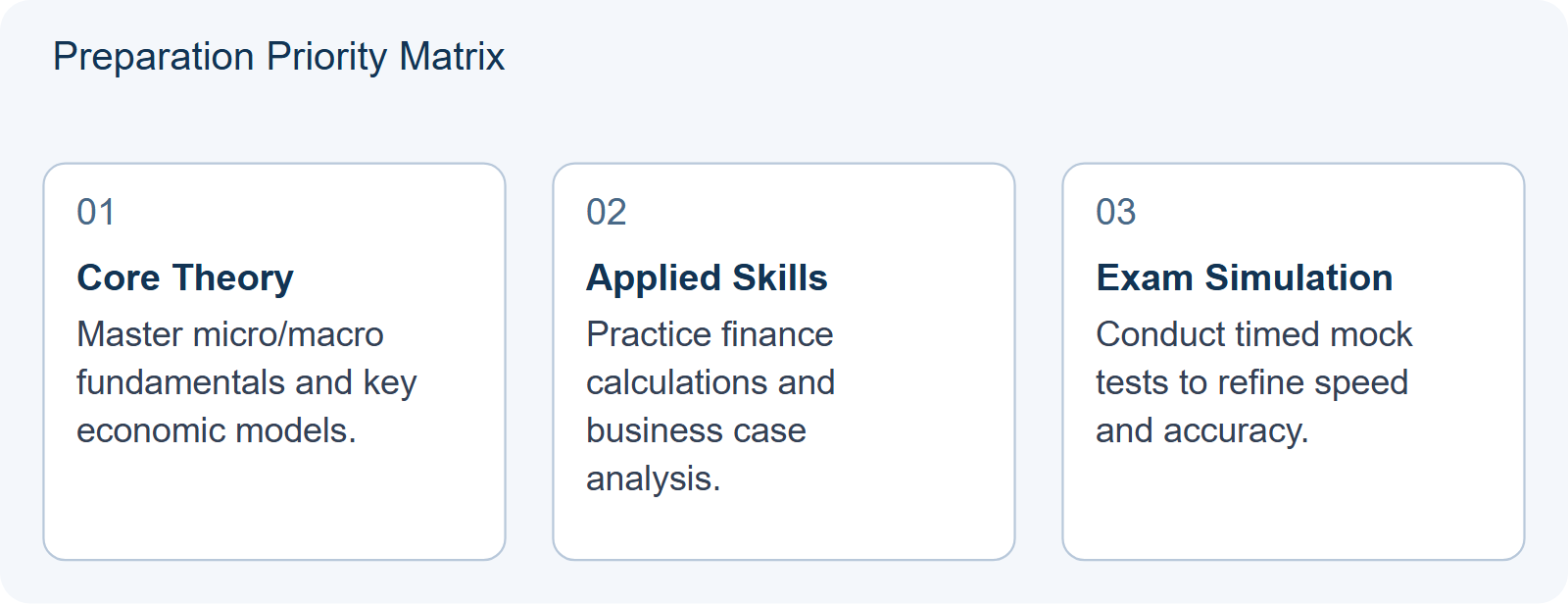
Regardless of your registration path, effective preparation follows a structured approach. Start by building a strong foundation in microeconomic and macroeconomic principles. Understand supply and demand curves, elasticity, market structures, and fiscal policy mechanisms. These concepts form the backbone of many IEO questions.
Next, develop your financial literacy. Learn how to read balance sheets, understand bond pricing, and calculate basic investment returns. The finance section often trips up students who focus solely on theoretical economics. Practice interpreting real-world economic data, such as inflation rates and GDP figures, to sharpen your analytical skills.
Finally, engage with business case studies. The IEO requires you to apply economic theories to practical business scenarios. Practice writing concise, evidence-based arguments. Time management is crucial here; learn to structure your responses quickly under pressure. Join study groups or seek mentorship if possible, as discussing problems aloud helps solidify understanding.
Common Misconceptions to Avoid
Avoid the trap of thinking OpenTrack is a “backup” option. It is not. Treat every registration as a serious commitment to compete at the highest level you can achieve. Another mistake is neglecting game theory. Many students skip this area, assuming it is optional. However, game theory components appear regularly and can differentiate top performers. Dedicate time to studying Nash equilibria and strategic interactions.
Also, do not underestimate the importance of practice exams. Reading textbooks is passive; solving timed problems is active. Simulate exam conditions to build stamina and identify weak areas. Use available resources to review past questions, focusing on why certain answers are correct and others are not. This analytical approach yields better results than rote memorization.
Conclusion
In summary, IEO OpenTrack is merely a registration category, not a shortcut to success. Your performance depends entirely on the quality of your preparation and the appropriateness of your division choice. Focus on mastering the syllabus, practicing under timed conditions, and engaging deeply with economic concepts. By ignoring distractions about track types and concentrating on substantive learning, you position yourself for a strong showing in the International Economics Olympiad.
HYPOTHETICAL/ILLUSTRATIVE: The Junior-HL vs. Senior Dilemma
To apply the advice on choosing the right division, consider a hypothetical student named Alex. Alex has completed one year of high school economics and is comfortable with basic supply and demand curves but has never studied game theory or complex financial instruments. Alex’s teacher suggests entering the Senior division because Alex scored highly in a local quiz. However, the article emphasizes that division choice should reflect actual syllabus mastery, not just general academic confidence. Let us compare two plausible preparation paths for Alex to see how this decision impacts readiness.
Choice A: Enter Senior Division Immediately
If Alex chooses the Senior track, the preparation focus shifts to advanced macroeconomic models, complex fiscal policy analysis, and sophisticated finance topics like bond duration and equity valuation. For Alex, this means spending the next three months trying to bridge a significant knowledge gap. The risk here is cognitive overload. By attempting to learn advanced concepts from scratch under time pressure, Alex may develop superficial understanding rather than deep analytical skills. In the actual competition, questions requiring multi-step logical deduction in unfamiliar territory could lead to blank answers or critical errors, regardless of whether Alex registered via OpenTrack or Main Track.
Choice B: Enter Junior-HL Division First
Alternatively, Alex selects the Junior-HL division. This category targets students with prior exposure but not necessarily advanced specialization. The preparation focus aligns better with Alex’s current state: reinforcing core principles, introducing basic game theory (such as Nash equilibria), and practicing case analysis. Alex can spend the first month mastering foundational gaps identified by reviewing past papers, then dedicate the second month to learning introductory game theory, which is often neglected. This approach allows Alex to build confidence through successful problem-solving rather than struggling against insurmountable difficulty. If Alex performs exceptionally well in Junior-HL, they can aim for Senior the following year with a solid foundation already in place.
| Factor | Choice A (Senior) | Choice B (Junior-HL) |
|---|---|---|
| Knowledge Gap | Large; requires rapid acquisition of new, complex topics. | Moderate; focuses on refining existing skills and adding basics. |
| Preparation Stress | High; risk of burnout due to overwhelming material. | Manageable; allows for steady, incremental progress. |
| Competition Outcome | Potential for low scores if advanced concepts are misunderstood. | Higher likelihood of strong performance within appropriate scope. |
The decision changes based on honest self-assessment of specific syllabus components, particularly game theory and finance, rather than general grades. A reusable self-check for any student is to take a sample set of ten questions from both divisions without studying. If you cannot solve more than half of the Senior questions using only your current knowledge, while solving most Junior-HL questions comfortably, the latter is the strategic starting point. Remember, the registration label does not alter the intellectual rigor required; it merely frames the scope of what you must master. Choosing a division where you can demonstrate genuine competence is far more valuable than chasing a title that exposes your weaknesses.
Before committing to the OpenTrack route, clarify its specific eligibility and scope by reading IEO OpenTrack Decoded. If you are new to economics, consider No Economics Course at Your School? to assess if this starting point suits your background. Finally, ensure your preparation aligns with the actual assessment style by reviewing What the IEO Business Case Has Actually Asked.
Frequently Asked Questions
Is IEO OpenTrack an online-only competition?
No. Source materials confirm OpenTrack is part of the registration path but do not indicate it is online-only. Participants should expect standard competition formats.
Does OpenTrack have easier questions?
There is no evidence suggesting OpenTrack has different question difficulty. All entrants face the same rigorous IEO standards regardless of registration track.
Which division should I choose?
Choose based on your experience. Senior for advanced students, Junior-HL for those with some background, and Junior-SL for beginners. Past papers help assess fit.