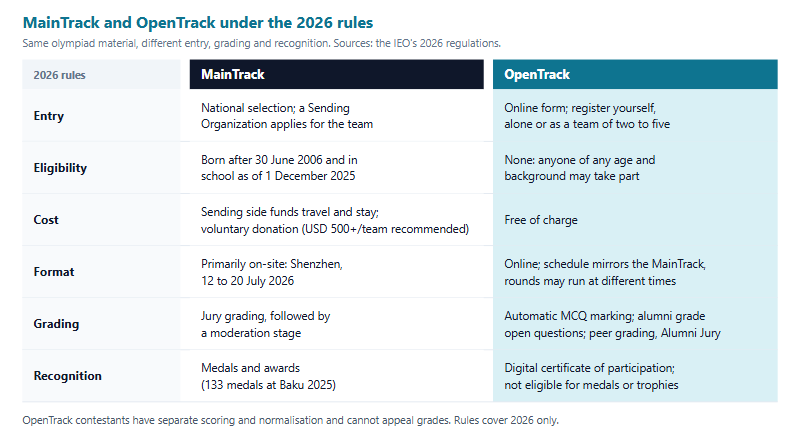
The IEO OpenTrack is the olympiad's free, online parallel category. Under its 2026 Specific Regulations, anyone of any age can enter, alone or as a team of two to five, and work through the same Economics and Finance material and a team Business Case, graded on a separate scale. Contestants receive a digital certificate of participation, not medals. It suits students not selected for a national team, younger students and those past the age criteria.
What the OpenTrack is, in the organiser's own terms
The OpenTrack is not a third-party imitation or a practice website. It runs under the IEO's own aegis, organised by what its regulations call the IEO OpenTrack Team: people drawn from the Executive Board, the International Board, IEO alumni and the wider community around the olympiad. Clause 1.2 of the 2026 OpenTrack Specific Regulations records that it was proposed in 2020 by the President and the Secretary of the Executive Board, in the wake of the covid-19 crisis.
Its purpose, per clause 1.3, is an alternative mode of participation with more relaxed conditions, which the document describes as “a full, live demonstration of the IEO’s activities.” Two structural rules give that phrase its meaning. The material is the same as on the MainTrack, although examination and grading procedures may differ (clause 3.3). And OpenTrack contestants compete in a category of their own, with their own scoring and normalisation (clause 3.2.1). You work through the olympiad's material; you are not ranked against its national teams.
The MainTrack, by contrast, is the competition between national teams whose members were selected through a national competition. The 2026 edition was primarily on-site, in Shenzhen from 12 to 20 July, with online participation only by Executive Board exception. For how the national-team side fits together, see our overview of what the IEO is and how it is structured.
Who it is built for, and how registration works
Clause 1.4 names four intended audiences, and clause 1.4.1 then lifts every restriction: anyone of any age and background can take part. The four groups are still worth reading, because each describes a situation students on the Greater China route actually find themselves in.
- National-round contestants not selected for their delegation that year. For our readers this is the key line. A student who competes on the China route and is not chosen for the national team is exactly who the regulations describe. MainTrack contestant names had to be submitted by 31 May for the 2026 edition, while OpenTrack registration by default stays open until four days before the olympiad begins, so a student who is not selected still has time to register.
- Students younger than high-school age. The regulations describe them as not yet eligible for the MainTrack. For a Grade 7 or 8 student, the OpenTrack is the IEO's own way in to the international material years before a national-team attempt is possible.
- Individuals older than the MainTrack's eligible age. Students who have left school, or who fall outside that edition's criteria, can keep competing. In 2026 the MainTrack required a birth date after 30 June 2006 and school enrolment as of 1 December 2025.
- Prospective organisers of national olympiads who observe the IEO. This group means national organisers, not school clubs, but a teacher weighing up a school team can still enter under the no-restrictions clause and see the rounds from the inside.
Registration is an online form asking for country of citizenship or residency, names, dates of birth, email addresses, phone numbers and, optionally, the institutions represented (clause 2.1.1). Personal identification and contact details can be deleted on request one calendar year after the event (clause 2.1.2). Then comes the decision that shapes your week: you can register as an individual or as a team of two to five (clause 2.2).
- Register alone and you join a pool from which the organisers form teams by location, timezone and expected languages, optimising for a team's logistical ability to work together (clause 2.2.1).
- Register as a team and your roster stays as it is unless you ask in writing for a change (clause 2.2.2).
Our advice, which is editorial judgement rather than anything in the rules: register as a team if you can. A pooled team is built around shared timezones, which is sensible, but not around complementary skills, which is what a business case actually rewards. A team formed in advance can agree before the week who owns the numbers, who owns the structure and who carries the English delivery. Our guide to the team business case sets out how those roles fit together.
On timing, clause 2.3 set a default window for 2026: registration opens about four months before the olympiad, in the second half of March, and closes four days before it starts, in the first half of July. The organisers may close it early if registrations pass 10,000 (clause 2.3.1). The document says it refers only to the 2026 edition (clause 8.2), so treat those defaults as a pattern rather than a promise, and check the next window when it is published.
The rounds and the grading: three details that change how you prepare
Clause 3.2 describes two main rounds: Economics and Finance, which is individual, and the Business Case, which is team-based. On the MainTrack the individual component is a 40-question multiple-choice paper plus five open questions of which four are graded, and the case is delivered in English. The OpenTrack uses the same material, with procedures that differ in two ways.
- Proctoring may apply. The Economics and Finance round may be held with proctoring in parallel Zoom breakout rooms (clause 5.1.1). The Business Case is organised freely by each team; the organisers make the first introductions between teammates and then leave teams to it (clause 5.1.2).
- Grading is split by format. Multiple-choice questions are marked automatically (clause 6.1). Open questions are graded by a group of IEO alumni, assisted by artificial-intelligence tools closely supervised by the IEO Central Office (clause 6.2). The Business Case is assessed by peer grading against official rubrics from the IEO Problem Committee, and then by an Alumni Jury (clause 6.3).
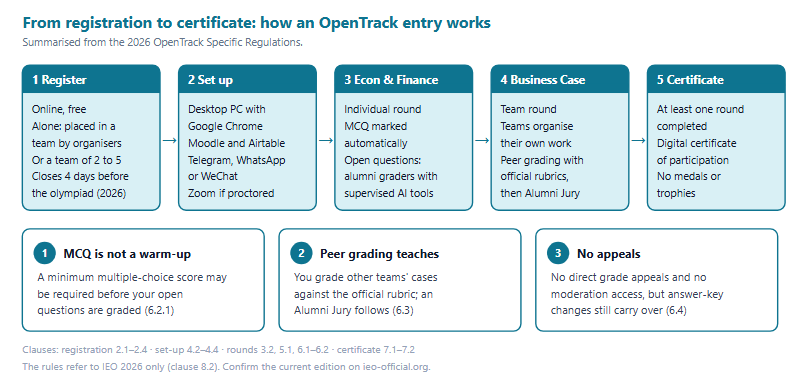
Three of those details deserve more attention than they usually get.
First, the multiple-choice paper is not a warm-up. Clause 6.2.1 allows a minimum multiple-choice score to be required before your open questions are considered for grading at all. A student who treats the 40 questions casually, saving effort for the open questions, risks never having those open answers marked.
Second, peer grading is a rare education. Assessing other teams' case solutions against the official rubric shows you, from the marker's side of the table, what separates a structured recommendation from a list of observations. Few students ever see another team's case work, let alone score it against a rubric, so treat this as preparation rather than a chore. Clause 6.3.1 says peer grading is designed and supervised to protect integrity and avoid conflicts of interest.
Third, there is no second chance on a misread question. OpenTrack contestants may not appeal their grades directly and have no access to moderation (clause 6.4.1), although any change to the official answer key made through MainTrack moderation is applied to the OpenTrack as well (clause 6.4). Slow down on the question stems.
The technical checklist, with a note for mainland China
The OpenTrack runs online and its general schedule mirrors the MainTrack's, although its rounds may run at different times for security reasons (clause 4.1). The infrastructure is specific, and the rules are blunt about devices.
| Requirement | What the 2026 rules say | What to test before the week |
|---|---|---|
| Device | A desktop PC with the Google Chrome browser is necessary; no technical support for tablets or phones (clauses 4.4 and 4.4.1) | Run a full practice session on the machine you will actually use |
| Access to the address you gave at registration (clause 4.3) | Check that announcements are not being filtered into spam | |
| Chat | At least one of Telegram, WhatsApp or WeChat, used for announcements and two-way communication (clauses 4.2 and 4.3) | Join from the account and network you will use during the week |
| Individual rounds | A Moodle course hosts the Economics and Finance rounds (clause 4.2) | Log in early and confirm the course appears for you |
| Business Case | Forms and tables on Airtable for uploading case work and peer-grading assignments (clause 4.2) | Rehearse an upload with your whole team |
| Proctoring | A Zoom address with breakout rooms, if proctoring applies (clauses 4.2 and 5.1.1) | Test your camera, microphone and Zoom access |
One row deserves particular care for students in mainland China. WeChat is on the official list of chat channels, which helps. Not every service on the list is reliably reachable from every network, though, so test each platform from the device and connection you will actually use, several days before the first round rather than on the morning of it.
The certificate, how to describe it, and three good uses
Clause 7.1 awards a simple digital certificate of participation to anyone who has effectively taken part in at least one round: the multiple-choice questions, the open questions or the Business Case. Clause 7.1.1 adds that the certificate highlights the OpenTrack's status as the massive open online version of the IEO, entered without national selection, and clause 7.2 says plainly that OpenTrack contestants are not eligible for medals or trophies.
That design matters before you list it anywhere. An admissions reader checks each entry against the rest of the file, and here the certificate itself states what the OpenTrack is. The only credible wording is one that matches that document, for example: “International Economics Olympiad OpenTrack (open online category), [year], certificate of participation.” Anything implying national selection would be contradicted by the document you were given. Nor should you claim a score or ranking unless one has been issued to you in writing; the rules describe separate scoring and normalisation, not a published individual result.
Described accurately, it still does real work. It corroborates an interest that your coursework, your reading and your referee can speak to, and it gives you something specific to discuss: what grading other teams' cases taught you, or which open question exposed a gap you then closed. Three uses make the most of it.
- The same-year rehearsal. Not selected for the national team this year? Register before the window closes, which in 2026 was the first half of July, and work through the international material in full a year ahead of your next attempt.
- The early look. A Grade 7 or 8 student, or a first-season junior-division entrant, can see the level of the international paper long before it counts. Pair it with a structured block such as our twelve-week preparation plan.
- The school pilot. A school weighing up a team can enter a self-formed OpenTrack team at no cost and learn, before committing to a national route, whether its students can divide a case and deliver it in English to a deadline.
What the OpenTrack is not is a selection route or a substitute for the MainTrack, and its own rules make that clear. Treat it as what it was designed to be, access to the olympiad on less demanding terms, and read the current edition's rules on the official OpenTrack page before planning around any date here.
Common questions
Is the IEO OpenTrack free to enter?
Yes. The 2026 OpenTrack Specific Regulations describe participation as free and unrestricted. Confirm the current edition on ieo-official.org.
Can OpenTrack contestants win medals?
No. Under the 2026 rules they receive a digital certificate of participation and are not eligible for medals or trophies.
Do I need a team before I register?
No. Register alone and the organisers place you in a team by location, timezone and language, or register a team of two to five.
Is there an age limit for the OpenTrack?
No. The 2026 rules say anyone of any age and background can take part; the MainTrack age and enrolment criteria do not apply.
This is an independent guide operated by Hanlin Education for China-based international-school students. We are not affiliated with, endorsed by, or sponsored by the International Economics Olympiad Association. The OpenTrack rules summarised here are the 2026 Specific Regulations, which apply to that edition only; confirm current details on ieo-official.org before registering or planning around any date. Errors are corrected within 7 working days of being reported.