When preparing for the International Economics Olympiad (IEO), many students approach game theory questions by trying to guess what will happen in the market or negotiation. They look for the “winning” strategy immediately. However, this often leads to errors in both multiple-choice questions and open-response business cases. The more reliable method is to identify the best response for each player given the other’s actions, before attempting to predict the equilibrium outcome.
The Core Mechanism: Why Best Response Comes First
In economic games, players are interdependent. Your optimal choice depends entirely on what you believe your opponent will do. If you skip the step of mapping out these conditional choices, you risk assuming rationality where it doesn’t exist or missing dominant strategies that simplify the problem. For IEO preparation, this distinction is crucial because the exam tests your ability to model strategic interaction, not just recall definitions.
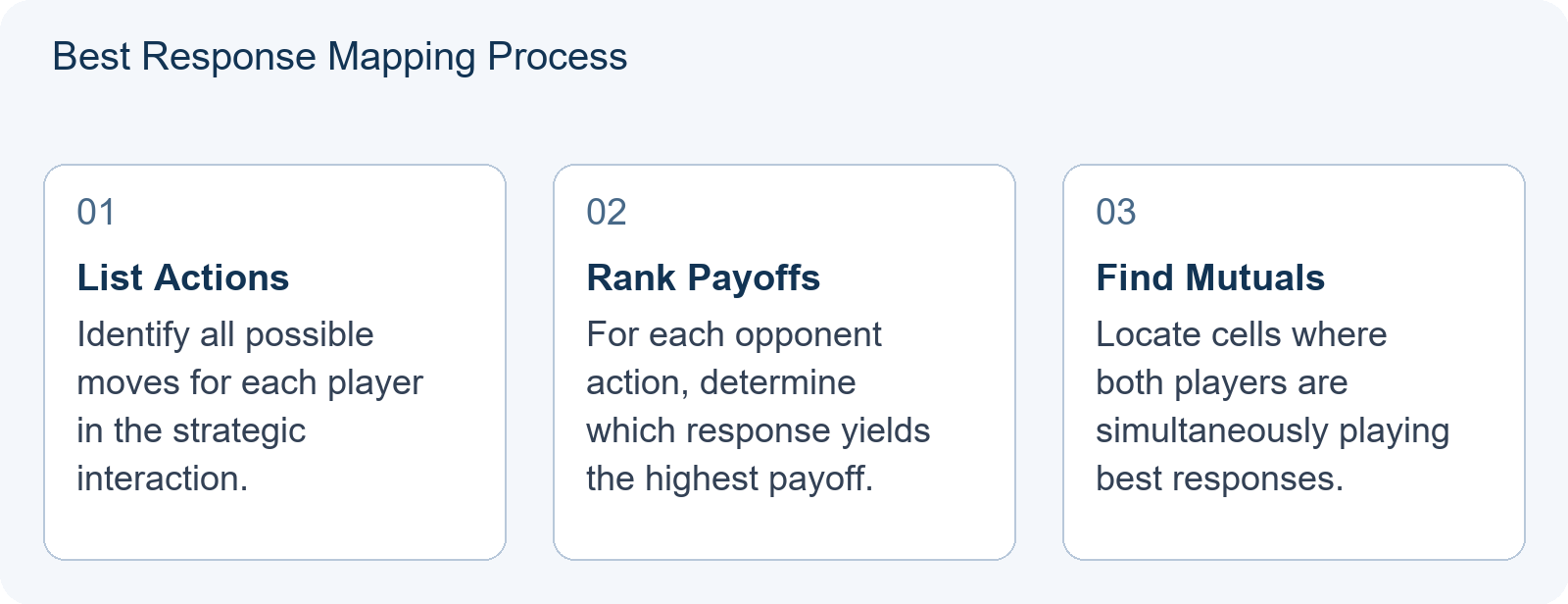
A best response is simply the action that yields the highest payoff for a player, given the specific action taken by their opponent. By constructing a matrix of these responses, you can visually see where mutual best responses occur—these are the Nash Equilibria. Trying to jump straight to the equilibrium without this map is like solving a maze without looking at the walls; you might get lucky, but you won’t understand why.
Teaching illustration—hypothetical scenario for methodological demonstration:
Worked Teaching Case: The Advertising Spend Dilemma
Imagine two competing smartphone firms, A and B, each deciding whether to run a High or Low advertising campaign. Payoffs represent profit in millions of dollars:
| B: High | B: Low | |
|---|---|---|
| A: High | (2, 2) | (5, 1) |
| A: Low | (1, 5) | (4, 4) |
Step 1: Find Player A’s Best Responses.
If B chooses High: A compares 2 (High) vs 1 (Low). Best response: High.
If B chooses Low: A compares 5 (High) vs 4 (Low). Best response: High.
Conclusion: High is a dominant strategy for A—best response regardless of B’s action.
Step 2: Find Player B’s Best Responses.
If A chooses High: B compares 2 (High) vs 1 (Low). Best response: High.
If A chooses Low: B compares 5 (High) vs 4 (Low). Best response: High.
Conclusion: High is also a dominant strategy for B.
Step 3: Identify the Equilibrium.
The only cell where both play their best response is (High, High), yielding (2, 2). Notice that (Low, Low) at (4, 4) would make both better off, but it is not stable—each has incentive to deviate to High. Students who predict “cooperation” without checking best responses miss this tension. The best-response method correctly identifies the non-cooperative equilibrium.
Contrasting Case: Where Superficial Prediction Fails
Teaching illustration—sequential move scenario:
Consider a market entry game. An Incumbent firm threatens to Fight if an Entrant enters. A student who predicts based on the threat alone might say: “The entrant stays out.” This is wrong without checking whether Fight is the Incumbent’s best response after entry occurs.
Payoff structure (Incumbent, Entrant):
- Enter + Fight: (-5, -10)
- Enter + Accommodate: (2, 5)
- Stay Out + (any): (10, 0)
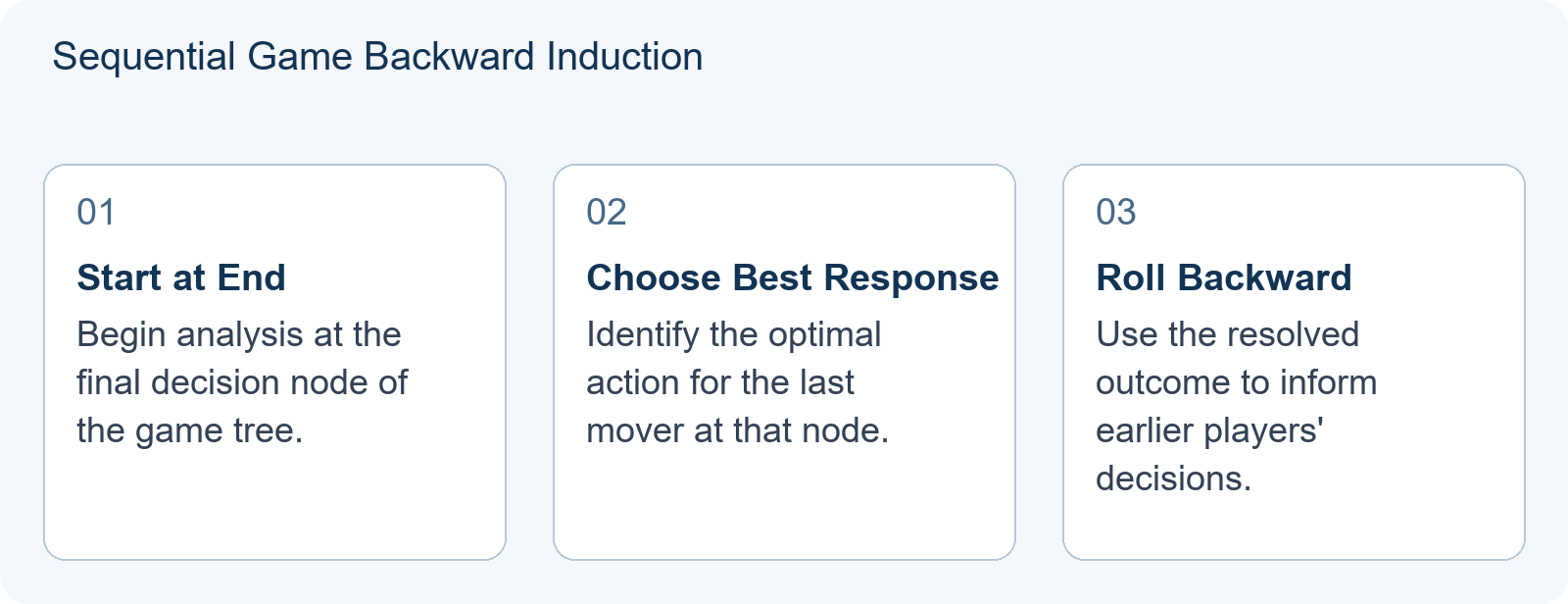
Backward induction analysis:
At the final node (after Enter), the Incumbent compares Fight (-5) vs Accommodate (2). The best response is Accommodate.
The Entrant, anticipating this, compares Stay Out (0) vs Enter (5). The best response is Enter.
Verified equilibrium: Enter/Accommodate. The threat to Fight was not credible—it was not a best response at the decision node where it would be executed. This is why checking best responses at each subgame matters. Sequential analysis requires observed moves at each node; the Subgame Perfect Nash Equilibrium (SPNE) refines the Nash Equilibrium concept by eliminating non-credible threats, but does not replace the underlying best-response logic.
Diagnostic Application: Test Your Best-Response Skill
Scenario: Two restaurants choose prices simultaneously: Low ($9), Medium ($12), or High ($15). Cost per meal is $8 for both. Total market demand is fixed at 1 unit for this teaching illustration (not a prediction of real market behavior). If prices differ, the lower-priced restaurant captures 70% of customers; if equal, split 50-50. Which statement is correct?
Verified payoff matrix for each restaurant (profit = (Price − $8) × share):
| B: Low ($9) | B: Medium ($12) | B: High ($15) | |
|---|---|---|---|
| A: Low ($9) | (0.50, 0.50) | (0.70, 1.20) | (0.70, 2.10) |
| A: Medium ($12) | (1.20, 0.70) | (2.00, 2.00) | (2.80, 2.10) |
| A: High ($15) | (2.10, 0.70) | (2.10, 2.80) | (3.50, 3.50) |
Options:
- (Low, Low) is a Nash Equilibrium.
- (Medium, Medium) is a Nash Equilibrium.
- (High, High) is a Nash Equilibrium.
- No pure-strategy Nash Equilibrium exists in this game.
Answer and verified reasoning:
Correct: 3.
Verification: For Player A, compare payoffs row-wise:
- Against B=Low: High ($2.10) > Medium ($1.20) > Low ($0.50). Best response: High.
- Against B=Medium: High ($2.10) > Medium ($2.00) > Low ($0.70). Best response: High.
- Against B=High: High ($3.50) > Medium ($2.80) > Low ($0.70). Best response: High.
High strictly dominates both Low and Medium for Player A. By symmetry, the same holds for Player B. Therefore, (High, High) is the unique Nash Equilibrium.
Option 1 is false: at (Low, Low), each earns $0.50; deviating to High yields $2.10 > $0.50.
Option 2 is false: at (Medium, Medium), each earns $2.00; deviating to High yields $2.10 > $2.00.
Option 4 is false: a pure-strategy Nash Equilibrium exists, namely (High, High).
Important note on mixed strategies: Even when no mutual pure-strategy best response exists in a simultaneous game, a mixed-strategy equilibrium may still exist. The absence of a pure-strategy equilibrium does not imply no equilibrium exists.
What This Diagnostic Reveals About Your Next Step
If you found the calculation above challenging—particularly verifying whether deviation is profitable—your next task is to practice systematic payoff comparison. Do not memorize; instead, for any payoff matrix, explicitly write out: “If I deviate from this cell, my payoff changes from X to Y.”
If you correctly identified that (High, High) is equilibrium but struggled with the arithmetic, your gap is in careful calculation under time pressure. The IEO multiple-choice round allows limited time; practice estimating whether a deviation is worth it without full calculation.
If you selected option 1 or 4, revisit the definition of Nash Equilibrium: it requires only that no player can benefit by changing strategy alone, given others’ strategies. No probability, dominance, or cooperation assumption is needed.
Applying Best-Response Logic to IEO Business Cases
The IEO Business Case round, confirmed in competition structure documentation, requires teams to present strategic recommendations. Best-response framing strengthens your argument structure:
Weak claim: “We recommend low pricing to capture market share.”
Strong claim: “Given that our competitor’s best response to our low price is to match rather than undercut (since undercutting drives both margins below sustainable levels), our low-price strategy sustains advantage. We verified this by checking that their payoff from matching exceeds their payoff from undercutting at the relevant margin structure.”
This demonstrates the rigorous economic thinking that distinguishes strong responses. For more on structuring business case arguments, see What the IEO Business Case Has Actually Asked: Three Prompts, One Recurring Shape.
Common Pitfalls in Student Work
Three errors recur in preparation observations:
- Confusing Dominant Strategy with Nash Equilibrium: A dominant strategy is a best response to all opponent actions. A Nash Equilibrium is a mutual best response pair. Every dominant strategy equilibrium is a Nash Equilibrium, but not vice versa.
- Ignoring the Order of Moves: Simultaneous games use matrices; sequential games require backward induction with observed moves at each node. Misidentifying the game type guarantees wrong predictions.
- Assuming Symmetry: Students often assume opponents share their payoffs. In IEO problems, asymmetric payoffs are common—check each player’s incentives separately.
Connecting to Broader IEO Preparation
Game theory appears across IEO rounds: in multiple-choice questions testing Nash Equilibrium identification, in open-response questions analyzing market behavior, and in business cases requiring strategic recommendations. For students building from a non-economics background, foundational concepts are covered in IEO Preparation for STEM Students: Starting Without School Economics.
The mathematical tools for payoff analysis overlap with other calculation-heavy IEO topics. A systematic review of essential techniques appears in The Maths You Actually Need for the IEO: Eight Calculation Families and the Five Errors That Cost Most Marks.
For practice material access strategies given limited official releases, see IEO Past Papers: How to Build Practice When Official Materials Are Scarce.
Summary: The Best-Response Checklist
- Identify all players and their available actions.
- For each possible opponent action, determine which response maximizes your payoff.
- Check whether any action is a best response to all opponent actions—this is a dominant strategy.
- Find cells where all players simultaneously play best responses—these are Nash Equilibria.
- For sequential games, start from the final decision node and work backward using observed moves.
- Verify credibility: would players actually carry out threatened actions at their decision nodes?
- Remember: absence of pure-strategy equilibrium does not mean no equilibrium—mixed strategies may exist.
Mastering this sequence transforms game theory from guesswork into a reliable scoring area on the IEO. The discipline of checking best responses before announcing outcomes is what separates candidates who understand strategic interaction from those who merely recognize game theory terminology.
Frequently Asked Questions
Do I need advanced math for IEO game theory?
No. Most IEO game theory questions rely on logical reasoning and basic arithmetic within payoff matrices. Advanced calculus is rarely required for standard Nash Equilibrium identification. The diagnostic in this article uses only multiplication and comparison.
How does game theory fit into the Business Case round?
It provides a framework for anticipating competitor reactions. You use best-response logic to justify why your proposed strategy is robust against rational counter-moves, as demonstrated in the strong vs weak claim comparison above.
What if the payoff numbers are missing in a question?
You can still solve it using ordinal rankings. As long as you know which outcome is ‘better’ than another for each player, you can identify best responses and equilibria. Exact cardinal values are only needed for expected utility in mixed strategies.