Most students check one eligibility rule for the International Economics Olympiad and stop. There are two. The official IEO 2026 Annual Regulations required every MainTrack — that is, national-team — contestant to have been born after 30 June 2006 and to have been working toward a high school diploma or a similar degree as of 1 December 2025. Fail either and that route closes for the edition. It is not the only route: the IEO also runs an official OpenTrack, a free online parallel category with no age or enrolment bar, which awards certificates of participation rather than medals — confirm the current cycle on ieo-official.org. Here is how both MainTrack tests work, who checks them, and how many cycles a Greater China student realistically gets.
The two tests, in the official wording
The IEO publishes a fresh set of Annual Regulations for each edition. Clause 3.6 of the 2026 document — the edition hosted in Shenzhen from 12 to 20 July 2026 — states that the Sending Organization is responsible for making sure its contestants fit the eligibility criteria, defined as two conditions joined by “and”. That conjunction is the part students skim past. It is not a choice of routes; both must hold at the same time.
| Test | IEO 2026 official criterion | What it actually asks | Evidence used |
|---|---|---|---|
| 1. Date of birth | Born after 30 June 2006 | Are you young enough on a fixed, dated cut-off — not on the day you compete? | Passport and/or national ID card, carried to the venue |
| 2. School enrolment | Working toward a high school diploma or a similar degree as of 1 December 2025 | Were you a secondary student on a status date roughly seven months before the final? | Confirmed by your Sending Organization before the event |
| Both together | Criteria joined by “and” | Passing one does not compensate for the other | Sending Organization is accountable for the check |
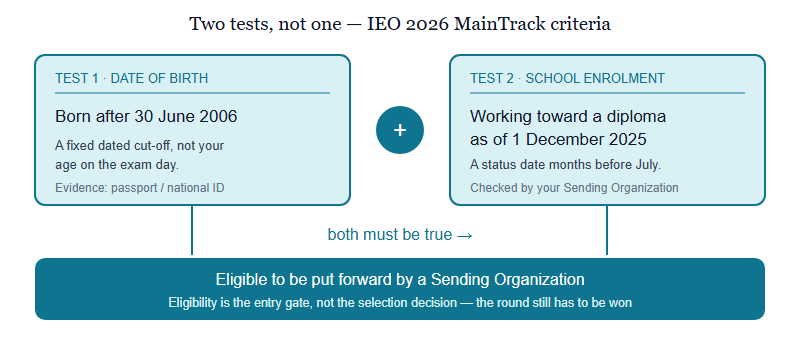
Test 1: why “under 20” is the wrong way to hold the rule in your head
Summaries of the IEO usually say contestants must be under 20 on 30 June of the competition year. For the 2026 edition that description and the official wording — born after 30 June 2006 — describe the same people. But the two phrasings behave differently in your head, and the official one is safer for three reasons.
- It is a date, not an age. You do not calculate anything. You compare your birth certificate against a printed date. Students who try to reason about “how old will I be in July” are the ones who get it wrong.
- It is fixed to the cut-off, not the event. Turning 20 in, say, October of the competition year does not disqualify you, because the test is anchored to the published date, not to the week you compete.
- It is re-published every year. The cut-off is restated in each edition's Annual Regulations. Do not assume next year's date by adding one to last year's. Open the current Annual Regulations and read the clause.
That last point deserves emphasis, because it is where confident students trip. The 2026 document itself carries a note that it “was updated with more precise details on 14/04/2026” — that is, the regulations were revised part-way through the cycle. Check the version date on the document you are reading, and confirm anything decision-critical on ieo-official.org rather than on a summary page, including this one.
Test 2: the enrolment status date almost nobody checks
The second criterion is the one that catches people, because it introduces a date that has nothing to do with either your birthday or the competition week. For IEO 2026, the question was whether you had been working toward a high school diploma or a similar degree as of 1 December 2025 — roughly seven months before the final.
Two practical consequences follow, and both matter for planning:
- The status date sits early in the school year. It falls near the start of the cycle, around the same period the application stages open, not near the event. Your situation in the winter is what is assessed, not your situation in July.
- Final-year students are not automatically excluded. Read literally, a student still in secondary school on the status date satisfies the enrolment criterion for that edition even if their school course ends before the summer. Whether that applies to your case, however, is not something to infer from a guide — graduating students should confirm their position with their Sending Organization and against the current Annual Regulations before counting on a final attempt.
If you are unsure what “a similar degree” covers for your school system — an international curriculum, a national senior secondary certificate, a vocational route — that is exactly the kind of question to put to your Sending Organization in writing, early. It is a five-minute question in October and an unrecoverable problem in June.
Who actually checks, and what you carry to the venue
Eligibility is verified twice, by two different parties, at two different moments. Knowing which is which tells you who to ask when something is ambiguous.
| When | Who checks | What they are responsible for |
|---|---|---|
| Before the event | Your Sending Organization | Making sure its contestants fit the eligibility criteria; organising the contestant selection process; appointing Team Leader(s) |
| At the venue | Each contestant, individually | Bringing the document — passport and/or national ID card — confirming eligibility to participate |
| For contestants under 18 | Legal guardians and Team Leaders | Guardians sign a disclaimer of liability; Team Leaders hold responsibility for contestants in their team |
The practical takeaway: the IEO does not assess individual students' eligibility on application. A Sending Organization certifies it, and you evidence it with an identity document on site. So if your birth date or school status is anywhere near a boundary, the person to resolve it with is whoever runs your route into the competition — not the international office, and not a third-party guide. Our registration page sets out how entry works, and our regions page covers the route by territory. For the wider structure of who these organisations are and where they sit, see our overview of what the IEO is and how it is organised.
How many cycles you actually get
Here is the part worth planning around, and it describes the MainTrack. For almost every Greater China student, the binding constraint is not the age rule. The birth-date cut-off typically only bites at the very end of secondary school; what limits you long before that is winning a place through a national or regional round, and having a route that is running in your territory at all. The OpenTrack sits outside this arithmetic: with no age or enrolment bar, it stays open to students below high-school age and to those past the MainTrack cut-off alike.
That inverts the usual anxiety. Students ask “am I too old?” when the more useful questions are “how many selection cycles do I have left?” and “is my first attempt going to be a wasted one?”
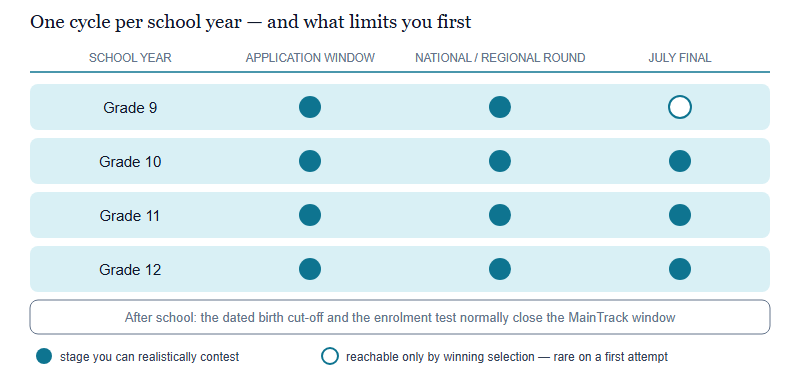
Read that chart as a budgeting exercise rather than a promise. A Grade 9 entry is usually a reconnaissance run: you learn the format, discover how far your economics actually stretches, and find out whether you can write under time pressure. Grades 10 and 11 are where most serious attempts land. Grade 12 is frequently squeezed by university applications rather than by any rule.
Which is an argument for starting earlier than feels comfortable. If you intend to make one real attempt, make it your second, and treat the first as data collection. Our 12-week preparation plan is built to be run more than once, precisely because the second pass through the same material is where most of the gain shows up.
What changes each year, and what does not
Treat the following as stable structure, and everything dated as re-confirmable:
| Stable across editions | Re-set every edition — confirm on ieo-official.org |
|---|---|
| Two criteria, joined by “and”: a birth-date cut and a school-enrolment status | The exact cut-off date and the exact status date |
| The Sending Organization verifies eligibility and runs contestant selection | Which organisation performs that role in your territory, and its own internal rules |
| Contestants carry an identity document confirming eligibility | Host country, venue city and event dates |
| Teams of up to five contestants with one or two Team Leaders | Application-stage deadlines and name-submission deadlines |
| Three assessed components, including a team business case in English | Anything about weightings or scoring — do not assume, read the official documents |
One closing point on sequencing. Eligibility only determines whether you may be selected; it says nothing about whether you will be. Once you have confirmed both tests, the next real hurdle is the round itself — and for teams that reach the international stage, a full day of preparation followed by a presentation before an international jury. If that is the part you are aiming at, read our breakdown of the team business case round next.
Frequently asked questions
Does the IEO have a minimum age or grade?
The 2026 MainTrack criteria set a birth-date cut-off and a school-enrolment condition, not a lower age bound. Confirm current rules on ieo-official.org.
I turn 20 in the autumn. Am I still eligible?
The MainTrack test is a fixed dated cut-off, not your age on the competition week, and the OpenTrack has no age bar at all. Check your birth date against the current edition's published clause.
Can I apply to the IEO directly as an individual?
Not for the main national-team competition — there a Sending Organization applies, runs selection and appoints Team Leaders. The IEO does also run an OpenTrack, a free online parallel category you register for yourself; it awards certificates of participation rather than medals. Confirm current arrangements on ieo-official.org.
I graduate before July. Can I still compete that year?
The enrolment test is set on a status date months before the final. Confirm your case with your Sending Organization and current regulations.
This is an independent guide operated by Hanlin Education for China-based international-school students. We are NOT affiliated with, endorsed by, or sponsored by the International Economics Olympiad Association. Eligibility criteria, dates and rules are re-published for each edition — confirm current details on ieo-official.org before acting on anything here. Errors reported to us are corrected within 7 working days.