A strong school economics grade is a good starting point for the International Economics Olympiad and a poor predictor of performance in it. The reason is structural: the IEO assesses three components — a 40-question finance and economics multiple-choice paper, a set of five open questions of which four are graded, and a team business case delivered in English. Only one of those resembles what IB, AP or A-Level Economics trains you to do.
Audit your course against the format, not against a topic list
The instinct when preparing is to find a syllabus and tick topics off. That is the wrong first move, because the gap between school economics and the IEO is less about which concepts you have met and more about what you are asked to do with them. Three of the four gaps below are skill gaps, not knowledge gaps.
So start by placing your course against the competition's three components. If you have not yet read how those components fit together, our overview of what the IEO is and how it is structured sets the frame; this article assumes it.
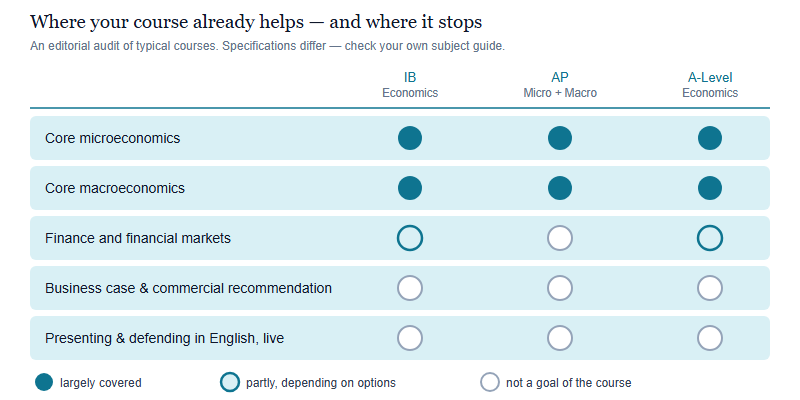
The pattern is consistent across all three curricula: the theory rows are solid, and everything below them is not what your course exists to produce. That is not a criticism of the courses. IB, AP and A-Level Economics are designed to certify understanding of economic theory through written examination. The IEO also asks you to price a decision, argue it to strangers, and do it as a team.
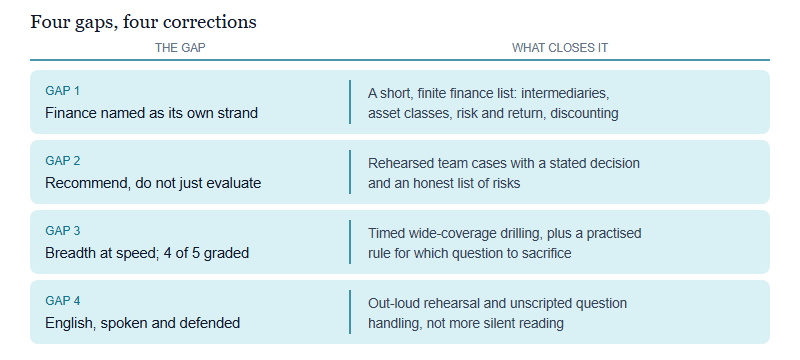
Gap 1: finance is not economics, and the IEO says so in its own naming
This is the largest and most reliably underestimated gap. The multiple-choice component is a finance and economics paper, and the official 2026 programme scheduled the individual assessments as “Economics and Finance Tests”. Finance is named as a distinct strand, not folded into economics as an afterthought.
Most school economics courses treat financial markets thinly — often as a macro topic about interest rates and monetary transmission rather than as a subject with its own vocabulary of instruments, returns, risk and valuation. A student who has only ever met “the money market” as a diagram will find the register unfamiliar even when the underlying logic is not hard.
Close it deliberately rather than by reading widely. The efficient sequence is: the function of financial intermediaries; the main asset classes and what a claim on each actually is; the relationship between risk and expected return; how interest rates and discounting move present values; what a company's basic financial statements report. That is a finite list, and it is the difference between guessing and reading a question. What the IEO examines in detail, however, is defined by the competition's own published materials — check those, and our syllabus page, rather than assuming a university finance syllabus.
Gap 2: the business case asks a question your syllabus never asks
School economics asks you to explain, analyse and evaluate. The team business case asks you to decide — to look at a commercial situation and recommend a course of action to a jury that will push back.
Those are different cognitive tasks. An evaluation essay is rewarded for balance; a recommendation is rewarded for commitment plus honest treatment of what could go wrong. Students trained only in the former produce presentations that survey options elegantly and never land, which reads as indecision.
The official 2026 agenda is instructive here: a full preparation day preceded the presentation day. The competition is not testing improvisation. It is testing whether five people can scope a problem, divide work, converge on a recommendation and rehearse it against a deadline. Our detailed treatment of the round is in the IEO business case guide; for this article, the point is simply that no economics specification asks you to practise it, so it will not happen by accident.
Gap 3: breadth at speed, and the four-of-five rule
Two format details change how you should study, and neither has a school equivalent.
- Forty multiple-choice questions reward recall speed and coverage. School economics rewards depth on a small number of extended answers. The revision behaviour that produces a strong essay — long, discursive, few topics — is close to the opposite of what makes a wide multiple-choice paper comfortable.
- Five open questions are set and four are graded. This introduces a triage decision that no school exam makes you take: you must judge, under time pressure, where your effort earns most. A student who spreads effort evenly across five, or who sinks time into the question they find most interesting, has made a strategic choice without realising it.
The drill that fixes the first problem is unglamorous and takes twenty minutes. Take forty short questions spanning the widest range of topics — if assembling that many is the obstacle, start from our resources page — give yourself a fixed clock, and answer every one, including the ones you would normally skip. Then mark them into three piles: knew it, worked it out, guessed. The middle pile is the one that matters. Questions you can eventually reason out but cannot answer quickly are the difference between finishing a wide paper and running out of time on it, and they are invisible in essay-based revision because an essay gives you room to think. Repeat weekly and watch the middle pile shrink.
The second problem — triage — needs a decision rule made in advance, not in the room. Decide now how many minutes you will spend reading all the prompts before writing anything, and what your tie-break is when two questions look equally attractive: the one with the clearer structure, or the one where you can name your evidence in the first ten seconds. A rule chosen calmly in advance beats a judgement made under time pressure, which is exactly when students default to the most interesting question rather than the most answerable one.
Note carefully what this article does not claim: how the components are weighted against each other. The IEO publishes its own rules on the parts of the competition and the rating system, and weightings should be read there rather than inferred. Plan your effort around the demands you can verify — breadth, speed, triage — not around a guessed mark split.
Gap 4: doing it in English, out loud, without a script
For Greater China students the language layer is often mischaracterised. The problem is rarely vocabulary in the reading sense — students who study economics in English can read the terms. The problem is production under pressure: presenting a recommendation to an international jury and then answering questions that were not in your slides.
Reading and listening improve through input. Speaking under scrutiny improves only through rehearsal. Three habits do most of the work:
- Rehearse aloud, standing, timed. Silent rehearsal hides the sentences you cannot actually finish.
- Practise the hostile question. Have a teammate ask why your recommendation is wrong, then answer in two sentences without re-presenting the whole argument.
- Build a small set of transition phrases for conceding a point, redirecting to evidence and closing an answer. Fluency under pressure is largely the ability to buy two seconds gracefully.
A course-by-course closing plan
| Your course | Strongest transfer | Priority to add first | Watch out for |
|---|---|---|---|
| IB Economics (SL/HL) | Global-economy framing and comfort with real-world commentary; used to applying theory to news | Finance vocabulary and the decision habit — move from commentary to recommendation | Evaluation reflexes that hedge every conclusion; a jury wants a position |
| AP Micro + Macro | Fast, wide, multiple-choice-trained recall across both halves of core theory — the best fit for the MCQ paper | Finance as a subject in its own right, and extended written argument | Model fluency without institutional or real-world grounding |
| A-Level Economics | Extended written argument and data response; strong for open questions | Speed and breadth for a wide MCQ paper; business decision framing | Essay pacing habits that are too slow for a timed multiple-choice format |
| No formal course yet | No unlearning required | Core micro and macro first — nothing else works without them | Jumping to competition papers before the theory base exists |
Two closing cautions. First, do not drop school work to prepare: the theory rows in the matrix above are the foundation everything else stands on, and your course is the most efficient way to build them. The additions are additions. Second, sequence them rather than attempting all four gaps at once — finance vocabulary before finance questions, individual work before team rehearsal, rehearsal before polish. Our 12-week preparation plan puts that sequence on a calendar.
The honest summary is that IB, AP and A-Level Economics get you roughly to the starting line of two of three components and to none of the third. Knowing precisely which parts of your preparation your school course will not do for you is worth more than another textbook.
Frequently asked questions
Is IB, AP or A-Level Economics the best preparation for the IEO?
AP suits wide multiple-choice recall, A-Level suits extended writing, IB suits real-world application. None covers the business case.
Do I need finance knowledge for the IEO?
Finance is named alongside economics in the assessed components. Most school economics courses treat it thinly, so plan to add it deliberately.
Can I prepare for the IEO without studying economics at school?
Yes, but build core micro and macro first. Competition practice before a theory base tends to waste time rather than reveal gaps.
How are the three IEO components weighted?
Weightings are set out in the IEO's own rules on the competition parts and rating system — read them on ieo-official.org rather than inferring.
This is an independent guide operated by Hanlin Education for China-based international-school students. We are NOT affiliated with, endorsed by, or sponsored by the International Economics Olympiad Association, nor with the IB Organization, the College Board, or any A-Level awarding body. Competition content and rules are re-published each edition — confirm current details on ieo-official.org. Errors reported to us are corrected within 7 working days.