The English that costs marks on the International Economics Olympiad is not difficult English. It is ordinary-looking English carrying precise technical meaning — phrases like “plausibly unrelated”, “closet indexing” and stacked superlatives of the “largest minimum” form. A student reads them, understands every individual word, arrives at a sensible everyday interpretation, and answers a question nobody asked.
Our coaches saw all three of those phrases function as barriers at the 2026 round. This article is Hanlin's coaching analysis, not an official statement about competition language or content — confirm arrangements for your cycle on ieo-official.org. If you need the format the language sits inside first, read what the IEO is and how the three components work.
Two kinds of language problem, and only one of them matters here
Greater China candidates usually diagnose the language issue as a vocabulary-size problem: I do not know enough English economics words, so I should learn more of them. For students already studying economics in English through IB, AP or A-Level, that diagnosis is almost always wrong. Your lexicon is fine. You can read the paper.
The real problem is narrower and nastier. Economics has a large stock of terms of art built out of common words. “Elastic” is one you already handle, because your course taught it explicitly and you would never read it as ordinary English. The dangerous ones are the terms your course never mentioned — the ones you meet for the first time in an exam, where the everyday reading is available, plausible and wrong.
Note what that means about failure mode. A vocabulary gap produces confusion, and confusion produces caution: you slow down, you hedge, you write what you can defend. A false friend produces confidence. You are not confused at all. You are wrong at full speed.
Three phrases from the 2026 round, decoded
| Phrase | The plausible everyday reading | What it actually signals in economics | Cost of the wrong reading |
|---|---|---|---|
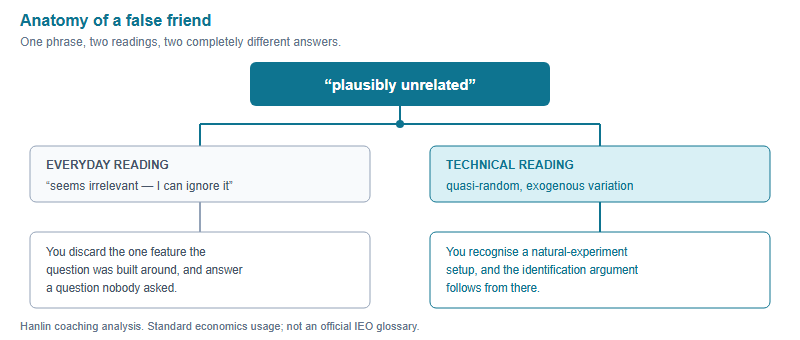
| plausibly unrelated | “seems irrelevant, probably not connected, safe to set aside” | Variation that is quasi-random with respect to the outcome — exogenous, and therefore usable to identify a causal effect | You discard the exact feature the question was built around, and answer a descriptive question instead of an identification one |
| closet indexing | “secret indexing”, something hidden or improper in a vague sense | A fund that charges active-management fees while holding a portfolio that closely tracks its benchmark index | You discuss dishonesty in general terms instead of the fee-versus-tracking arithmetic that carries the marks |
| “largest minimum” constructions | Read as one loose superlative — “the biggest contribution”, or “the smallest one” | A stacked quantifier: first find a minimum within each case, then take the maximum across those minima | You compute a single extreme value, and the entire downstream answer is built on the wrong object |
The third one deserves a moment because it is not really vocabulary at all — it is grammar doing technical work. “Largest minimum” is a two-stage instruction compressed into two words. English lets you stack quantifiers like that; the reader has to unstack them in the right order, and reading left to right without pausing gives you the wrong order. Mathematics has notation for this precisely because natural language is bad at it.
Why this hits strong students hardest
There is an uncomfortable asymmetry here. A weak candidate who meets “plausibly unrelated” is already struggling with the economics, so the phrase costs them a question they were unlikely to secure anyway. A strong candidate meets the same phrase, understands every surrounding concept, forms a coherent everyday interpretation, and produces a well-structured, well-argued, entirely misdirected answer.
Fluency is what makes this possible. If your English were shakier you would stop and reread. Because it is good, you do not notice there is anything to reread. This is why the standard advice — “improve your English” — is unhelpful here: the students most exposed are the ones whose English is already strong.
It is also why this is worth treating as its own preparation strand rather than folding it into general reading practice. The skill you need is not comprehension. It is a specific reflex: noticing that a phrase might be doing technical work, and stopping to check.
The three families to watch for
- Terms of art that look descriptive. Two or three ordinary words that name a specific, defined phenomenon: closet indexing, moral hazard, adverse selection, sunk cost, friend-shoring, free-riding, network effects. If a phrase feels like it is naming something rather than describing it, treat it as a defined term and ask what the definition is.
- Precision and quantifier language. The small structural words that carry mathematical weight: “largest minimum”, “at least”, “at most”, “weakly” versus “strictly”, “for all” versus “there exists”, “necessary” versus “sufficient”. These are invisible in casual reading and decisive in a maths-heavy paper. Given how much more calculation the 2026 open questions demanded, this family has become more expensive to ignore, not less.
- Identification language from empirical economics. The vocabulary of causal inference: plausibly unrelated or exogenous, quasi-random, natural experiment, confounder, treatment and control, selection. This family is newest to the competition and the one Chinese-curriculum students have met least, because school economics teaches theory and rarely teaches how economists establish that something caused something else.
Sorting a new phrase into one of those three families is itself the useful move, because each family has a different check attached. For a suspected term of art, the check is definitional: can I state what this names in one sentence? For quantifier language, the check is structural: what is being quantified over, and in what order? For identification language, the check is causal: what is this phrase claiming about why the variation exists? Three questions, one of which almost always applies, and all of them answerable in seconds once the habit is there.
A method that builds the reflex — and where it fits your schedule
Word lists do not work for this, because the failure is not recognition — it is precision under time pressure. What works is a four-step drill that forces each term all the way through to production.
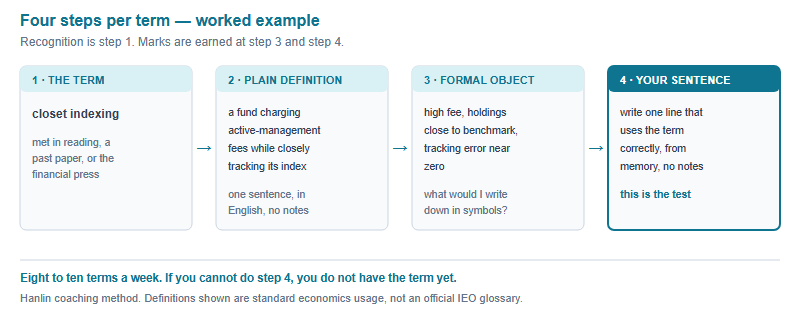
Three practical notes on running this. Harvest terms from prose, not from lists. Take them from the financial press, from working papers you half-understand, from practice questions — anywhere the term appears doing a job in a real sentence. A term learnt in context comes with its collocations attached, which is most of what you need to use it correctly later.
Do not translate at step 2. The moment you write a Chinese gloss, you have anchored the term to a translation rather than to a definition, and translations of terms of art are frequently looser than the English original. Define in English, even if the sentence is clumsy at first.
Add one exam-room drill. When a question sentence contains a phrase that could be technical, reread it as a mathematical statement before you write anything — what object is this naming, what is being quantified over, in what order. Ten seconds. It is the single highest-return habit available in the individual rounds, and it costs nothing.
This strand is small and continuous rather than blocked. Eight to ten terms a week, run through all four steps, takes perhaps forty minutes total and can sit alongside whatever else you are doing. Our twelve-week preparation plan has enough slack to absorb it without displacing content work.
One extension is worth the effort. The same terminology precision pays twice, because the team business case is delivered and defended in English in front of judges. A candidate who has drilled step 4 — producing correct sentences containing technical terms from memory, without notes — has been rehearsing for the live defence the whole time without realising it. Precision in reading and precision in speaking turn out to be the same underlying skill, practised from two directions.
Frequently asked questions
Do I need a bigger English vocabulary to score better?
Not size, precision. The costly words are ordinary-looking phrases carrying exact technical meanings, such as “plausibly unrelated”.
What does “plausibly unrelated” mean in economics?
It signals quasi-random, exogenous variation used to identify a causal effect. It does not mean seemingly irrelevant or unimportant.
What is closet indexing?
A fund that charges active-management fees while holding a portfolio which closely tracks its benchmark index, so investors pay active prices for passive exposure.
How many terms should I learn each week?
Eight to ten, learned until you can define and use each one from memory. Recognition alone does not survive exam pressure.
This is an independent guide operated by Hanlin Education for China-based international-school students. We are not affiliated with, endorsed by, or sponsored by the International Economics Olympiad Association. Competition rules, dates and formats change — confirm current details on ieo-official.org. Factual errors are corrected within 7 working days of notification.