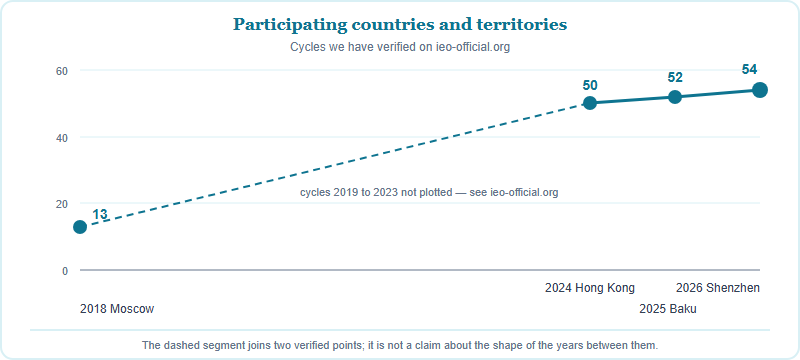
The IEO has now run nine editions. The first, in Moscow in 2018, drew 13 countries; the 2026 edition in Shenzhen drew 54. The delegation, by contrast, is small: under the current rule a country sends a team of up to five students plus one or two leaders. A four-fold larger olympiad is therefore not a wider door for any one country, and that changes less about your plan than you might expect.
The record, and where these numbers come from
The IEO Association, based in Bern, publishes participation figures for the olympiad. Below are the cycles we have checked ourselves. We have deliberately not reproduced the figures for the cycles in between: the official record is the place to look them up, and we would rather send you there than repeat numbers we have not personally verified. That is a slightly annoying editorial habit, and this article is partly an argument for why it is the right one.
| Cycle | Host | Countries and territories | What else the record shows |
|---|---|---|---|
| 2018 (first edition) | Moscow | 13 | The olympiad’s first year |
| ⋮ | For cycles 2019–2023, check ieo-official.org; we have not verified them here | ||
| 2024 | Hong Kong | 50 | — |
| 2025 | Baku | 52 | 258 participants; 133 medals (24 gold, 43 silver, 66 bronze); Singapore took team gold |
| 2026 (ninth edition) | Shenzhen | 54 | Held 12–20 July 2026 |
Roughly five seats per country: the arithmetic that actually matters
Here is the calculation almost nobody does. The delegation rule is verified: a country sends a team of up to five students, plus one or two leaders. At Baku in 2025 there were 258 participants from 52 countries. Divide one by the other — this is our arithmetic, not the organiser’s — and you get about five participants per country. In other words, the cap binds: countries are, on the whole, sending full teams rather than one or two students each.
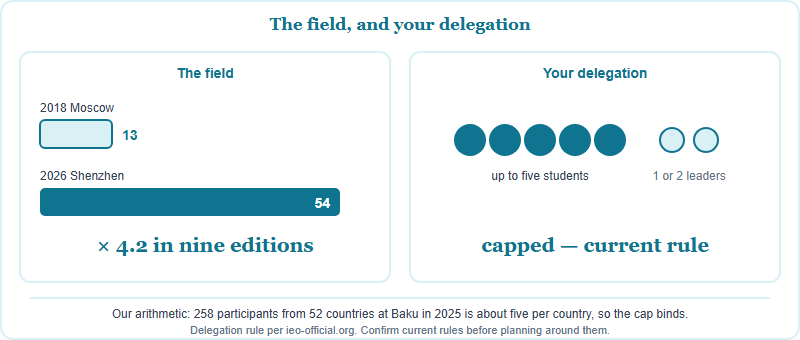
Follow that through and the consequence is sharper than it first appears. If the world’s supply of finalist places is roughly five times the number of participating countries, then the four extra countries between 2024 and 2026 added something like twenty places worldwide — and every one of them sits inside a country that was not there before. None of them is in yours.
So the growth curve is genuinely good news about the competition and almost no news at all about your route. A bigger olympiad means a broader international field, more national selections running each year, and a longer institutional track record. It does not loosen the bottleneck you are actually standing in, because that bottleneck is set by how many students compete on your own route for a fixed handful of seats — a number entirely unaffected by how many other countries attend. If you are still mapping how the stages connect, our overview of what the IEO is and how it is structured covers the sequence.
What the Baku record does and does not tell you
The 2025 final in Baku is the most complete published record we have checked, and it is a good exercise in reading a results record properly — which is a skill worth having, because a lot of what circulates about this competition is a confident summary of a number nobody checked.
What is stated: 52 countries; 258 participants; 133 medals, comprising 24 gold, 43 silver and 66 bronze; Singapore took team gold.
What can be derived, carefully: about five participants per country, which tells you the delegation cap is binding. And 133 medals set against 258 participants tells you the order of magnitude: a medal of some colour is a common outcome at the final, while gold is not.
What cannot be derived, and where we stop: we cannot tell from the published totals alone whether team awards are counted inside that 133, so we will not convert it into a precise individual medal rate. Nor does the record tell us the standard required for each colour, how the national selections that fed it differed from one another, or how the marks behind them were composed. Those are the organiser’s to publish, and inventing them would be worse than leaving the gap visible.
A young competition keeps changing its own rules
Nine editions is not very old for an international olympiad, and it shows in a way that matters practically: the details move. We are not speculating about this — every item below is something we have run into directly while maintaining this site.
- The field moved in every recent cycle we checked — 50, then 52, then 54.
- The shape of the paper can move. How the three components are packaged into papers on the day is the organiser’s to decide and can change between cycles, so a guide describing one cycle’s packaging can be quietly wrong the next.
- Division names on the China route moved. The 2027 handbook uses JUNIOR-SL, JUNIOR-HL and SENIOR. Older promotional material still in circulation uses different names and, in places, describes the junior divisions in ways the handbook does not support.
- A claim about the olympiad’s own origins circulates that the official site does not support. You will see it said that Eric Maskin founded the competition and chairs its board. The official site’s wording is that the olympiad is supported by Eric Maskin, the 2007 Nobel laureate in economics. We use the official wording, and we would suggest you do too — in an interview or an application, the conservative version is the one that cannot be contradicted.
- There is a separate olympiad with a near-identical name, run by a different organisation, and it is a standing source of scrambled facts — different founding story, different host country, different academic leadership. The reliable test is the domain. Ours is ieo-official.org.
The working rule that falls out of this: treat any statement with a year attached to it as perishable, including the ones on this page. Structural facts age slowly. Numbers, names and dates age fast.
What to re-verify every cycle, and what has stayed put
Sorting the two is the most useful half-hour you can spend before you start preparing, because it tells you what you can safely build a training plan on and what you must go and look up.
| Durable so far — safe to build on | Perishable — check every cycle |
|---|---|
| The competition is built from three components: a 40-question finance and economics multiple-choice paper, five open questions of which four are graded, and a team business case delivered in English | How those components are packaged into papers on the day |
| Age test: competitors must be under 20 on 30 June | Division names and grade bands on the China route |
| A delegation is a team of up to five students plus one or two leaders | Registration windows and the preliminary round date |
| Entry to the international round is via a national or regional round | Host city, dates and the size of the field |
| The IEO Association is based in Bern; the olympiad is supported by Eric Maskin | Honours thresholds, percentages and grade names |
Notice what that left-hand column is: it is almost exactly the list of things you can train against. The three components have been stable enough that the skills they demand — fast accurate finance and economics under multiple-choice conditions, written argument under time, and a team business case delivered in English — are safe to build a term around even when the packaging shifts. That is the premise behind our twelve-week preparation plan: train the durable skills, look up the perishable facts.
And when you look them up, go to the right layer. The international facts — eligibility, delegation size, hosts, field size — belong to ieo-official.org. The route facts — divisions, registration, the preliminary, honours — belong to your sending organisation and the current handbook. Any third-party summary, this one very much included, is a starting point for a question, not a substitute for the answer.
Common questions
How many countries take part in the IEO?
The 2026 edition in Shenzhen had 54 countries and territories, up from 52 in 2025 and 50 in 2024.
When was the IEO founded?
The first edition was held in Moscow in 2018 with 13 countries taking part. The 2026 edition was the ninth.
Did Eric Maskin found the IEO?
The official site says the olympiad is supported by Eric Maskin, the 2007 Nobel laureate. We use that wording rather than stronger claims.
How many students can one country send?
A delegation is a team of up to five students plus one or two leaders, so the field grows by country rather than by seat.
This is an independent guide operated by Hanlin Education for China-based international-school students. We are not affiliated with, endorsed by, or sponsored by the International Economics Olympiad Association. Field sizes, hosts, formats and route rules change between cycles — confirm current details on ieo-official.org and with your sending organisation before acting on anything here. Figures described as our arithmetic are our own calculations from published totals, not official statistics. Errors are corrected within seven working days of being reported.