The recorded prompts do not ask teams to invent a company. They ask you to sit on the advising side of a public decision — a bridge, a development zone, a university's land — and say whether resources should be committed to it. That is a cost-benefit appraisal, and it needs a different toolkit from the one most teams rehearse. This is what the pattern looks like and what to pack.
The prompts we hold, and how carefully we are treating them
A China-route handbook in our possession lists three past business-case prompts as preparation material. Before you read them, two pieces of housekeeping that matter more than they look.
First, this is not a complete archive. We have not seen an official, exhaustive list of every case prompt the olympiad has ever set, and we are not going to imply one exists. Three data points are enough to notice a pattern and nowhere near enough to promise it repeats.
Second, a word on how firmly to hold these. All three line up with editions we have checked against the organiser's own list of past hosts: Volos, Greece in 2023, Baku in 2025, Shenzhen in 2026 (ieo-official.org, checked September 2026). All three prompts are our paraphrase of a handbook rather than official case texts, so treat the pattern as a pattern and not a promise: three data points are not an archive.
| Cycle | The role you are given | The object being appraised | The decision asked for | Our confidence |
|---|---|---|---|---|
| 2026 — China | Young government economists | A newly proposed regional economic development zone | Assess whether it is feasible | Host matches an edition we have verified |
| 2025 — Azerbaijan | An appraisal team | A cross-border bridge project in the Caspian region | Assess the economic feasibility of building it | Host matches an edition we have verified |
| 2023 — Greece | A youth consulting team | A Greek university's land resources | Achieve effective land use alongside environmental sustainability goals | Host matches the 2023 edition on the organiser's published list of past hosts |
The shape underneath: you are advising, not founding
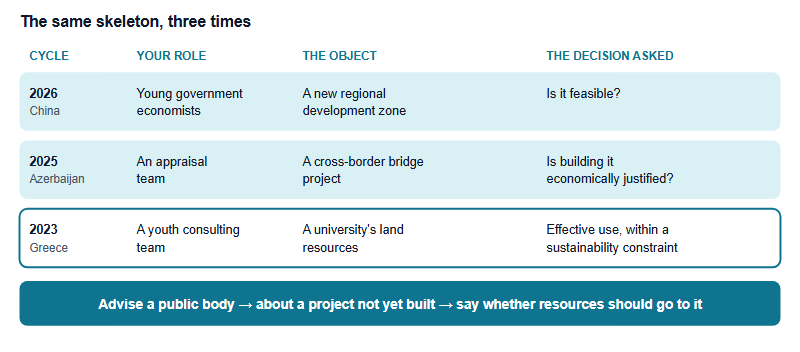
Strip the geography out and the same skeleton appears in each. You are handed a role on the advisory side of a decision. There is an object — infrastructure, land, a zone — that has not been built yet. And there is a question about whether it should be, usually with a constraint bolted on: sustainability, cross-border coordination, regional development.
Notice what is absent. Nobody asks you to invent a product, find a customer, or design a business model. There is no market to enter. There is a proposal that already exists and a public body that wants to know whether it is worth doing. That is a genuinely different intellectual task, and it explains why teams that have drilled startup-style cases sometimes deliver a polished presentation that answers a question nobody asked.
The appraisal toolkit: six tools a startup toolkit does not contain
If the question is “should this be built with public resources”, then profit is not the test and revenue is not the answer. Here is what actually does the work, in the order a good analysis uses it.
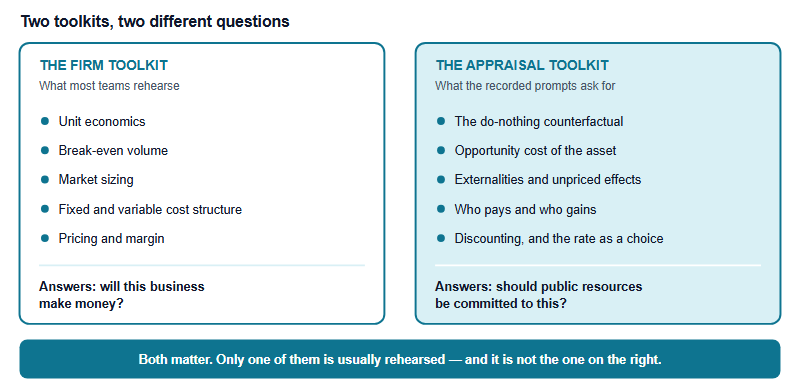
- 1. The counterfactual. Before anything else: compared with what? A development zone is not being judged against nothing; it is being judged against the land staying as it is, or against a cheaper version, or against spending the same money elsewhere. Teams that skip this end up computing benefits that would have partly happened anyway. State the do-nothing baseline in your first two minutes and half the analysis organises itself.
- 2. Opportunity cost of the asset. The university's land, the bridge's budget and the zone's site all have alternative uses. The cost of the project is not the construction invoice; it is the invoice plus the value of what that land or capital would otherwise have produced. This is first-year microeconomics and it is the single most reliable way to sound like an economist rather than a consultant.
- 3. Externalities and unpriced effects. A cross-border bridge produces effects that no one is billed for: congestion relief, emissions, border-town trade, ecological disruption. Handle these honestly — quantify what you can defend, list what you cannot, and never invent a number to fill a gap. “We could not price this, so here is its likely direction and size” is a stronger answer than a fabricated figure, and it is much harder to attack.
- 4. Incidence: who pays and who gains. A project can be positive in aggregate and still be a bad decision for the body commissioning it, because the costs land on one group and the benefits on another. Cross-border infrastructure is the textbook case: the two countries do not share costs and benefits in the same proportion. Say who bears what. Judges notice.
- 5. Time, and the discount rate as a judgement. Infrastructure costs now and pays later, so the comparison requires discounting. The important move is not computing a present value; it is recognising that the discount rate you choose is a policy judgement rather than a fact. Show the recommendation at two rates. If it flips, that is your finding.
- 6. Sensitivity, ending in a break-point. Finish by naming the assumption that carries the result and the value at which your recommendation reverses: “this is worth building if traffic volumes exceed roughly this level; below it, phase the project instead.” A team that can state its own break-point is telling the room it has understood its analysis rather than performed it.
None of this makes firm-level analysis useless. Unit economics, cost structure and market sizing remain the right tools when a case actually concerns a business, and they still show up inside an appraisal — a development zone is only worth building if the firms inside it can operate viably. The point is ordering. In these prompts, the firm-level work is a supporting calculation, not the answer. Our companion guide to building and delivering the team business case covers the delivery method that sits on top of whichever toolkit the prompt demands.
Building a recommendation that survives being questioned
An appraisal ends in a decision, and a decision that is hedged into meaninglessness scores like an absent one. Three structural habits are worth building in advance, because none of them can be improvised on the day.
Lead with a verdict, then the condition. “Build it, but in two phases, and only if the second phase is contingent on first-phase traffic” is a recommendation. “There are arguments on both sides” is a summary of your reading. The conditional structure is what lets you be decisive without being reckless: you commit to an answer and to the circumstances that would change it.
Carry one number that does real work. Most teams present five numbers of equal weight, which reads as data rather than analysis. Pick the calculation on which the recommendation actually turns — a payback horizon, a cost per beneficiary, a break-even volume — put it on a slide of its own, and show how you got it. If you cannot show the working, drop the number rather than defend it under questioning.
Pre-mortem your own case. The hour before you finalise anything, have one teammate argue that the project should not be built, using your own figures. Whatever they land on is what the room will ask about, and answering it inside the presentation is far stronger than answering it afterwards. This is also the exercise that reveals whether your team understands the analysis or has merely divided it up.
How to practise this before the season starts
You do not need an official prompt to train the reflex, and waiting for one is a poor use of the autumn. Take a real project near you — a metro extension, a school being rebuilt, a district being rezoned, a bridge that has been argued about for a decade — and run a ninety-minute drill on it.
- Minutes 0–10. Write the counterfactual and the decision-maker: who is choosing, and what is the alternative to saying yes?
- Minutes 10–40. List costs and benefits in two columns, marking each one as priceable, roughly estimable or unpriceable. The third column is a finding, not a failure.
- Minutes 40–65. Build the one number that carries the case, and write its assumptions where you can see them.
- Minutes 65–80. Sensitivity: change the two most fragile assumptions and see whether the verdict moves. Record the break-point.
- Minutes 80–90. State the recommendation aloud in ninety seconds, in English, without notes.
Repeat that on four different projects and you will have done something more useful than reading about case method: you will have discovered that the difficulty is almost never the economics. It is deciding what to leave out. That is also why the case belongs in a preparation plan alongside the written components rather than after them — our twelve-week preparation plan sets out one way to interleave the three, and the overview of the competition's structure explains where the team case sits among them.
A final caution, since this whole article rests on a pattern of two or three observations. The next prompt may not be a public project at all. What we would defend is narrower and more useful: a team that can appraise a public investment can also analyse a firm, while a team that only knows how to analyse a firm has no route into the prompts we have actually seen. Train the broader skill and you are covered either way.
Common questions
Are past IEO case prompts published anywhere?
We have not seen a complete official archive. The prompts here come from a China-route handbook we hold, paraphrased, not from official text.
Is the case round a startup pitch?
Not in the prompts we hold. They ask you to appraise a public project already proposed, which is cost-benefit analysis rather than product design.
What should we do about benefits we cannot price?
Name them, state their likely direction and size, and say you could not price them. Inventing a figure is the worse answer.
How is the business case marked?
We do not assert the marking scheme or how the three components are weighted. Check the current criteria on ieo-official.org.
This is an independent guide operated by Hanlin Education for China-based international-school students. We are not affiliated with, endorsed by, or sponsored by the International Economics Olympiad Association. Case prompts described here are our paraphrase of a China-route handbook we hold, not official text and not a complete archive; marking criteria and component weightings are the organiser's to publish and are not asserted here. Confirm current details on ieo-official.org and with your sending organisation. Errors are corrected within seven working days of being reported.