IEO 2026 Open Question 1: Why the AI Export-Policy Answer Loses Marks Even When the Maths Looks Right
A correct final number is not enough because the 2026 marking scheme rewards visible economic reasoning. In Open Question 1, Country A’s welfare counts only firm profit, government revenue and the security cost. If a student adds foreign consumer surplus, uses total external cost where marginal cost is needed, or cannot show how a fee changes behaviour, the answer loses credit even when arithmetic is neat.
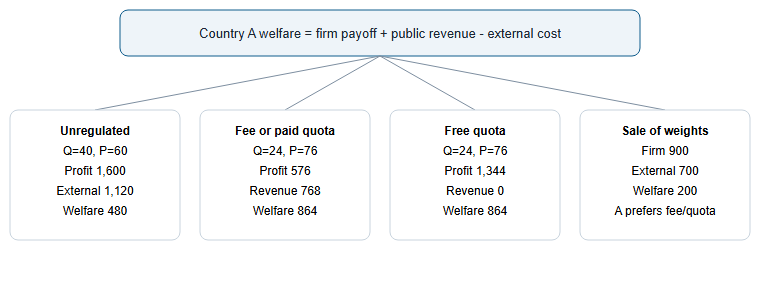
The 2026 task, “The Model That Could Not Cross the Border”, asks students to compare export-policy outcomes for Country A using a small monopoly model. The official solution shows that unregulated sales produce welfare of 480, a well-designed fee raises it to 864, and a sale of model weights yields only 200. The diagnostic value is not the final table. It is the chain of reasoning that connects demand, costs, external harm, and the government’s objective.
The figures below are drawn from the official IEO 2026 Economics & Finance Open Questions with Solutions and Marking Schemes. This article paraphrases the setting and uses the published values only for study. For the wider 2026 structure, see our format-shift overview.
A compact table of the official outcomes
The four rows below are the most useful for self-diagnosis. A complete ban gives welfare 0, so the official solution uses it as a benchmark rather than a competitive outcome. Since a ban gives 0, unregulated trade is better than no trade, but it is not the best policy.
| Outcome | Quantity | Price | Firm profit or receipt | Government revenue | External cost | Country A welfare |
|---|---|---|---|---|---|---|
| No-Fee Unrestricted Access | 40 | 60 | 1,600 | 0 | 1,120 | 480 |
| Per-unit fee or paid quota | 24 | 76 | 576 | 768 | 480 | 864 |
| Free quota at Q=24 | 24 | 76 | 1,344 | 0 | 480 | 864 |
| Sale of model weights | — | — | 900 | 0 | 700 | 200 |
A paid quota and a per-unit fee can produce the same total welfare because both place the same 768 rent with the government. A free quota gives that rent to the firm instead. The firm may prefer a 900 sale to the fee outcome’s 576 profit, but Country A prefers the fee outcome because 864 exceeds 200.
What the table is really testing
The table is not mainly a test of multiplication. It asks whether a student can separate three ideas: market power, national welfare, and policy incidence. The firm chooses quantity by comparing marginal revenue with its private cost. The government cares about the same quantity only through profit, revenue, and external harm. The policy instruments then decide who captures the rent created by restricting output. That is why two rows can have identical welfare but very different distributional consequences.
Why the optimal fee is 32
The fee result is the easiest place to hide a reasoning gap. The official answer is t=32, but the markable path is the sequence of decisions.
- Find the unregulated monopoly quantity. With P=100-Q, marginal revenue is 100-2Q. Setting marginal revenue equal to marginal cost 20 gives Q=40.
- Write Country A welfare. Because the fee is a transfer inside Country A, welfare is (P-20)Q minus E(Q). Substituting P=100-Q gives W=72Q-1.5Q2.
- Maximize welfare. The derivative is 72-3Q, so the best quantity is Q=24.
- Make the firm choose that quantity. A per-unit fee raises the firm’s effective marginal cost to 20+t. At Q=24, marginal revenue is 52, so 52=20+t and t=32.
- Check the split. At Q=24, P=76. Profit after fee is (76-20-32) × 24 = 576, fee revenue is 32 × 24 = 768, external cost is 480, and welfare is 864.
This is also why the fee equals marginal external cost at the chosen quantity: E'(24)=8+24=32. The equality is a check, not a substitute for the derivation.
Students often get Q=24 but cannot explain why the fee is not simply average external cost. The fee changes the firm’s private incentive at the margin. Average external cost at Q=24 is 20, but that number would not induce the efficient quantity. The policy logic lives in the marginal comparison, not in the accounting total.
E(Q) is not E'(Q)
A common error is to treat the total external-cost function as if it were the marginal cost facing the policymaker. E(Q)=8Q+Q2/2 tells you the total security cost at a quantity. At Q=40 it is 1,120. The marginal cost of one more unit is E'(Q)=8+Q. At Q=24 it is 32, which is exactly the fee needed to decentralize the welfare-maximizing quantity. If a student divides total external cost by quantity, uses 1,120 as a per-unit tax, or sets price equal to total external cost, the arithmetic may look tidy but the economics is wrong.
Four error types the marking scheme reveals
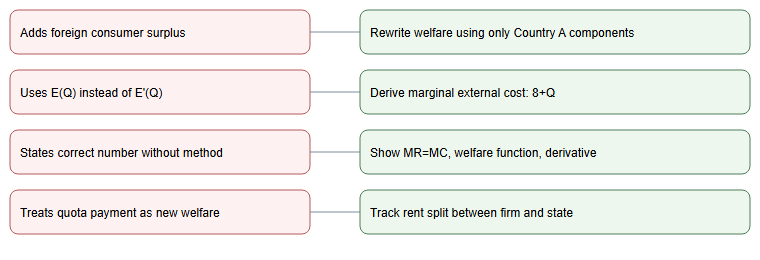
The official scheme is useful because it shows where credit stops. A correct figure without method can be capped, and an elegant calculation built on the wrong welfare definition can lose reasoning credit. Use the map below after attempting the question.
- Welfare-scope error. The answer adds Country B consumer surplus or talks about global efficiency. The fix: rewrite W = firm profit + government revenue – external cost, then redo every policy comparison using only those components.
- Total-versus-marginal error. The answer uses E(Q) where the decision needs E'(Q). The fix: derive E'(Q)=8+Q and compare it with the firm’s marginal revenue and the fee at the welfare-maximizing quantity.
- Hidden-method error. The answer states 864 or 32 without showing the welfare function, derivative, or fee condition. The fix: write each equation, label each variable, and add one sentence saying why the step matters.
- Rent-transfer error. The answer treats a paid quota as creating extra welfare or a free quota as destroying welfare. The fix: track who receives the 768 rent. The total is unchanged; only the firm-government split changes.
A small arithmetic slip may still receive later credit if the logic remains intact, but an error that changes the policy comparison is harder to carry forward.
When reviewing your attempt, annotate in three colours or labels. Mark every number as “definition”, “derivation”, or “interpretation”. A strong script should have a definition of welfare, at least one marginal condition, and one sentence interpreting the policy comparison. If a row of numbers has no label, it is probably where credit would leak.
A short diagnostic self-check
Do this without looking at the official solution. Write each answer in one or two lines.
- Write Country A’s welfare function using only the allowed components.
- Derive the unregulated quantity and welfare.
- Derive the welfare-maximizing quantity and explain why the fee is a transfer.
- Find the fee that induces Q=24.
- Reassign the quota rent from government to firm. Which numbers change, and which do not?
- Compare the sale option: why might the firm like it, and why does Country A not?
If step 1 fails, study objective functions. If step 2 fails, review monopoly marginal revenue. If steps 3 or 4 fail, practise Pigouvian fees and marginal external cost. If step 5 fails, work on transfers and incidence. If step 6 fails, compare firm objective with national welfare.
A strong answer does not merely say that the fee is better. It says that the fee moves the market from Q=40 to Q=24, reduces external cost from 1,120 to 480, and raises Country A welfare from 480 to 864. It then notes that the quota instrument achieves the same quantity and welfare, while the allocation of quota rights determines whether the 768 rent appears as firm profit or government revenue.
A realistic next practice session
A useful 45-minute session should be narrow enough to produce evidence. Use the self-marking protocol from our earlier article if you need a timing framework.
- 10 minutes: rebuild the outcome table from memory.
- 15 minutes: derive the fee and quota splits with full equations.
- 10 minutes: write an English explanation of why free and paid quota have the same welfare.
- 10 minutes: compare the sale option and write one policy recommendation.
Afterwards, record only two errors and choose one drill. A long list of mistakes is less useful than one corrected reasoning habit.
How Hanlin coaching reads Question 1(c)
A 31 July 2026 Hanlin analysis by economics coach Bai treats part (c) as a diagnostic moment: the same quota quantity can shift rent between firm and government while leaving total national welfare unchanged. The analysis stresses that mathematics alone is not enough; students should translate the words into functions, solve the model, compare outcomes, and explain the economics in English. This is a coaching interpretation, not an official marking rule.
Practice files and next steps
Use the contact or QR pathway in the site footer to ask whether Hanlin can share a free IEO practice selection. An advisor will confirm the available years, files, and worked solutions before sending any materials. This article does not replace the resources hub; for general materials, visit the Hanlin IEO resources hub.
This independent guide is not affiliated with, endorsed by, or operated by the International Economics Olympiad Association. It does not reproduce the official question text and is intended for study guidance only. For the official event, see the International Economics Olympiad home.
FAQ
Does a correct welfare number earn full marks?
Not automatically. The 2026 scheme limits credit for unsupported numbers; visible method and correct welfare definition are needed.
Why is foreign consumer surplus excluded?
Because the question defines Country A welfare as domestic firm profit plus government license revenue minus external cost, not global welfare.
What is the difference between E(Q) and E'(Q)?
E(Q) is total external cost at a quantity; E'(Q)=8+Q is the marginal external cost used when choosing the efficient quantity or fee.
Do quota auctions change total welfare?
In this model, moving from free to paid quota at Q=24 shifts 768 from firm to government but leaves total Country A welfare at 864.
How should I practise this question?
Rebuild the table without looking, explain each step aloud, then map mistakes to the error-to-action list and attempt a similar policy question.